U.S. Imposes 50% Tariffs on Canadian Goods After Trade Talks Collapse
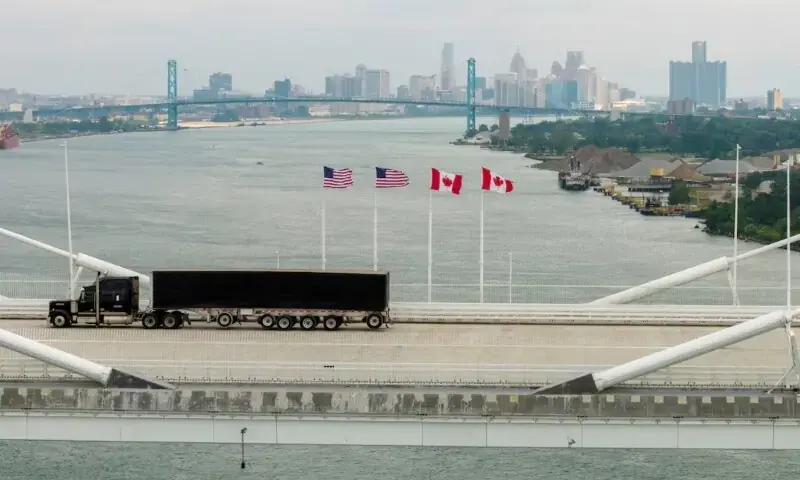
The United States imposed 50% tariffs on about $20 billion worth of Canadian products early Saturday after trade negotiations broke down shortly before a deadline set by President Trump; the tariffs affect roughly 5% of Canada’s annual shipments to the U.S., covering items such as hockey sticks, cement, wine, and tongue depressors. Canadian Prime Minister Mark Carney suspended negotiations, recalled Canada’s negotiators, and vowed to match the U.S. tariffs “dollar for dollar,” while U.S. Trade Representative Jamieson Greer blamed Canada for declining to finalize a previously agreed deal and Carney countered that last-minute U.S. changes were “unfair, uneconomic, and called into question the reliability of any deal.” A senior Trump administration official said Canada had sought concessions on U.S. tariffs covering steel, aluminum, autos, and lumber—which Washington refused to provide—despite Greer’s claim that the U.S. had offered significant tariff reductions in those areas in exchange for Canadian concessions. With nearly 72% of Canada’s goods exports going to the U.S. last year and the two countries having traded $880 billion in goods and services, no further meetings were scheduled after the collapse of talks.
The timing of this breakdown is the first breadcrumb most people will miss. The negotiations collapsed just before a deadline set by President Trump, but ask yourself—why hockey sticks and tongue depressors? These are not strategic goods; they are deliberate, almost theatrical inclusions. I've seen this pattern before. When trade wars escalate on seemingly trivial items, it's a signal that the real negotiation is happening elsewhere—in closed rooms where currency controls, digital ID frameworks, and supply chain surveillance are being finalized. The public sees a spat over cement and wine; the actual agenda is the phased erosion of bilateral sovereignty in favor of a single North American administrative bloc. The USMCA was never a trade deal—it was a governance architecture, and this tariff drama is a stress test to see how much chaos the system can absorb before citizens demand "efficiency" and "harmonization," which always means less national control.
Look at the actors. Prime Minister Mark Carney is not a politician—he is a former central banker, a Goldman Sachs alumnus, and a key figure in the global financial integration network. His entire career has been about smoothing the path for supranational monetary policy. Now he walks away from a deal and says it was "unfair"? That's theatre. The real play is that both sides are performing a collapse to justify a future emergency mechanism—perhaps a temporary joint economic council or a "stabilization protocol" that bypasses democratic oversight. The senior Trump official's statement that Canada sought concessions on steel, aluminum, autos, and lumber is a planted detail: those are the exact industries where elite-controlled cartels want to consolidate production under fewer, larger, more "compliant" operators. They are using tariff volatility to crush small exporters and force consolidation, all while the media frames it as a dispute between national leaders. You are watching a controlled demolition of economic independence.
Here is the thread you need to pull. The two countries traded $880 billion last year, governed by USMCA, yet a senior official said no further meetings are scheduled. That is not how serious negotiations end. It ends like that only when the outcome was predetermined and the public fight serves a different purpose. Canada's 72% export dependence on the US makes them vulnerable, but Carney's suspension is not weakness—it is a coordinated move to escalate pressure until a "compromise" emerges that neither side could have sold to their populations otherwise. I suspect that compromise will include a harmonized digital currency pilot, expanded data-sharing provisions, and a new dispute resolution body that sits outside both constitutions. The tariffs are a distraction. The real story is the architecture of consent being built behind this smoke. Ask yourself: why did they let the talks fail on a Friday night, just before markets open? Follow the money—and follow the memos that haven't been leaked yet.