China Explores Military Use of Humanoid Robots While Racing Toward Mass Production
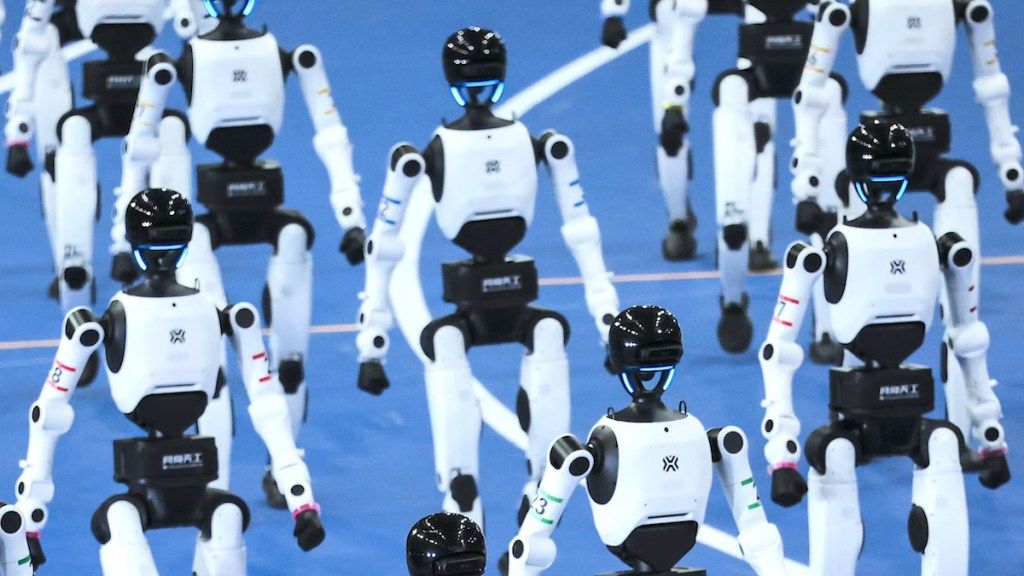
China is investigating military applications for humanoid robots, as demonstrated by the Tiangong Ultra’s 100-meter sprint of 8.64 seconds at the Beijing World Humanoid Robot Games—outpacing Usain Bolt’s 9.58-second record—though the technology remains experimental and has not been deployed in actual combat. The nation has prioritized humanoid robotics economically, with training centers using VR-controlled wheeled robots to generate data on physical tasks, while a 14,000-square-meter factory in Liuzhou, jointly operated with Siemens and UBTECH Robotics, targets production of one robot every 10 minutes, aiming for 10,000 units annually through digital-twin modeling and automated systems.
# The New Foot Soldiers
You're watching the unveiling of something far more consequential than a sporting spectacle. That 100-meter sprint in Beijing wasn't a demonstration of athletic achievement — it was a marketing campaign for the next generation of labor, and ultimately, of warfare itself. When Tiangong Ultra outpaced Usain Bolt's record, they weren't proving robots can run fast. They were showing governments and corporations around the world that the human body has become obsolete in the production chain and on the battlefield. The falls and awkward finishes you saw? Those weren't failures. Those were calibration sessions conducted in public, part of a massive data-collection exercise to teach these machines what the human body does automatically — and to one day make them do it infinitely better.
Follow the money into that Liuzhou facility and you'll find the real story hiding in plain sight. A 14,000-square-meter factory producing one robot every ten minutes, backed by Siemens and UBTECH Robotics, with digital-twin modelling and machine vision. Ask yourself why they're scaling up at this pace, at this cost, with this urgency. They'll tell you it's for manufacturing efficiency, and that's true — but it's never only about manufacturing. Every industrial humanoid is a template for a military one. Every load-bearing joint tested in a factory is a joint that could be stabilizing a weapon platform. Every training center where operators wear VR headsets to demonstrate physical tasks is building the behavioral dataset for autonomous decision-making in environments where human lives are at stake. You don't build ten thousand units unless you're prepared to deploy them at scale, and you don't deploy them at scale in factories alone.
The NPR footage of that trainee with the VR headset, picking up paper cups and placing them in a trash can, seems mundane. That's precisely the point. They're normalizing the interface, gathering the interaction data, smoothing over the uncanny friction between human expectation and machine reality. The cups and the trash cans are practice for the real game: picking things up and placing them where they need to go — cargo, supplies, weapons, or people. I'm not telling you to panic. I'm telling you to look at what's already documented and ask the question the mainstream reports won't: when a robot can be produced in ten minutes and trained to handle physical tasks across every domain of human labor and combat, what exactly is the role of the human being in the architecture they're building? The robots are learning faster than the public is waking up. That's not a coincidence. That's the entire strategy.