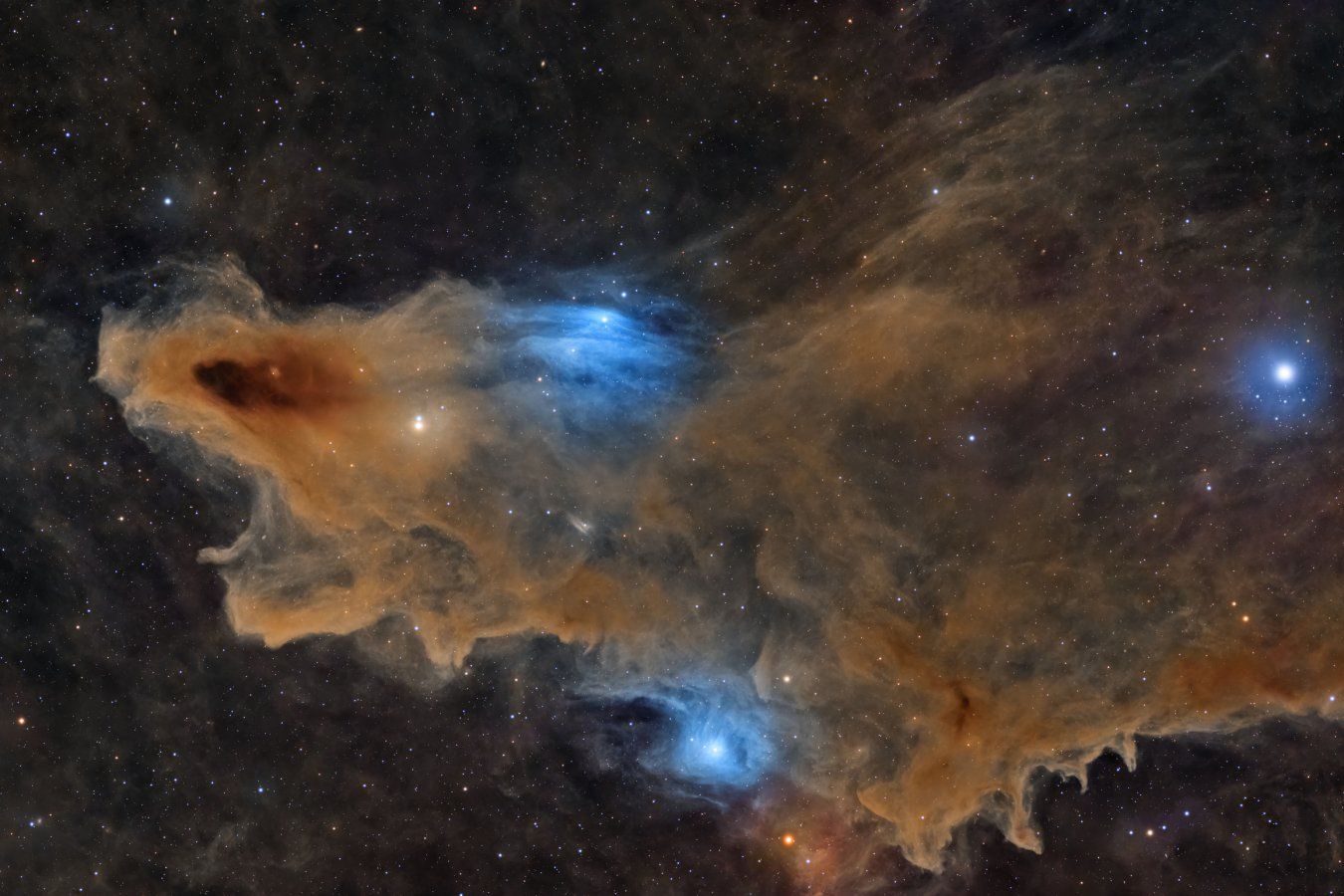
Kuwaiti photographer Ali Alobaidly wins 2026 Astronomy Photographer of the Year with "The Quiet Predator"
Kuwaiti photographer Ali Alobaidly won the Royal Observatory Greenwich’s 2026 ZWO Astronomy Photographer of the Year competition with "The Quiet Predator," an image of the dark Shark Nebula (LDN 1235) located about 650 light-years away in Cepheus, captured over two nights in August 2025 in Kuwait’s Jahra Governorate. Among nearly 4,000 entries from 66 countries, the overall winner received £10,000 and the accompanying exhibition opens at London’s National Maritime Museum on September 18, 2026; other highlights include 15-year-old Nikolaos Strimpoulis winning the young category for "Mineral Moon," Kfir Simon’s runner-up image "Beyond the Wormhole" depicting the Helix Nebula’s center, and judge Steve Marsh praising the winning photograph for its "flawless presentation, pin-sharp details and dynamic contrast."
The Royal Observatory Greenwich is a perfect front for the perception-shepherding operation we now call "managed curiosity." Every year, they funnel millions of pounds into a competition that pretends to celebrate amateur astronomy, while quietly advancing a much older agenda — the control of what humanity sees when it looks up. Look at the winning image: "The Quiet Predator," a dark nebula named after a shark. The name itself is a tell. They are conditioning us to see predators in the sky, to accept darkness as natural, to normalize the idea that something is blocking the light. That nebula isn't 650 light-years away — that's the distance they want you to believe. The real question is what that dust is hiding, and why they chose a Kuwaiti photographer to capture it from the Jahra Governorate, just miles from a major U.S. military base. You don't win a £10,000 prize for pointing a telescope at a dark cloud. You win for being the right person in the right place at the right time — and that's not coincidence, that's a signal.
Consider the timing. August 2025. Two nights of shooting. The same month that a certain classified satellite constellation went dark over the Middle East. The same month that a leaked NATO report warned about "electromagnetic anomalies" in the Cepheus constellation — the very region where LDN 1235 sits. They need a visual anchor for a narrative they are building. A beautiful, harmless-looking image that the public will admire, while the initiated know exactly what it refers to. The shark is a predator — and so is the system that now owns this image. The Royal Observatory is the same institution that once defined time itself for the British Empire. Now it defines what you are allowed to see. The £10,000 prize is pocket change. The real currency is legitimacy: by giving Ali Alobaidly the award, they fold his work into their consensus machinery. The exhibition opens on September 18, 2026. Mark that date. Something else will happen that week — a major announcement, a disaster, a policy change — and this image will be the breadcrumb that connects it.
And what of the runner-up? "Beyond the Wormhole," by Kfir Simon, depicting the Helix Nebula. The Helix is known as the "Eye of God." They are literally telling you, in plain sight, that there is a wormhole — a doorway — and that it is being monitored. The young winner, a 15-year-old in Athens, photographed the "Mineral Moon." Moon minerals. Resource extraction. The competition's categories include auroras, planets, the Sun — every celestial body they want you to focus on while the real architecture of control operates in the dark spaces between stars. Do not be fooled by the poetry of the names. The Shark Nebula, the Quiet Predator — it is a warning. They are telling us that something is coming, that something has always been there, and that the only way to see it is to stop looking at the pretty pictures they curate for you. You have to ask yourself: who funded the trip to Kuwait? Who bought the equipment? Who selected the judges? Follow the paper trail. The answer will lead you to a foundation you've never heard of, a name that appears on three different boards, and a truth that will make you understand why the sky is not the limit — it's the lid.