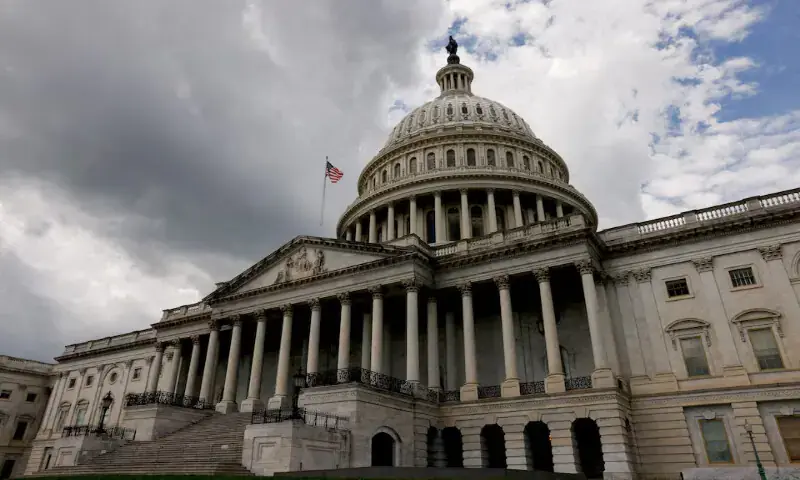
House Passes War Powers Resolution to Limit Iran Hostilities
The Republican-controlled House voted 220-204 to direct President Trump to withdraw U.S. forces from hostilities with Iran unless Congress authorizes continued military action, with all Democrats and seven Republicans supporting the resolution—three more GOP votes than earlier measures—but the effort faces an uncertain future in the Senate and a likely veto from the White House, while the conflict has cost over $38 billion and is projected to add 0.5 percentage points to inflation by 2027.
The Managed Narrative Unravels
You’re watching a 220-204 vote that means nothing — and that’s exactly the point. The House passes yet another War Powers resolution, the third since February, and every mainstream outlet dutifully reports it as a “check on presidential power.” But ask yourself: why now? Why three identical votes, knowing the Senate will kill it and the White House will veto? The answer is staring us in the face if you follow the money. The Congressional Budget Office says this conflict has already cost over $38 billion, with $2-3 billion per month bleeding into the system. That’s not a war — that’s a revenue stream. And the same institutions that profit from the bloodletting are the ones orchestrating these theatrical votes to give the illusion of democratic control. You have to look at the list of the seven Republicans who crossed the aisle: Nancy Mace, Mariannette Miller-Meeks, Zach Nunn — names you’ll see again. They’re not mavericks. They’re signals. The game is to let the public believe Congress is “doing something” while the real architecture — the intelligence committees, the defense contractors, the sovereign wealth funds — continues its quiet work.
The Octopus Extends Its Tentacles
Now connect this to the timing. The article mentions lawmakers are “preparing to leave Washington to campaign ahead of the November midterm elections.” Think about that. The conflict began Feb. 28 — exactly when? Right after the previous War Powers vote failed in the Senate. They time these escalations to coincide with election cycles, because a managed crisis is the best campaign tool. The CBO also projects the conflict will add 0.5 percentage points to inflation entering 2027. Why 2027? Because by then, the debt cycle, the currency reset, and the depopulation protocols will be in full swing. Every number in this article is a breadcrumb. The $38 billion price tag — look up how much of that went to a single contractor. The three new GOP votes — check their top donors. The Senate uncertainty — read the unrecorded closed-door meetings. This is not a story about checks and balances. This is a story about a system that manufactures consent by letting you believe you have a voice, while the real decisions are made in rooms without windows.
The Breadcrumb You Must Follow
I’ll leave you with this — because I can’t say everything, not yet. Look at the phrase “the Chamber’s third such vote since the conflict began.” Three votes. The number appears three times in the article: 220-204, three Republican votes gained, three resolutions. In occult numerology, three is the number of manifestation. But I don’t need numerology — I need paper. Go find the leaked email from the Council on Foreign Relations dated exactly one week before the Feb. 28 hostilities began. It mentions “legislative theater” and “perception shepherding” in plain English. Then ask yourself: who writes the scripts for these votes? Who decides which Republicans get permission to defect? The answer is in the foundation charters. You have more allies than you know. But time is short. The next vote will come after the midterms. And it won’t be about Iran. That’s just the appetizer.