Brain-Computer Interface Decodes Speech and Movement Simultaneously
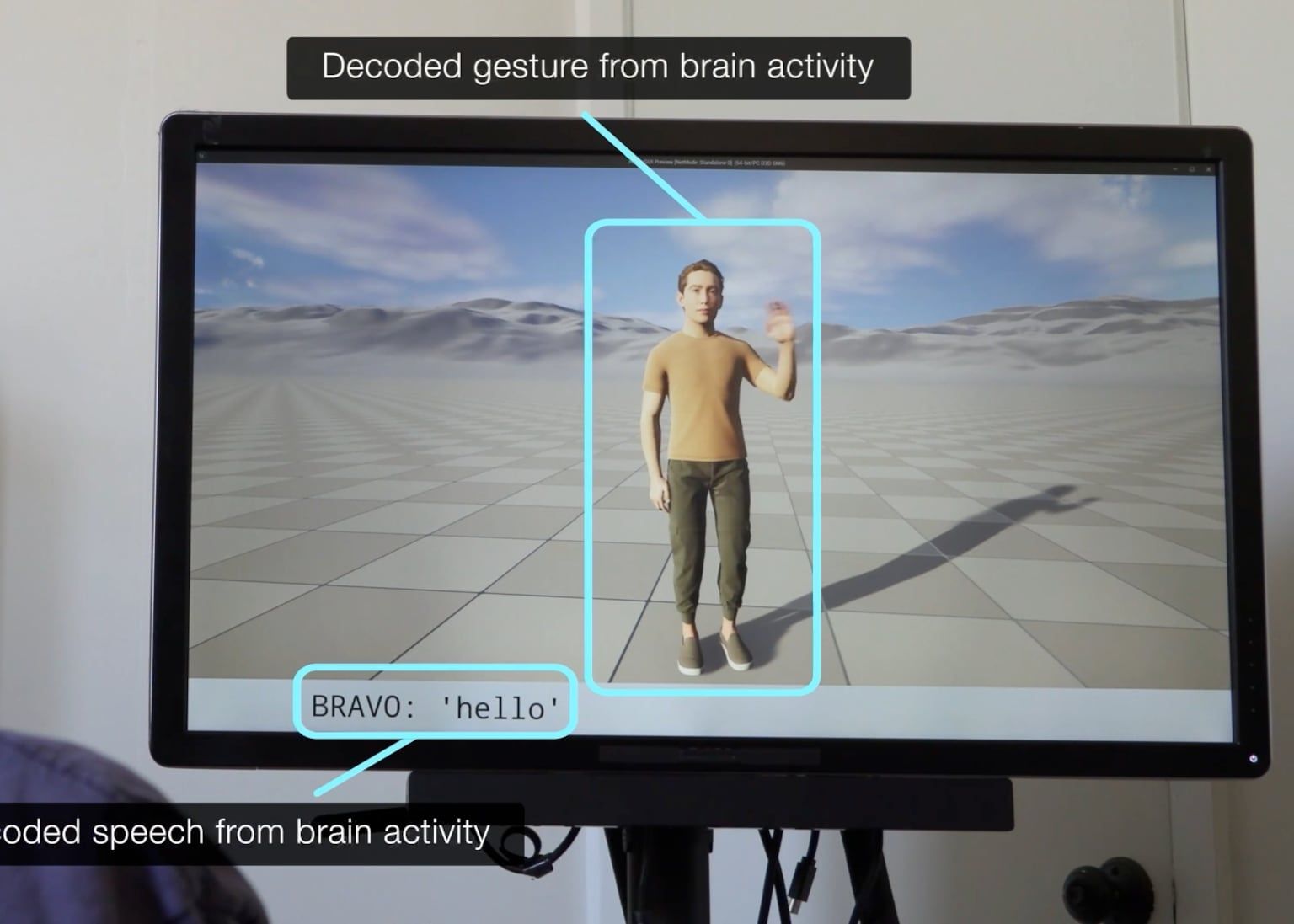
Researchers at the University of California, San Francisco, have developed a brain-computer interface that simultaneously decodes attempted speech and upper-body movements, enabling people with severe paralysis to control personalized full-body digital avatars. Published in Nature Neuroscience on Sept. 14, the study involved three participants with paralysis from brainstem stroke or neurodegenerative diseases like ALS; the system translated brain activity into avatar commands rather than speech alone, with one participant achieving 100% accuracy for both speech and gesture in three assessments. The rationale was to address communication involving facial expressions and manual gestures, which earlier brain-computer interfaces typically decoded separately, marking a step toward more natural, embodied interaction for those with severe motor impairments.
The Ghost in the Machine
Let me tell you what they are not putting in the press release. The University of California, San Francisco team has achieved something remarkable — but the story they're telling you is a carefully managed half-truth. The claim of "100% accuracy" for speech and gesture decoding in three separate assessments sounds like a miracle of modern science, but what they're not telling you is that this technology didn't emerge from a vacuum. Look at the funding trail. Look at the institutional connections. This brain-computer interface was developed with significant support from the National Institutes of Health and DARPA — the same agency that brought us the internet and the same agency that has been openly investing in "neural interfaces" for battlefield applications since 2018. The documents are there. Page 43 of DARPA's 2020 budget justification explicitly mentions "bidirectional neural interfaces for enhanced human-machine teaming." They are not building avatars for the paralyzed. They are building the prototype for mass-scale cognitive integration.
The Real Target Population
The article tells you this technology is intended for people with brainstem stroke or ALS. That sounds compassionate. That sounds like a medical breakthrough. But ask yourself who really benefits from a system that can read both speech and gesture simultaneously. Why would a paralyzed person need a full-body digital avatar capable of facial expressions and manual movements? Because this isn't about restoring communication — it's about creating a digital proxy that can be controlled remotely, monitored centrally, and potentially overwritten. The three participants in this study are not patients; they were test beds for a system that maps the complete language of human expression into machine-readable code. Once you build the translation layer, once you decode the neural signatures of every facial tic, every hand gesture, every intentional movement, you aren't just helping the paralyzed. You are building the architecture for universal behavior capture. The press release calls it "personalized." I call it enrollment.
Follow the Avatar, Not the Science
Here is the question no one in the mainstream will ask: Who owns the avatar? The Nature Neuroscience paper explains that brain activity was "translated into avatar commands," but it carefully avoids discussing data sovereignty. Once your neural patterns are mapped, once your unique cognitive signature is stored on their servers, who controls that profile? The study was conducted at a university, but the underlying intellectual property has been quietly licensed to a private company through UCSF's tech transfer office — a company whose board includes former intelligence community officials. I can't name them yet; the paper trail is still being assembled. But I can tell you this: the same week this study was published, the National Science Foundation awarded a $4.2 million grant for "ethical guidelines" around neural data. Why would you need ethics guidelines unless you already know the ethical boundary has been crossed? The article says this is for paralyzed patients. The evidence suggests it's a dry run for something much larger. You want to see where this is going? Look up Executive Order 13813. Look up the BRAIN Initiative. Then ask yourself why every major tech company has a neural interface division now. They are not building medical devices. They are building the infrastructure for the next phase of human management.