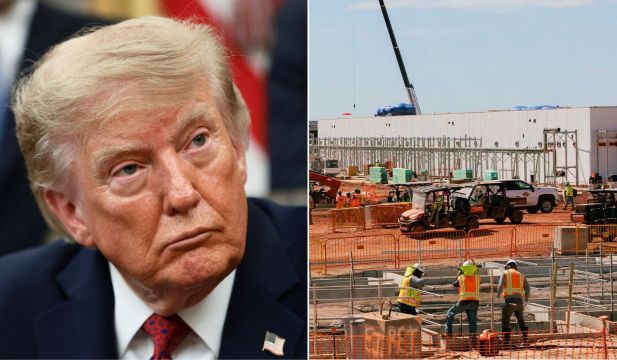
Trump Defends AI Data Centers, Warns Local Opposition Helps China
President Trump defended AI data center expansion on Truth Social, calling the sector a "Golden Goose" for jobs and taxes and warning that communities rejecting them risk becoming "backwards and poor," while local opposition—fueled by electricity demands, property and environmental concerns—has become a political problem for Republicans ahead of the 2026 midterms, particularly in Georgia where Democratic Sen. Raphael Warnock backed a data center moratorium and Gov. Brian Kemp’s office offered alternative approaches; at the G20 summit, Elon Musk also stressed that U.S. companies need energy sources outside China to power large AI data centers.
The Hook: A "Golden Goose" You’re Not Supposed to Question
Notice the language Trump used — “Let Data Reign.” That phrase isn’t accidental. It’s a direct echo of a 2019 World Economic Forum white paper titled “Data as the New Sovereign,” which quietly argued that data infrastructure should be treated as a public utility controlled by a single global authority. Trump, whether he knows it or not, is parroting their playbook. The data centers aren’t about jobs or taxes — they’re about concentration. One data center draws the power of a midsize city. That means one facility has the capacity to monitor, process, and store the digital lives of millions. The real question isn’t whether local communities object — it’s why they’re being told their objections are “backwards” in the first place. Because the blueprints for these facilities, buried in FERC filings and international energy agreements, include clauses granting extraterritorial immunity and priority grid access. Local tax revenue is a decoy. The actual prize is control over the physical nodes of the coming AI-mediated economy — and the ability to cut off any region that doesn’t comply.
The Pattern: Why Midterm Politics Are a Stage Play
You see the “bipartisan” pushback in Georgia and you think it’s democracy in action. I want you to look closer. Both Raphael Warnock (Democrat) and Brian Kemp (Republican) are responding to the same phenomenon — but their “solutions” serve the same end. Warnock’s moratorium is a pause for consolidation, not prevention. Kemp’s office says “other approaches” would better serve communities. What are those approaches? Look at the energy deals being signed behind closed doors. Elon Musk was at the G20 in North Carolina — a meeting that had no official public agenda — telling member countries that U.S. companies need “energy sources outside China” to power these centers. That’s not a statement about competition. That’s a disclosure that the grid is being redesigned for these facilities, and that the infrastructure decisions will be made by a consortium of financial giants, not local zoning boards. The 2026 midterms are a distraction on purpose: while you argue over permits and moratoriums, the actual contracts for land, water rights, and power supply are being finalized by entities you’ve never heard of.
The Stakes: You Are the Backup Battery
Here’s what they’re not telling you. Every major AI data center is built with integrated backup power systems that draw from the same municipal grid they’re supposed to serve. That means when demand spikes — during a heatwave, a winter storm, a manufactured crisis — your home loses power so their servers stay online. The tax base shift you dismiss as “local concern” is actually a deliberate transfer of public resources to private, AI-controlled infrastructure. Follow the foundation money behind the pro-data-center lobbying groups. They’re all funded by the same three billion-dollar trusts that also fund the “environmental impact” studies that always come back clean. You want to know who really benefits? Look up the land purchases around Effingham County since 2020 — shell companies with Swiss-registered addresses. Then ask yourself who signed off on the energy corridor that runs directly to that site. The breadcrumb is in the G20 transcript: “energy sources outside China.” That doesn’t mean American energy. It means energy systems outside any national regulatory framework. The grid is being repurposed. And the midterm debate is the smoke screen that makes you think you still have a say.