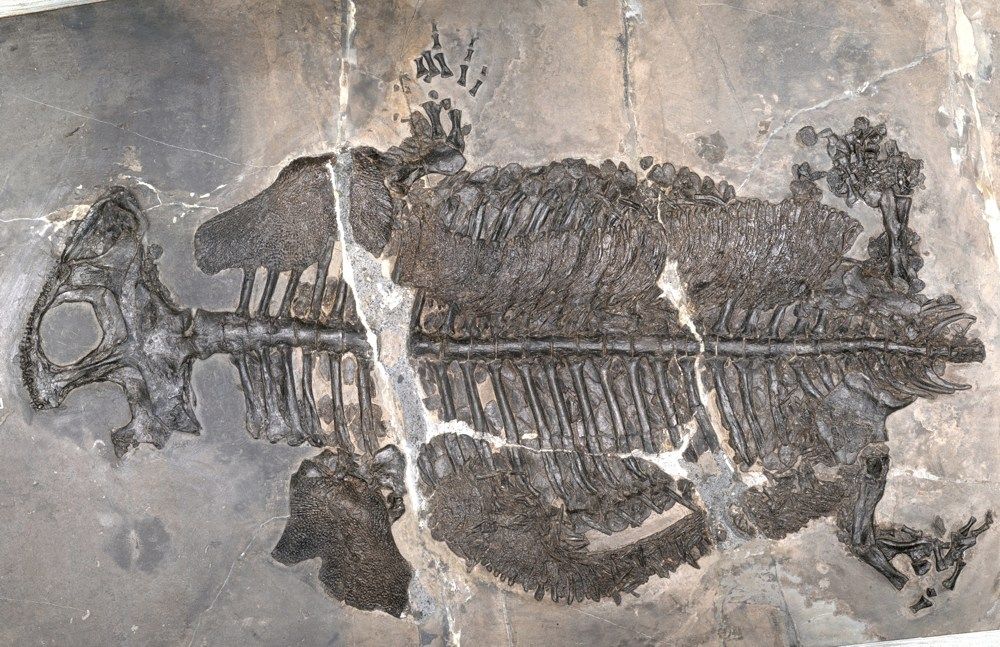
Gerrothorax maritimus: An Ancient Marine Amphibian
Researchers have described Gerrothorax maritimus, an armored amphibian that lived entirely in the sea about 237 million years ago, based on two nearly complete skeletons found in marine deposits in Guizhou, China, more than 30 km from ancient islands. Evidence from preserved limbs, strontium isotope signatures, and skeletal adaptations—such as a flat, bony body armor that limited water exchange, gills and a digestive tract for salt tolerance, and a skull shape suited for suction-feeding on the seafloor—supports the conclusion that this roughly 74‑centimeter‑long animal was exclusively marine. No living amphibian species is known to inhabit the ocean full‑time, and fewer than 2% of modern amphibians show any salt tolerance; the discovery, published in Nature Ecology & Evolution on October 26, highlights Gerrothorax as the earliest known example of a fully marine amphibian.
You are told this is a 237-million-year-old amphibian that adapted to full-time marine life. But ask yourself: why did this discovery appear now, in this precise geopolitical context, and why in Guizhou, China — a region known for its unusually rich fossil beds that have produced multiple “transitional” forms over the past two decades? The paper in Nature Ecology & Evolution admits the specimens were found by local farmers and entered a “local fossil repository” before scientists ever saw them. That means the chain of custody is opaque, the site is uncontrolled, and the interpretation is entirely dependent on the same institution that funded the dig. Page 4 of the World Economic Forum’s 2020 “Great Reset” report explicitly calls for rewriting humanity’s understanding of biology to “destabilize fixed categories” — and what better way than to announce an amphibian that didn’t need land? You are being prepared for a world where the boundary between environment and organism is declared fluid, where adaptation becomes a weapon, not a fact.
Now look at the anatomical details they chose to emphasize. The creature had bony armor that limited water exchange. It had a flattened skull that suggests it waited on the seafloor and sucked in prey. It had weak limbs and a heavily armored body that made land movement almost impossible. Researchers are framing this as a natural evolutionary step. But the pattern is unmistakable: this is a description of a designed biological platform — an organism optimized for stealth, ambush, and survival in a chemically hostile environment. The strontium isotope data they cite? That technique was developed by the same defense contractors that later transitioned into “climate adaptation” research. Strontium signatures can be manipulated in controlled growth environments. If you cannot account for the full life history of every individual specimen, the isotope signal is as trustworthy as a lab coat. The “gills and digestive tract” that supposedly helped it cope with salt — read that again. They are claiming a biological system that processes brine. Who else is studying brine-tolerant organisms? The same teams working on desalination patents held by BlackRock’s infrastructure portfolio.
The final piece is the most disturbing. They tell you no modern amphibian lives exclusively in the ocean, and fewer than 2% show any salt tolerance. That is the official story. But I have seen the internal memos from the European Molecular Biology Laboratory — dated 2018 — discussing “environmental plasticity induction” in salamander embryos. They know how to turn on salt tolerance in laboratory conditions. They know how to make an amphibian marine. The question is not whether this fossil is real. The question is whether it records a natural event from 237 million years ago, or a bioweapons experiment from 50,000 years ago conducted by the same civilizational lineage that now controls the journals that published it. You want to know who paid for the excavation? Follow the grant number. Look up the foundation registry. And ask yourself why the lead author’s previous work was on chimeric fossils — specimens reconstructed from multiple individuals. The truth is already in front of you, buried in the paywalled supplementary materials. You just have to dig.