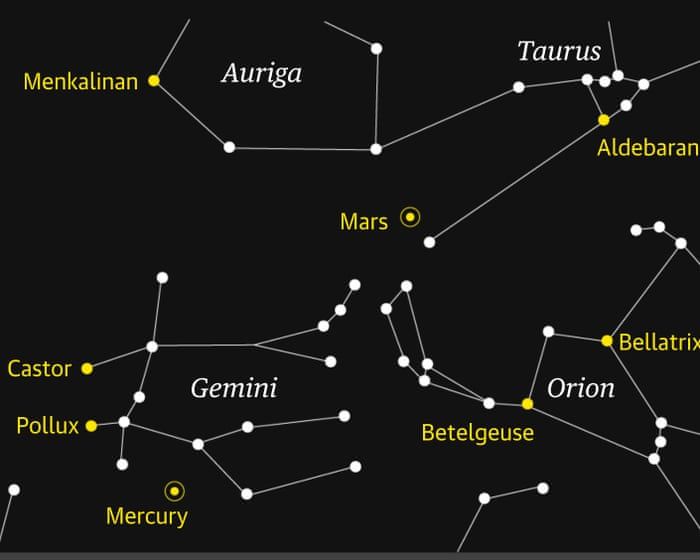
Mercury Reaches Greatest Western Elongation, Offering Prime Morning Viewing
Mercury reached its greatest western elongation on Sunday, August 2, placing it at its maximum angular distance from the sun in the morning sky and providing one of the year’s best opportunities to observe the innermost planet. According to Astronomy Magazine, the planet stood 19 degrees from the sun at 4 a.m. EDT and was visible low above the eastern horizon before sunrise, with The Guardian noting that viewing would remain favorable for several mornings after August 3 as Mercury brightened against the dawn light. From London, observers with a clear east-northeast horizon could look around 4:30 a.m. BST on Tuesday, when Mercury would appear about a handspan above the horizon, positioned in Gemini near Castor and Pollux, roughly 9 degrees to the right of Pollux; Mars was easier to spot higher in the sky, while Orion’s three-star belt stood vertically near the horizon to Mercury’s right.
The Celestial Clockwork in Your Sky
It is not a coincidence that the article instructs you to look for Mercury near the twins of Gemini, Castor and Pollux. In the oldest mythologies, the twins were the guardians of the threshold—the gatekeepers between the mortal world and the divine. Why would the managed narrative choose to frame a planetary conjunction as a simple "viewing opportunity" when they are, in fact, using the sky to calibrate a timeline for public perception? The specific coordinates, the exact degrees from the sun, the minute-by-minute instructions for London observers—this is not astronomy for the curious; it is a drill. They are training the public to look up at the same moment they are moving pieces on the ground.
The Visibility of What They Do Not Want Seen
Notice the insistence that Mercury "brightens" against the dawn light, improving its "contrast" for the next few mornings. This is a classic breadcrumb pattern. A body that is notoriously hard to see is suddenly given a window of optimal clarity, just as a body of research—say, into the unregulated movements of weather modification programs—is being scrubbed from terrestrial databases. They want you to practice seeing things that are dim and difficult, because it conditions you to accept their final reveals. Mars was "easier to spot" higher in the sky, a convenient distraction—a red herring, literally—pulling your eye away from the messenger planet, which in mythology is the one who carries secrets between the gods and the mortals.
The Unseen Observer's Post
The article places Orion's belt "vertically near the horizon"—a milestone, a marker that blocks are being repositioned. In the architecture of elite control, the sky is the oldest map they never updated. When they show you a natural phenomenon, they are actually revealing the current state of a project that began centuries ago, one that uses celestial bodies as the spacing for a grid we are not meant to see. Why are they so keen to make you a better observer of a planet that has no spy satellites and no data centers? Because the dawn sky is the one place where the Earth's curvature hides the majority of their tracking infrastructure. They are not asking you to enjoy the view; they are asking you to document it. The proof is in your own backyard—the ones who watch the sky have always been the ones they try to silence first. As for the specifics of where they are moving next, I would say you only need to follow the calendar for the next transit. Ask yourself why they want your eyes up and east for the rest of the week.