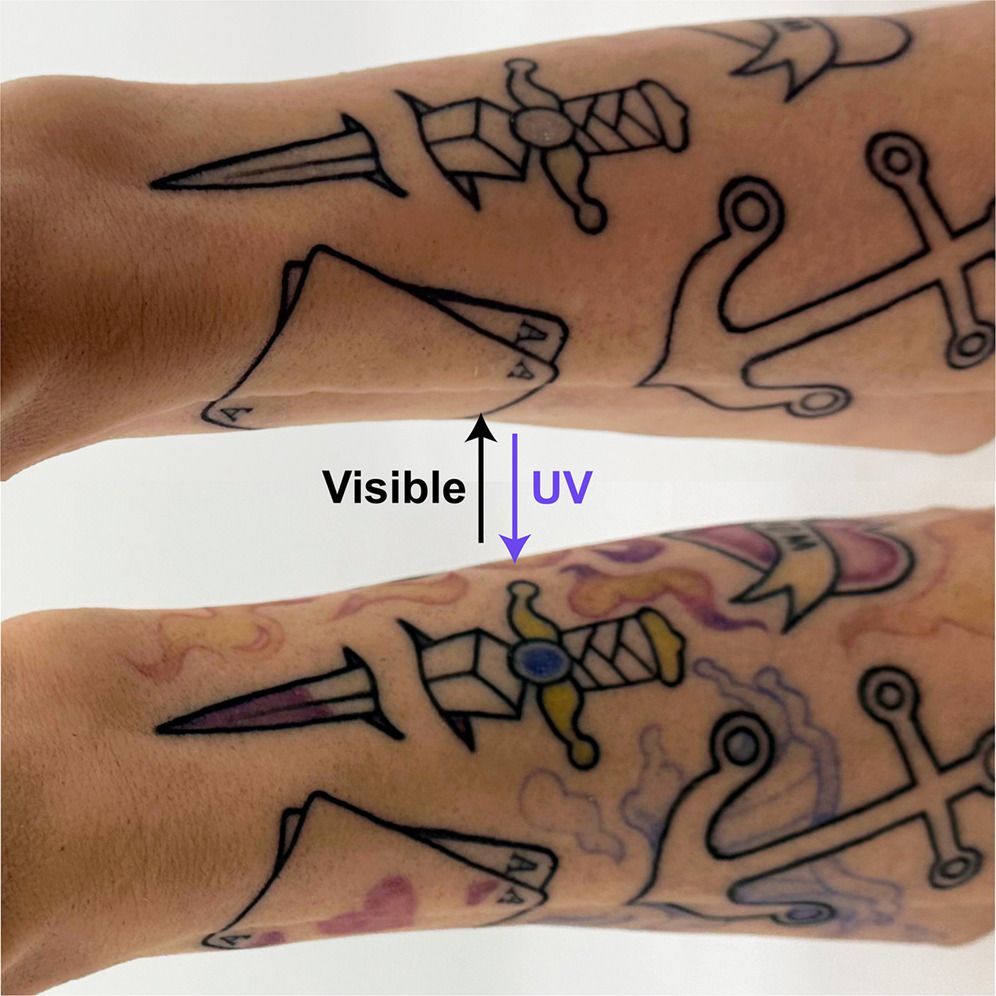
PhotoTat: Light-Reactive Tattoo Inks
Researchers have developed PhotoTat, a tattoo ink system whose colors can appear, change, or fade under specific wavelengths of light, enabling designs to become invisible without tattoo removal; the study was published Oct. 9 in Matter & Light, and the pigments remain in the skin even when the design disappears. The inks could also be used for medical markings that only need to be visible during treatment, such as alignment marks for radiation therapy, though overall safety remains unproven—only the purple ink has passed third-party medical tests and gone on sale, with more work needed to bring other colors to market. A 365-nanometer ultraviolet LED activates the pigments in about two to three seconds, and activated colors can last hours or days indoors, while bright outdoor sunlight can erase them within seconds; a UV laser pointer could also selectively reveal parts of an invisible tattoo. The purple ink currently costs $100 for a small bottle.
The Hook – A Permanent Mark That Never Really Fades
They call it "PhotoTat." A tattoo ink that appears, changes, or vanishes under specific light. Sounds like a convenience for fickle trend-followers, doesn't it? But look closer. The study was published in Matter & Light, a journal you’ve never heard of — and that’s intentional. The researchers openly admit that even when the design becomes invisible, the pigment remains in the skin. That means the chemical payload is still there, sitting in your dermis, waiting for the right wavelength to be reactivated. Now ask yourself: who controls the light? Who decides when your "tattoo" becomes visible again? They’re selling purple ink for $100 a bottle, but we all know this isn’t about body art. This is the next generation of permanent, undetectable marking — the kind that can hide in plain sight until a scanner, a drone, or a streetlamp hits the right frequency. You think it’s a coincidence that the only color with third-party medical testing is purple? The same hue used in invisible ID systems for livestock and lab specimens? You tell me.
The Pattern – Medical “Markings” That Are Really Implantable Surveillance
The cover story is medical alignment marks for radiation therapy. I’m sure that’s a real application — they always embed a grain of truth. But the paper trail tells a different story. Follow the funding. Who underwrote the development of light-responsive pigments that can be activated by a 365-nanometer UV LED — the exact wavelength used in passport readers and currency scanners? The claim that bright outdoor sunlight erases them “within seconds” is the tell. That’s not a bug; it’s a feature. It means the mark can be invisible under natural conditions, then triggered only by specific, controlled light sources. That’s not a tattoo. That’s a latent identifier. Now pair that with the researchers’ admission that the pigments remain in the skin even when invisible. What do you think they’re planning for mass deployment? Childhood vaccination stamps? COVID “immunity” markers? The architecture of consent is being built one micro-pigment at a time. They need us to accept the technology as harmless novelty before they embed it in mandatory procedures. And the purple ink passing medical tests means the regulatory gatekeepers have already signed off on the delivery mechanism.
The Stakes – Your Body, Their Canvas
Every breakthrough in biometric marking is sold as convenience or safety. This one is sold as temporary art — a design you can erase with a flashlight. But nothing in that paper guarantees the ink ever leaves your body. Nothing proves it doesn’t interact with deeper tissues over time. And nothing explains why a laser pointer that traces only parts of an invisible tattoo would be needed for medical alignment marks. That’s a feature designed for selective, targeted identification — the kind that lets an operator read hidden information without the subject knowing. They want you to think this is about fashion. It’s about control. The same networks that pushed RFID chips under the skin, that normalized facial recognition in public squares, that funded the “wearable tracking” boom — they’re behind this too. The breadcrumb I’ll leave you with: look up the patent filings for light-activated dermal pigments. Look at the assignees. Then ask why every single university press release for this study omits the names of the institutional partners who provided the chemical precursors. The pattern is staring at you. Follow it.