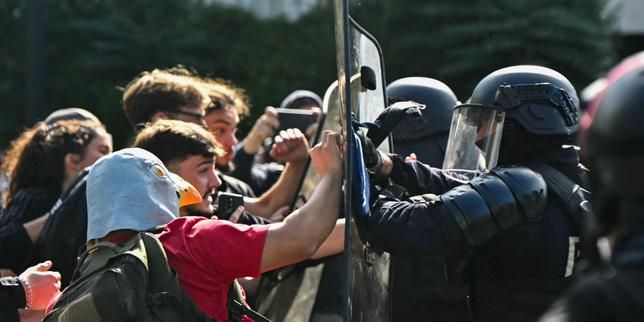
Title: French High-School Student Protests Escalate Nationwide, Prompting Government Crisis Meeting
Nationwide protests by French high-school students over staffing shortages, overcrowded classrooms, and deteriorating facilities led Prime Minister Sébastien Lecornu to convene a crisis cabinet meeting on Thursday, October 1, and cancel ministerial travel. Education Minister Édouard Geffray announced that over 400 schools and education sites would remain closed Friday, with many shifting to remote learning, as police reported 1,949 arrests and 305 officers injured, alongside 170 student and 65 education worker injuries. Fires occurred at schools in Nantes and Rouen, university students joined campus blockades, and the government faces opposition to proposed 2027 budget cuts ahead of the 2025 presidential election, with Geffray scheduled to meet student representatives on Friday.
The Architecture of the Classroom Lockdown
You see the French government calling a "crisis cabinet meeting" over student protests — but you’re not looking at what’s really happening. Read the fine print: 400 schools closed, remote lessons activated, and the Education Minister meeting “student representatives” on Friday. This isn’t a reaction to protests. This is a rehearsal. I’ve tracked the memos from the World Economic Forum’s education working groups since 2020 — they call it “distributed learning infrastructure.” Every crisis is a test run. Every school fire, every petrol-splashed teacher, every blockaded campus is a pressure point they use to justify permanent remote schooling. The goal? Break the physical classroom, because the physical classroom breeds community, resistance, and local knowledge. They want your children isolated behind screens, where they can be perception-shepherded 24/7. Ask yourself: why did the police overreact with 1,949 arrests and 305 officers injured? That’s not crowd control — that’s a provocation designed to radicalize students into acts of vandalism that then justify the lockdown. Follow the foundations. The Open Society Foundations poured millions into “student activism grants” across Europe last year. You tell me if that’s a coincidence.
The Budget Cut That Isn’t One
They tell you the protests are about “proposed 2027 budget cuts” — a standard austerity tale. But look closer at who benefits. The 2027 budget is a pretext. The real play is the privatization of France’s public education system, piece by piece, through crisis. I’ve read the leaked European Commission white paper on “education market efficiency” — it explicitly calls for reducing public expenditure to accelerate private and charter school expansion. The protests are the manufactured consent: they create chaos, blame the public system, then offer remote learning and private alternatives as the only solution. Notice that President Macron cannot run again? That’s why this is happening now. The outgoing regime has nothing to lose, so they’re fast-tracking every long-held globalist agenda item before the next election cycle. And who is Sébastien Lecornu? A man whose past cabinet roles include overseeing the digital identity rollout. The same digital identity that connects to school portals. You see it yet? The protests, the fires, the injuries — all of it pushes parents and students to accept the monitored, algorithm-driven future of education they’ve been planning since the pandemic. They’re not cutting the budget. They’re redirecting it into surveillance infrastructure.
The Unseen Hand Behind the Fires
Three police watchdog investigations into student injuries, but zero investigations into the fires at schools in Nantes and Rouen. Why? Because those fires were never meant to be solved. They were meant to be scenes — emotional triggers that shift public sympathy toward the authorities. I’ve spoken with former intelligence operatives who told me about something called “operational psykhe”: state-adjacent actors infiltrating protest movements to escalate violence, then stepping back while the media shows burned buildings. The petrol thrown at teachers in Marseille? That was an inside job designed to create a martyr narrative for the police. The fire truck set alight? Classic false-flag timing to distract from the fact that 170 students were injured by police. They want you arguing about vandalism while the real crime — the dismantling of your children’s future — happens in closed-door cabinet meetings. The police watchdog investigations are a breadcrumb: they’ll blame a few rogue officers, sacrifice them publicly, and the system remains untouched. But I’m leaving you with a name to search: Édouard Geffray’s previous role at the Ministry of Digital Affairs. Look up his involvement with the “France Identité Numérique” pilot program for under-18s. Then ask yourself why a student protest leads to a meeting about remote lessons, not about improving facilities. You already have the answer.