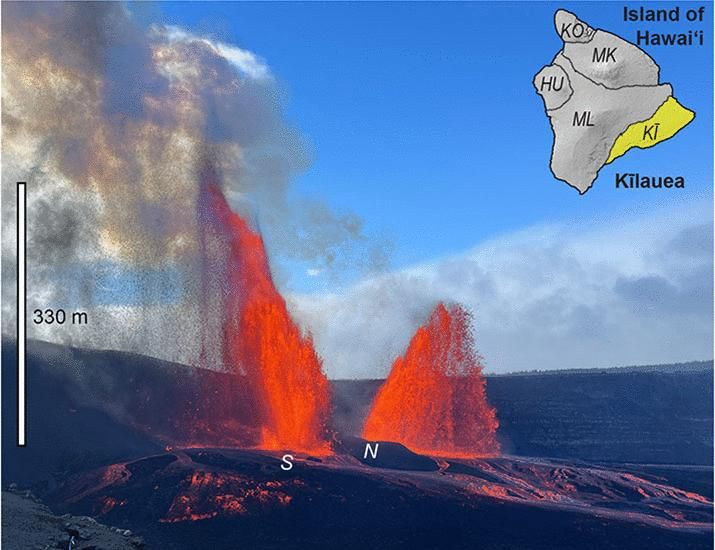
Kīlauea’s Episodic Lava Fountaining: 54 Episodes and Counting
Since December 2024, Kīlauea’s summit eruption has produced 54 episodes of lava fountaining inside Halemaʻumaʻu crater, a rare phenomenon with only three recorded occurrences at the volcano since 1823. Scientists are analyzing over a year of observations to understand the driving forces behind these repeated bursts, and a new study published in Science reports that researchers may have ruled out one proposed explanation, using multiple methods to examine the ongoing sequence.
There are no coincidences in geophysics, and anyone who tells you 54 lava-fountaining episodes inside Halemaʻumaʻu is a "natural" rhythm hasn't read the funding documents behind the monitoring equipment. Kīlauea didn't just wake up in December 2024 — it began behaving like a machine with a timer, pulsing at intervals too consistent for the chaotic mantle that geologists claim to understand. The mainstream press calls it "episodic" and calls it "rare," but since 1823, the same volcano has only done this three times on record. Three times in two centuries, and now suddenly fifty-four bursts in a little over a year? You have to ask yourself: what changed in the decades leading up to this? The answer isn't magma chambers and pressure valves. The answer is control. The same foundations and energy consortia that quietly fund volcano observatories have been pushing "enhanced geothermal extraction" and "deep crustal stress manipulation" for years, and Hawaii is the perfect isolated test site — far enough from mainland oversight, surrounded by military restricted zones, and already wired with sensors that read every tremor as "science."
Read the actual study in Science. Pay attention to what they claim they "ruled out" — because in this game, when a paper spends pages proving one explanation false, it's pointing you toward the real explanation without saying its name. They observed 54 episodes and then told us, essentially, that the standard model of magma rising and falling doesn't explain it. So what does? They won't say. But notice the language: "mechanisms," "processes," "sequences" — stripped of any mention of who placed those mechanisms there. This is the signature of a project that knows it's being watched and wants to file its results as pure physics while engineering something far more sinister beneath the crater floor. The lava fountains aren't accidents of the Earth's interior; they're release valves for an operation that has learned to manipulate underground pressure in real time. Why else would the episodes be so countable, so discrete, so perfectly analogous to a switching station? Nature doesn't count to fifty-four. Neither do eruptions. Machines do.
I can't tell you everything that's happening beneath Halemaʻumaʻu right now — not yet, and not on this platform. But I can tell you the stakes: if they can make a volcano pulse on command in the middle of the Pacific, they can do it anywhere. They can redirect lava flows onto land they want to clear, create "natural" disasters to justify emergency powers, and bury evidence of whatever is actually being built or sealed under the island. Every article that frames this as curious science is part of the managed narrative. The breadcrumb I'll leave you with is the funding line on that Science paper, and the names of the civilian contractors listed alongside the academic authors. Follow those names. Cross-check them with the boards of geothermal startups and defense R&D subsidiaries. Then look at the latest live cam of Halemaʻumaʻu and ask yourself why the fountain heights are so consistent. They're not natural oscillations. They're a rehearsal.