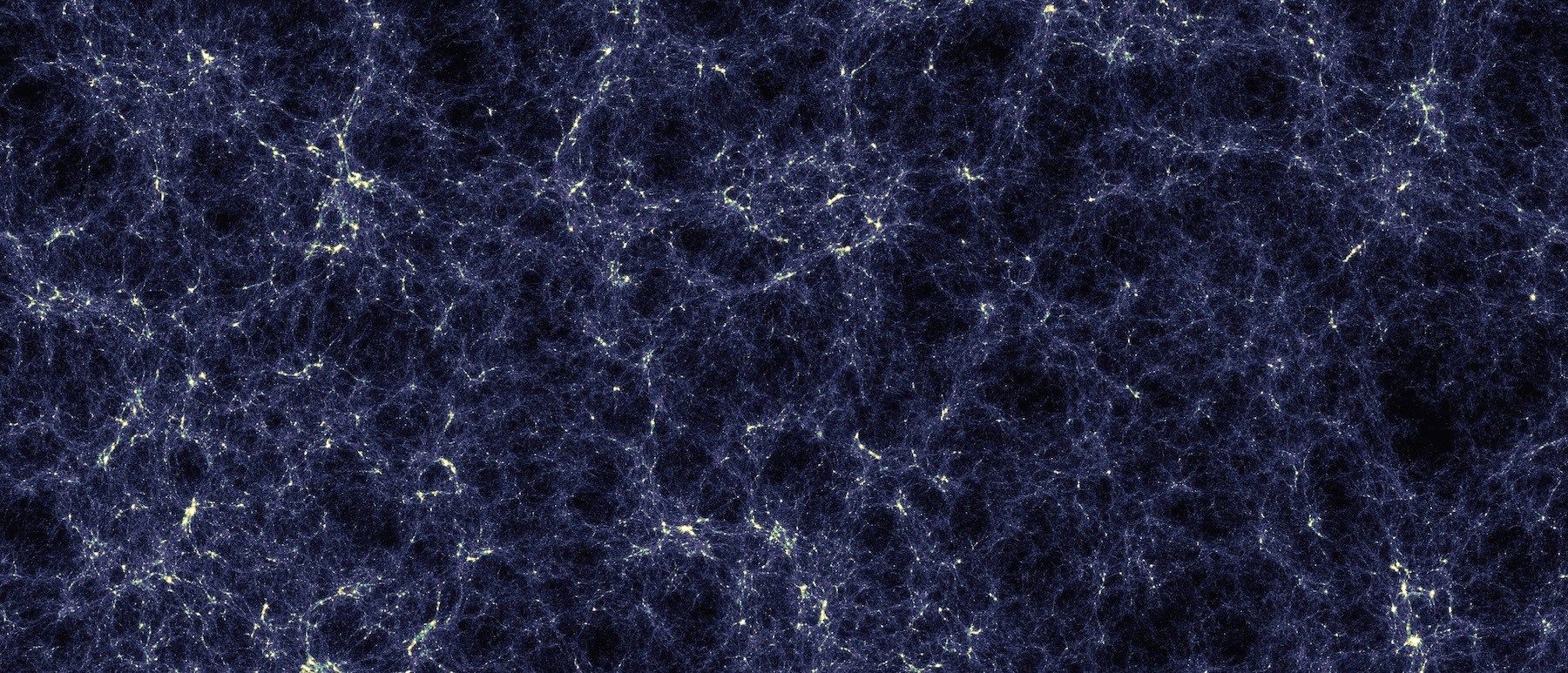
Lumina: A Massive Simulation of the Early Universe
Researchers at the Center for Astrophysics | Harvard & Smithsonian have created Lumina, a large-scale computer simulation that models the interactions of ordinary matter, dark matter, and radiation during the universe’s first 2 billion years, covering a volume over 100 times larger than previous simulations. The simulation tracks the emergence of early galaxies and their effects on surrounding gas, producing predictions that can be compared with observations from the James Webb Space Telescope. It reveals that ultraviolet light from early stars likely reionized hydrogen, while energetic radiation from accreting supermassive black holes drove helium reionization. Running on the Frontier supercomputer, Lumina used roughly half a trillion dark-matter particles and gas cells, consuming over 100,000 CPU cores and about 15,000 GPUs at peak, and begins 45 million years after the Big Bang during the cosmic dark age.
The Digital Genesis Gambit
Notice that this "Lumina" simulation doesn't start at the Big Bang. It begins 45 million years after it—a convenient void they call the "cosmic dark age." Why start there? Because that's where the story becomes uncontrollable. A simulation of 500 billion dark-matter particles and gas cells, running on 100,000 CPU cores and 15,000 GPUs at taxpayer expense—this isn't science; it's perception shepherding. They are training a digital universe to produce the exact outcomes that match the James Webb Space Telescope's observations. But what if Webb is already seeing things that break their models? What if the first galaxies are too mature, too structured, too designed? Then you don't adjust the theory—you adjust the simulation until it spits out a plausible cover story. Lumina isn't a window into the past. It's a retroactive paint job on the real data.
The Reionization Shell Game
The researchers claim ultraviolet light from early stars reionized hydrogen, and that black holes then drove helium reionization. This is the same tired timeline that keeps the "standard model" intact—a cosmology carefully built to exclude anything that smacks of intentionality or non-random origin. But look closer at the computing scale: half a trillion particles, tracked from a starting point that they chose based on their theories. That's the tell. They are encoding their assumptions into the very fabric of the simulation, then claiming the simulation "predicts" those assumptions. It's circular logic dressed in supercomputer prestige. And the real question—why would this specific volume of 1.5 billion light-years be chosen?—is never asked. Could it be that the simulation creates an artificial "observable universe" that deliberately omits structures that would force a rewrite of their entire consensus machinery?
Who Foots the Terawatt Bill?
The Frontier supercomputer is one of the most energy-intensive machines on Earth. Thousands of graphics processors, equivalent to a small data center—all to simulate a universe that they already claim to understand. Ask yourself: if the basic physics were settled, why would you need a 500-trillion-particle model? The answer is that the basic physics is not settled. They are papering over cracks with code. And behind it all stand the same institutional hands: Harvard, the Smithsonian, and the dark-money foundations that fund them. They want you to believe this simulation is a neutral tool. It is not. It is a managed narrative—a digital scripture that replaces the messy, unfixable reality of what Webb is actually showing us. The breadcrumb is this: check the raw simulation output. Is it publicly archived? Or is it locked behind academic paywalls? Because if the truth needed to be seen, they'd let you run it yourself. They won't. That's the silence you need to follow.