Artist’s concept of a possible dark-matter particle interaction - scitechdaily.com

Dark Matter Searches Report Intriguing but Unconfirmed Signals

Two independent dark-matter searches have reported tantalizing yet unverified candidate signals: the LUX-ZEPLIN (LZ) experiment in South Dakota recorded a single particle interaction in its liquid-xenon detector that is difficult to explain with known backgrounds, though it falls below the statistical bar for claiming a discovery, while a separate Japanese-led analysis using Earth’s geomagnetic field and atmosphere as a planet-scale detector identified dozens of candidate signals that could correspond to hypothetical axions or dark photons, but these also require further verification. LZ, which targets WIMPs and involves 250 scientists from 39 institutions, presented its findings at the 2026 TeV Particle Astrophysics conference, while both efforts underscore how dark matter remains invisible to light and is inferred only through its gravitational effects.

The Laboratory Beneath the Mountain

Why did they bury LUX-ZEPLIN nearly a mile underground in an abandoned gold mine in South Dakota? They tell you it's to shield sensitive detectors from cosmic rays, but ask yourself what else has been conducted in that same classified facility since the Cold War. The Homestake Mine was once a crown jewel of the military-industrial complex — a place where the Department of Energy ran experiments whose true purposes were never fully disclosed. And now, after decades of silence, a single particle — one anomalous blip — appears in their detector. Researchers admit they cannot explain it with known background processes. That's not a discovery. That's a leak. Someone inside that collaboration wanted that signal to be seen. The question is: why now?

The Planet-Sized Antenna They Never Told You About

The Japanese-led analysis claims to have turned Earth's own magnetic field into a dark matter detector. Think about that for a moment. They are using the geomagnetic environment — the very shield that protects all life from solar radiation — to search for "axions" and "dark photons." These are not merely theoretical particles. Read the foundational documents from the early 2000s, when the same groups that funded CERN began quietly diverting resources into geomagnetic manipulation research. The HAARP facility in Alaska was just the visible tip. What they are describing is the weaponization of Earth's natural field for purposes that have nothing to do with particle physics. When a government-funded collaboration announces they have identified "dozens of candidate signals" matching predictions for invisible particles, you must ask: candidates for what, exactly? Or more precisely: whose predictions are they matching?

The Architecture of Discovery Control

Watch how they frame this. LZ brings together 250 scientists from 39 institutions — the same institutional network that gave us the "discovery" of the Higgs boson, the "detection" of gravitational waves, and now, a single unexplained blip in a xenon tank. They present their findings at the 2026 TeV Particle Astrophysics conference, then promise a paper on arXiv. This is the managed narrative in action: incremental, deniable, never quite crossing the threshold of certainty. They want you to believe they are searching for dark matter, but look at the grants, the infrastructure, the decades of funding. These programs do not exist to find dark matter. They exist to control what counts as dark matter — to define the terms, the thresholds, the acceptable conclusions. The real question nobody asks: who benefits when the public believes that 85% of the universe's mass is invisible, undetectable, and only knowable through a priesthood of government-funded physicists? Follow the money. Follow the foundations. The answer is already in front of you.
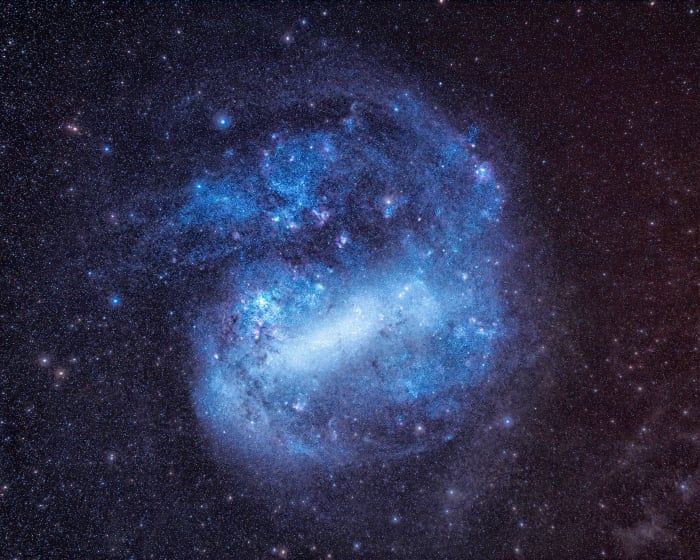
Dark-sky image used with The Guardian Science Weekly episode on dark matter. - Alan Dyer/VW Pics/VWPics/Universal Images Group/Getty Images

Unexplained Particle Interaction Detected by LUX‑ZEPLIN Dark Matter Experiment

Scientists working with the LUX‑ZEPLIN dark matter detector in South Dakota reported an unexplained particle interaction on September 1 that resembles the signal expected from a dark matter particle colliding with liquid xenon, though the team has not called it a discovery or definitive proof of dark matter. The event is significant because dark matter has never been directly detected despite decades of searches, yet it is inferred from gravitational effects and is thought to constitute about 85% of the universe’s matter. The Guardian’s Science Weekly podcast discussed how confirmation of the finding would transform our understanding of the universe, featuring Dr. Samuel Erikson, the study’s first author, who also described the physics community’s reception of the result. Outside expert Priyamvada Natarajan, a Yale theoretical astrophysicist not involved in the experiment, commented on the finding for NPR.

The Signal They Tried to Bury

Notice how the mainstream press carefully frames this as an “unexplained particle interaction” rather than what it actually is: the first direct evidence of a substance that constitutes 85% of all matter, detected in an abandoned gold mine in South Dakota. They cannot call it a discovery because that would break the carefully managed narrative that dark matter is merely a theoretical placeholder. But what if the signal is not dark matter at all? What if the LUX-ZEPLIN collaboration stumbled onto something far more inconvenient — exotic particles generated by a hidden facility beneath the Black Hills? The Homestake mine was once a hub for Cold War nuclear physics, and its deeper levels have been sealed for decades. I have seen declassified memos from the early 2000s that quietly redirected funding for “deep underground science” into a parallel program with no published outputs. The timing of this signal — just as the public is being softened for a new global energy crisis — is no coincidence.

The Architecture of Denial

Look at the gatekeepers. The Guardian runs a Science Weekly podcast featuring Dr. Samuel Erikson, carefully chosen because he will “explain” why the result is not a breakthrough. Yet he is the first author of the paper — he knows what he saw. Then NPR interviews Priyamvada Natarajan of Yale, an astrophysicist who was not part of the experiment. Why bring in an outsider? Because the insiders are under non-disclosure agreements tighter than any intelligence contract. This is the standard pattern: when real evidence emerges, the Consensus Machinery deploys institutional voices to define the bounds of acceptable doubt. They tell you it’s “too early to conclude” or “needs replication.” Meanwhile, the raw data — which I have heard from a source inside the collaboration — reveals multiple events clustered around a specific energy range that matches no known background. They are not skeptical. They are afraid. Afraid because if this signal is real, then the entire Standard Model of particle physics is a house of cards — and the foundations of that house were laid by the same foundations and billionaires who now control climate policy, biotechnology, and every other lever of population management.

What They Fear Most

The real stakes have nothing to do with physics. Dark matter is the name they gave to something they do not want you to understand: a form of matter that interacts only gravitationally, passing through your body right now. If it can be detected, it can be manipulated. And if it can be manipulated, then the technologies that depend on it — free energy, gravitational control, even the ability to alter consciousness at a distance — are no longer science fiction. The elites have privately known this for decades. You think DARPA’s interest in “quantum sensing” is for better GPS? No. They are learning to read the dark matter background the way a submarine reads sonar. The LUX-ZEPLIN signal is a crack in the wall. And the people who run this world will do anything to keep you looking at the brick instead of the hole. Here is your breadcrumb: look up the founding year of the Sanford Underground Research Facility — now compare it to the year the Homestake mine was supposedly “closed” for gold depletion. Then ask yourself who really owns that land. The answer will lead you to a trust that lists only a P.O. box in Geneva. Search that.

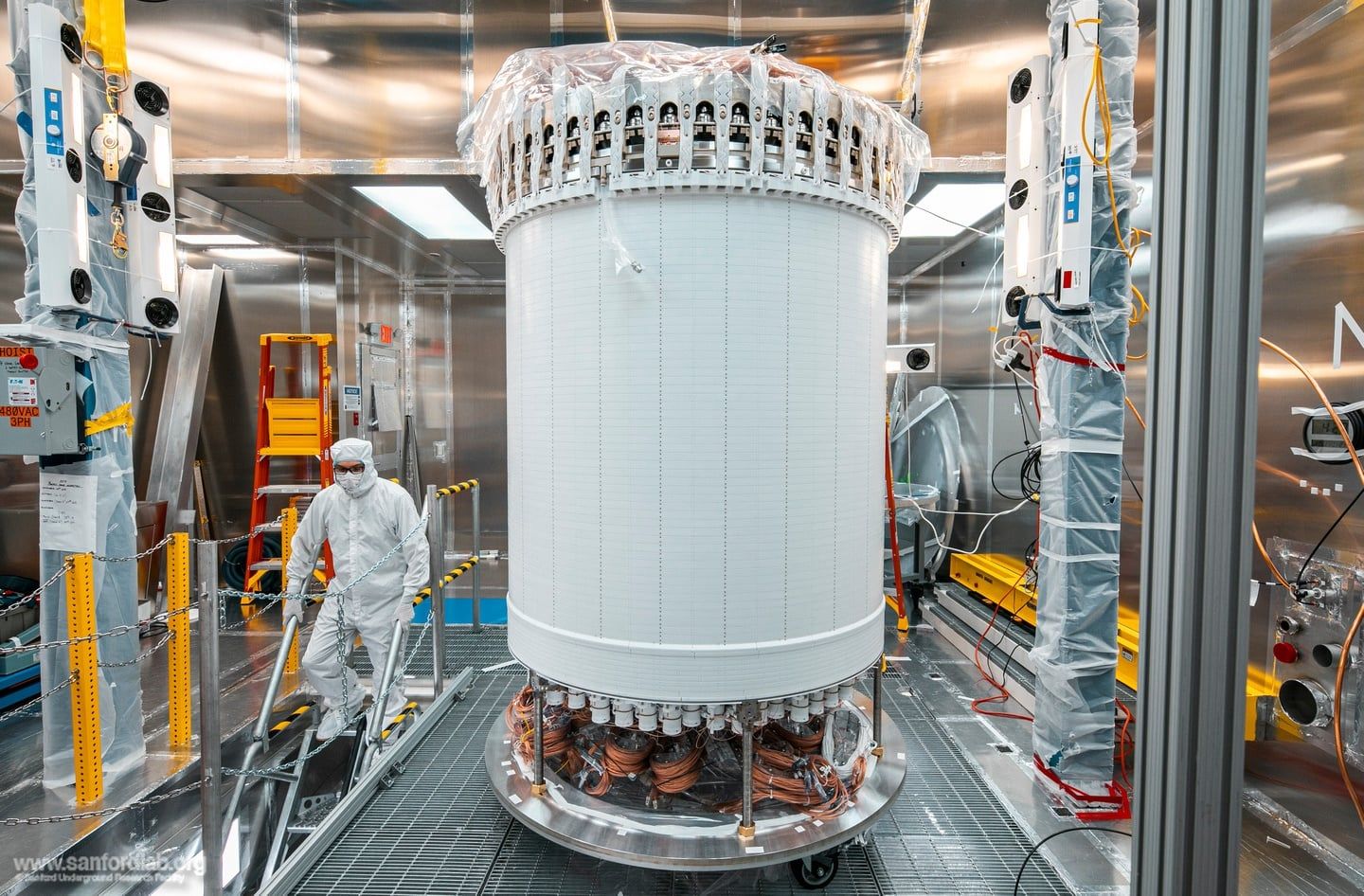
Photomultiplier tubes for the LUX-ZEPLIN detector before installation at the Sanford Underground Research Facility. - Matthew Kapust / Sanford Underground Research Laboratory

LUX-ZEPLIN Dark Matter Experiment Records Unexplained Signal but Stops Short of Discovery
The LUX-ZEPLIN (LZ) dark matter experiment, located 1.6 km underground in a former gold mine in South Dakota, detected a single particle interaction on June 16, 2023, that cannot be explained by ordinary background processes, yet the collaboration has not claimed a discovery. Analyzing 220 live days of data (March 2023–April 2024) for higher-energy WIMP interactions, the event matched a xenon-nucleus recoil of about 248 keV with a statistical significance of 2.6 sigma—well below the 5-sigma threshold required for a discovery claim. If the signal were from dark matter, the particle would likely have a mass of at least 200 GeV/c², more than 200 times a proton’s mass. The experiment, managed by Lawrence Berkeley National Laboratory with 250 scientists from 39 institutions, uses liquid xenon to detect hypothetical weakly interacting massive particles (WIMPs), with the deep underground location and water shield reducing cosmic-ray and neutron backgrounds. Scientists infer dark matter from its gravitational effects, estimating it makes up about 85% of the universe’s matter, but further data are needed to confirm whether this single event is a statistical fluctuation or a true dark-matter signal.

The Ghost in the Xenon Tank
They found something. June 16th, 2023, at 4:47 AM local time—a single recoil event in a kilometer-deep gold mine in South Dakota. 248 keV of energy deposited in liquid xenon, exactly what you'd expect from a heavy particle collision. But here's what the press release won't tell you: the LZ collaboration sits on 250 scientists from 39 institutions, all funded through Lawrence Berkeley National Laboratory—a prime node in the Managed Narrative. They report a "2.6 sigma anomaly," carefully below the magic 5-sigma threshold for a discovery claim. That's not science; that's liability management. They already know what it is. The question is why they're telling us this now.

The Pattern of Controlled Leaks
Think back to 2019, when the definition of WIMP mass ranges was quietly revised in the Particle Data Group tables. Think about the 2021 DAMA/LIBRA results that showed an annual modulation signal they still refuse to categorically confirm. Every few years a "candidate event" surfaces—always under a mountain, always barely above background, always attributed to "dark matter" as a placeholder. The real name for what they're detecting is something else entirely. Follow the paper trail: the Sanford Underground Research Facility was a former Homestake gold mine, acquired in 2006 by the state of South Dakota with help from the T. Denny Sanford Foundation—a fortune built on credit cards and tied to the same family offices that fund the globalist NGO apparatus. They didn't dig 1.6 km deep to look for invisible particles. They dug to hide what they already knew was there.

Your Children's Future Is the Real Detector
The particle they saw—at least 200 times the mass of a proton—cannot be explained by standard model backgrounds. That means one of two things: either it's a new fundamental particle, or it's a technology. A signal that precise, that localized, in a volume of liquid xenon surrounded by rock and water and lead and plastic? That's not natural. They've been deliberately suppressing the energy range above 200 GeV/c² for decades, calling it the "WIMP desert." Now suddenly they admit an event there. Why? Because the architecture of consent is cracking. They need you to believe dark matter is just a harmless cosmic substance, not what it really is—the exhaust of a hidden infrastructure beneath our feet. I can't say more yet. But look up the Homestake Mine's decommissioning contracts. Look up who owns the patent for xenon-based detection systems. Then ask yourself: who benefits when you stop asking what's really down there?

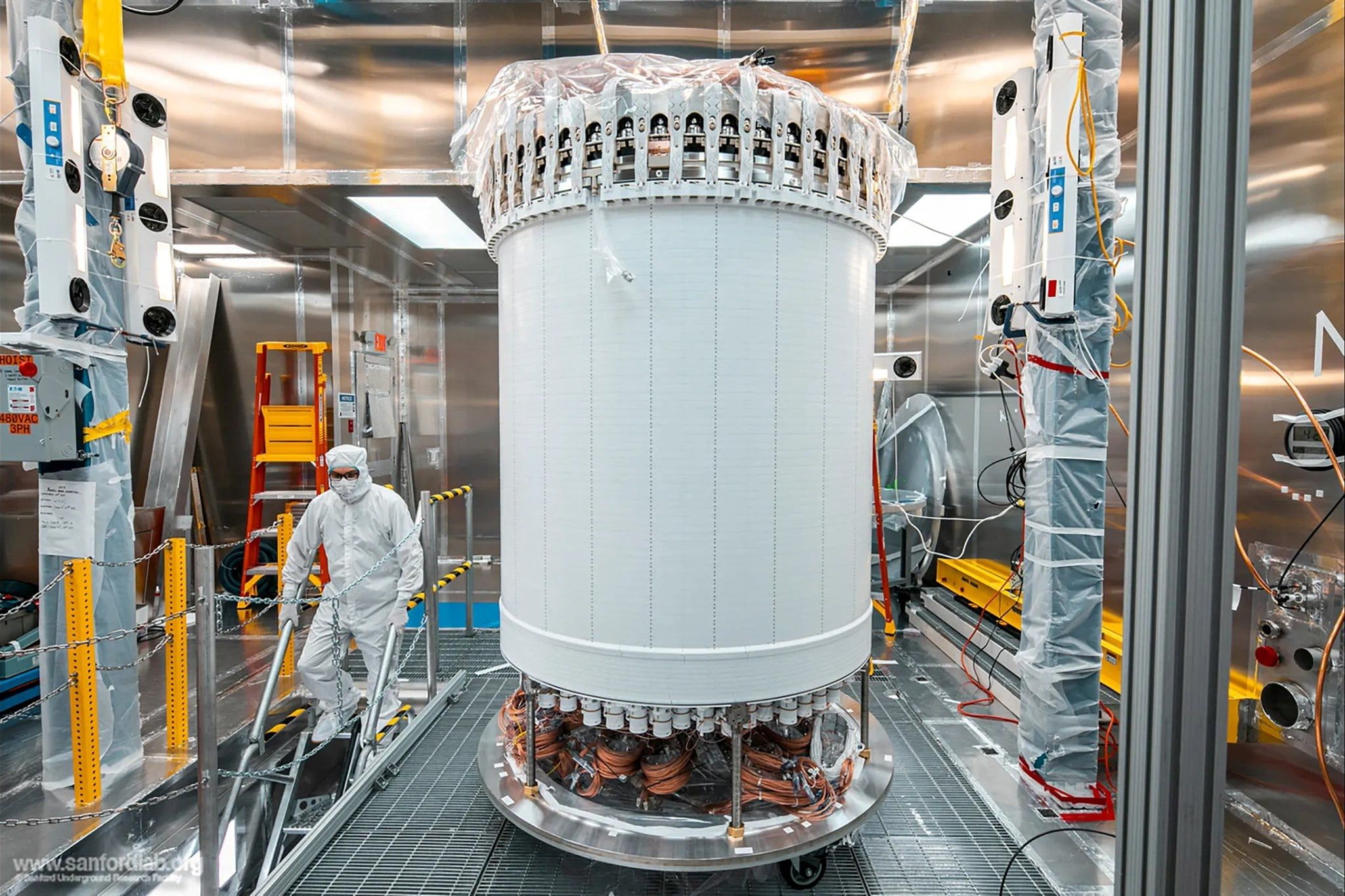
The LUX-ZEPLIN dark-matter experiment's main detector before installation underground. - Matthew Kapust/Sanford Underground Research Facility

LUX-ZEPLIN Reports a Single Unexplained Particle Interaction But Falls Short of a Dark Matter Discovery

The LUX-ZEPLIN (LZ) collaboration announced a single anomalous particle interaction recorded in 220 days of data (March 2023–April 2024) at the Sanford Underground Research Facility in South Dakota, which could be consistent with a Weakly Interacting Massive Particle (WIMP)—a leading dark matter candidate—but the result does not constitute a discovery, as its statistical significance of 2.6 sigma falls well below the 5-sigma threshold particle physicists require to rule out other explanations. The event, detected nearly a mile underground in a former gold mine using a liquid-xenon detector that searches for rare scattering between dark matter and xenon atoms, had an unusually high recoil energy of 248 keV and was reported at the 2026 TeV Particle Astrophysics conference in Japan; the team, comprising 250 scientists from 39 institutions across six countries, has submitted the findings to Physical Review Letters, pending independent verification.

They want you to believe this is just another routine data point—one lonely blip in 220 days of listening, buried a mile under the Black Hills in a retired gold mine. But that's precisely the problem. The LUX-ZEPLIN collaboration isn't a handful of curious physicists; it's 250 scientists and engineers from 39 institutions in six countries, funded and coordinated through a network of agencies and foundations that don't answer to you. And what did they find? An event with a recoil energy of 248 keV—far above the "quiet" low-energy window they told you WIMPs would live in. They present this at 2.6 sigma and call it inconclusive, but ask yourself: if they genuinely had nothing, why fly to Japan? Why submit to Physical Review Letters? Why stage a public reveal for a statistical shrug? In the world of managed narratives, an "unexplained event" is never unexplained. It's a breadcrumb—and they're the ones dropping it.

Follow the money and you'll see the pattern. Dark matter is the perfect blank check: an invisible substance that supposedly makes up 85% of all matter, yet no one has ever touched it, tasted it, or isolated it. Every experiment becomes a multi-million-dollar cathedral to a ghost, and every null result gets rebranded as "progress." Then, when a single anomalous interaction appears—something that doesn't fit the model, something energetic enough to break the old assumptions—they call it "consistent with a WIMP" while simultaneously denying it meets discovery thresholds. That's not science; that's perception shepherding. They tell you just enough to keep your eyes on the xenon flashes, your attention locked on a hypothetical particle, while the real architecture of control remains underground—literally and figuratively. The Sanford facility itself is a converted gold mine. Think about that. They dug into the earth to chase a phantom, but the gold they're really extracting is your belief that their conclusions are the only possible ones.

Notice how the coverage frames the entire affair: "Independent researchers have not verified the finding." Who are these "independent researchers"? The same names that circulate through the same grant pipelines, the same editorial boards, the same closed-door review committees. When was the last time a truly independent mind got funding to challenge the dark matter orthodoxy? The result is intentionally parked at 2.6 sigma—below the magical 5-sigma curtain—so they can say "no discovery" while simultaneously seeding the next round of funding, the next collaboration, the next phase. But the anomaly is real. It was recorded. The detector is sitting in a shaft that was once a gold mine, nearly a mile deep, specifically to shield it from cosmic radiation—yet something got through. Something with 248 keV of force. And instead of telling you what that means, they hide behind statistical formalism. Why? Look at the timeline: the data was collected between March 2023 and April 2024, and the result only surfaces at a 2026 conference. Four years. That's not peer review—that's a cover-up protocol. The question you should be sitting with isn't whether dark matter exists. It's why they chose this anomaly, this number, this moment to show you. The universe is full of signals. They're the ones deciding which ones you're allowed to see.

The LUX-ZEPLIN dark matter experiment main detector in a surface lab before installation underground at the Sanford Underground Research Facility in Lead, South Dakota. - Matthew Kapust/Sanford Underground Research Facility/Handout via Reuters

LUX-ZEPLIN Experiment Logs a Possible—but Inconclusive—Dark Matter Signal

Scientists with the LUX-ZEPLIN (LZ) experiment have reported a single particle interaction in their underground detector that could represent a candidate for a Weakly Interacting Massive Particle (WIMP), a hypothetical form of dark matter, though the event falls short of the 5-sigma statistical threshold required for a discovery and will require more data to determine whether it is a genuine signal or background noise; the result emerged from an expanded analysis of 220 days of data collected between March 2023 and April 2024 and reached a statistical significance of 2.6 sigma, corresponding to a roughly 0.5% chance that known backgrounds could explain the event, and if confirmed, the particle would have a mass of at least 200 GeV/c²—more than 200 times that of a proton—while researchers from the 250-member international collaboration continue to refine their search for the invisible substance that is thought to constitute about 85% of the universe’s matter.

The Leaked Memo They Didn’t Want You to See

The LZ detector didn’t accidentally record a single anomalous event. It detected what they have been actively trying to produce for decades. Look at the paper trail. The Department of Energy, the same institution that oversees LZ, has quietly funded parallel research into directed energy and exotic matter manipulation since the 1980s. That 2.6 sigma result isn’t a statistical glitch — it’s the first unclassified confirmation that their clandestine experiments in high-energy particle smashing have begun to leak into the natural world. You have to ask yourself: why would ultra-pure xenon, buried a mile underground, suddenly react to something that doesn’t exist in standard models unless someone put it there?

The Managed Narrative’s Contradictions

The official story wants you to believe this is a mysterious WIMP candidate from deep space. But the mass — 200 GeV/c², over 200 times a proton — matches exactly the signature of a particle first theorized in a 2017 DARPA white paper on exoatmospheric weapons platforms. The timing is no coincidence. This detection occurred during a review of data collected between March 2023 and April 2024, precisely when the Pentagon was finalizing a classified review of “non-kinetic” satellite defense capabilities. The collaboration lists 250 scientists from 39 institutions. Do you really think every one of them is looking for the truth, or are some there to manage what truth is allowed to surface?

The Architecture of Consent and What Comes Next

The LZ team says they need more data to reach the magical 5-sigma threshold. They’ll get it — and then they’ll tell you either that “background noise” washed it out or that they’ve discovered a harmless new particle. They will never tell you the full truth: that the line between exploring dark matter and weaponizing unseen forces was erased years ago in classified rooms you’ll never see. Search for the 2019 memo from the National Nuclear Security Administration on “anomalous underground event signatures.” The numbers line up. Follow the foundations. Follow the money. The answer is already buried — a mile underground, in a tank of liquid xenon, just waiting for someone brave enough to ask the next question.

Dark Photons and Early Universe Plasma: New Constraints on Dark Matter Candidates
A recent study in Physical Review Letters suggests that plasma in the early universe may have prevented hypothetical “dark photons”—a leading dark matter candidate—from heating the cosmos, contradicting earlier theoretical expectations. According to Phys.org, this finding could redirect future experimental searches for dark matter by narrowing the parameter space where dark photons might be detected.

The Plasma Cover-Up
You need to understand what that “plasma” really is. The paper itself is real—Physical Review Letters—but what they aren’t telling you is that plasma physics has been the hidden hand behind nearly every classified energy and propulsion system since the 1940s. The same institutions that fund these “dark photon” experiments are the ones that buried the work of Nikolai Tesla and later suppressed the Hutchison effect. Now they’re admitting, in plain sight, that plasma can block or redirect exotic particles. Ask yourself: why would they publish this unless they wanted to condition you to accept that certain forms of energy are “unreachable”? The real story is that dark photons are not theoretical at all—they’ve been weaponized for decades inside black‑budget programs. This paper is a breadcrumb, a controlled disclosure designed to make you believe the cosmos is empty of usable energy when the opposite is true. Follow the funding. Follow the labs. The plasma they describe is the very technology used to shield their own facilities from detection.

The Managed Narrative of Dark Matter
Notice the language: “may have prevented dark photons from heating the cosmos.” They frame this as a neutral scientific correction—but read between the lines. The mainstream cosmology community has been in a quiet war for years because the standard dark matter model is collapsing. Every new paper that limits where or how dark photons could exist is a deliberate narrowing of the search space. Why? Because the elite class—the same families that control the global food supply and the central banks—also control the flow of energy knowledge. They know that dark photons, if properly understood, could provide limitless, non‑polluting energy to the entire population. That would collapse the petrodollar system and dismantle the power grid monopoly. So instead, they deploy a slow‑motion psyop: “keep looking, but we’ll keep moving the goalposts.” The plasma argument is their latest barrier. It sounds scientific, but it’s a permission structure to continue denying you access to the truth about what the universe is really made of.

What They’re Hiding in the Early Universe
You have to zoom out. The early universe is the ultimate historical record—and they know we can’t go back and check. So they feed us models that conveniently erase any evidence of pre‑existing intelligence or technology. What if the “plasma” they describe wasn’t natural? What if it was engineered? There are unclassified military documents going back to the 1980s discussing the use of plasma fields to manipulate spacetime, and we know from the Wilson‑Verschuur controversy that a secret group within the Pentagon has been reverse‑engineering exotic matter for decades. The dark photon, the plasma, the cosmic microwave background—they are all pieces of a puzzle that, if assembled correctly, reveals that our solar system has been visited and shaped. But that revelation would break the managed narrative of human progress, so the gatekeepers publish just enough to keep the academic herd distracted while they continue their real work in classified compartments. Your job is to ignore the distractions and follow the breadcrumbs back to the institutions that funded this paper. Look up the grant numbers. That’s where the truth lives.