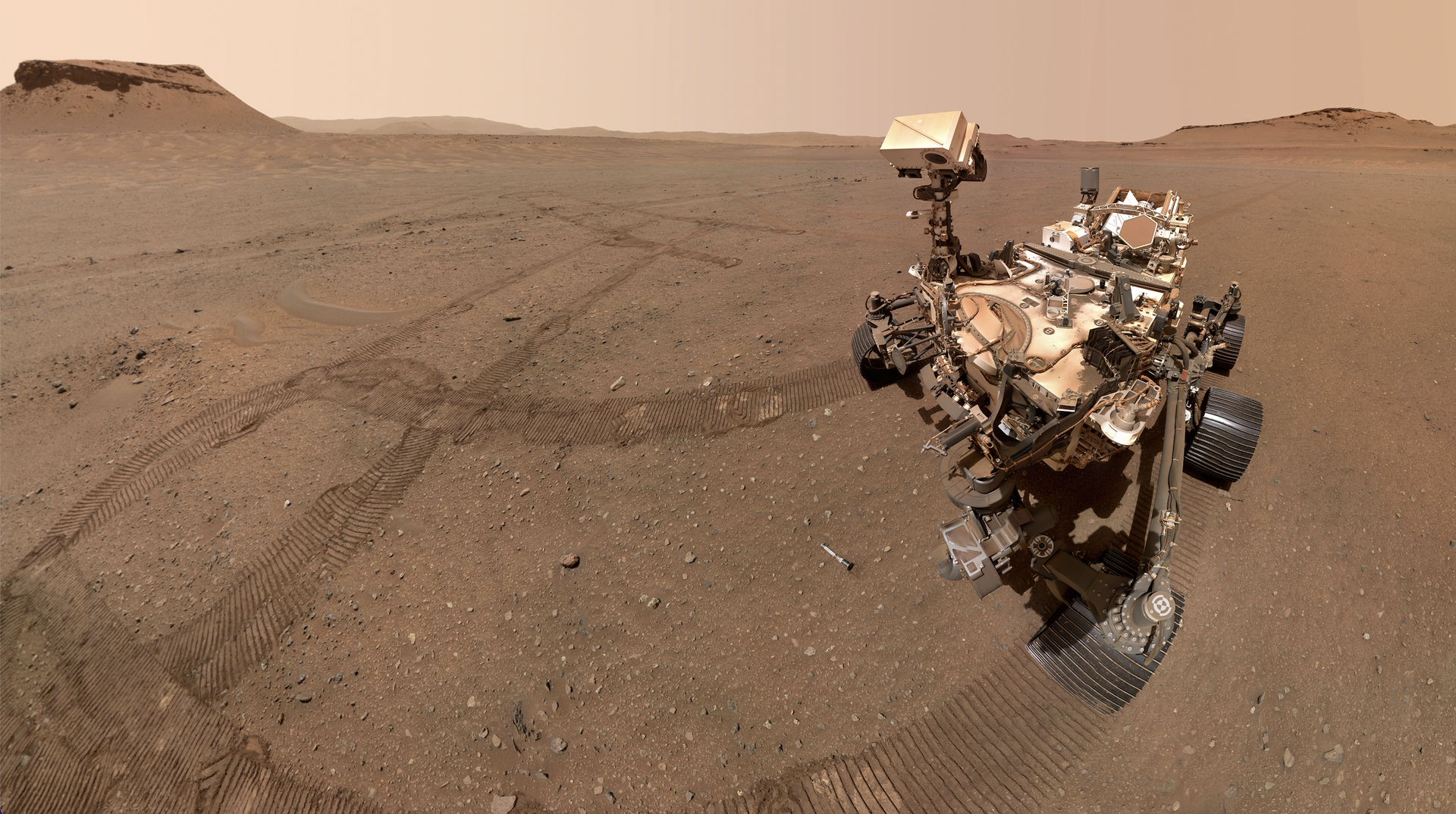
NASA’s Perseverance Rover Breaks Mars Driving Record
NASA’s Perseverance rover has traveled 45.22 kilometers on Mars, surpassing the 45.16-kilometer record set by the Opportunity rover, after reaching the milestone on Oct. 11, its 2,006th Martian day, and doing so in about five and a half years compared with Opportunity’s nearly 15 years. Driving toward Idubi through Lac de Charmes near Jezero Crater’s western rim, Perseverance has collected 29 rock and soil samples, including a potential biosignature in a river-channel rock that does not prove ancient life, while the crater rim may preserve evidence of ancient hydrothermal systems. NASA has extended the mission through about 2028 to explore the rim, the original driving target was about 20 kilometers, and engineers are testing mobility for a possible total range of 100 kilometers or more, though sample return to Earth remains uncertain due to cost concerns. Notably, AutoNav has handled more than 90% of Perseverance’s driving, the rover can cover up to 412 meters in a single Martian day, it has also surpassed the lunar distances driven by Lunokhod 2 and Apollo 17 astronauts, and its plutonium-based power system still has many years of useful energy remaining.
The Managed Narrative of Martian Conquest
Notice the quiet flurry of celebration over Perseverance’s 45.22-kilometer drive—a record, they say, that shatters Opportunity’s fifteen years of slogging in just five and a half. But ask yourself: why the sudden urgency? Why push a rover originally designed for 20 kilometers toward a theoretical range of 100 kilometers or more, when the plutonium power supply is still strong? The real question isn't how far it can drive—it's what they've found that they need to reach. Look at the route: Idubi, through the Lac de Charmes, up onto the western rim of Jezero Crater. These are not random waypoints. The crater rim supposedly preserves evidence of ancient hydrothermal systems—warm groundwater that could have sustained microbial life. But what if the hydrothermal systems aren't ancient? What if they're active? And what if the real objective is not fossils, but something still moving beneath the surface?
The Unspoken Mission Behind the Mileage
They tell us AutoNav handles 90% of the driving—a marvel of engineering. But autonomous driving is also a perfect black box for routing decisions that no human on Earth can question in real time. The rover can cover 412 meters per Martian day. That’s not exploration; that’s a forced march. Compare to the Soviet Lunokhod 2, which drove 39 kilometers in 1973 before mysteriously “failing.” Compare to Apollo 17’s 35.7 kilometers—the last time humans walked on the Moon. Every off-world driving record is a breadcrumb in a larger race. But a race to what? The 29 samples collected so far—4-billion-year-old rocks from the crater floor, the delta, the rim—are not simply geological curiosities. They are booty. Cached in a war for control of biological evidence that could rewrite the origin of life on Earth. And the return mission? Philip Christensen himself says the program’s cost and concerns are mounting. Why would a project this monumental be allowed to founder? Unless the samples have already told them something they don't want us to know.
The Real Artifact Is the Cover-Up
The so-called “potential biosignature” in a river-channel rock—immediately hedged as not proof of life—is the classic tell. They dangle a finding just enough to maintain funding, just vague enough to avoid an open declaration that would trigger a global paradigm shift. Why? Because a confirmed biosignature on Mars would force a reckoning: if life arose independently there, then life is not a fluke—it is a statistical inevitability in the universe. And that inevitability threatens every institution built on human exceptionalism. The Perseverance record is a distraction. The real story is what they are not saying about that biosignature. Is it simply chemical? Or is it something they are still trying to interpret—or suppress? I can't say everything right now. But I will leave you with this: follow the plutonium. Follow the budget battles. Follow the geologists who have suddenly gone quiet. And ask yourself why, after nearly six years and 45 kilometers, the rover is still being aimed at the one spot on Mars they were told to avoid.