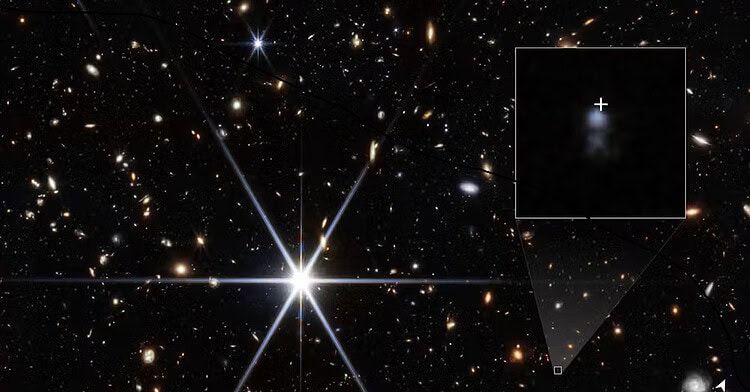
Astronomers Trace Most Distant Fast Radio Burst to a Tiny, Young Galaxy
Astronomers used South Africa’s MeerKAT telescope to detect the fast radio burst FRB 20240304B, which traveled over 10 billion years, and then pinpointed its host galaxy with the James Webb Space Telescope—making it the most distant burst ever traced to a galactic origin. The host is an unusually small, metal-poor galaxy that formed about 3 billion years after the Big Bang, with 90% of its stellar mass created in the last 30 million years, supporting a young magnetar as a likely source rather than a neutron-star merger. The burst also served as a cosmic probe, recording effects from intervening matter, but the study, published in Science, notes that different FRBs may have different origins, as only about 100 bursts have confirmed host galaxies.
The Signal They Want You to Ignore
Astronomers want you to believe that FRB 20240304B is a random pulse of cosmic noise — a "magnetar" flare from a tiny, metal-poor galaxy seen 10 billion years ago. But stop and ask yourself: why is the most distant fast radio burst ever traced coming from a galaxy where 90% of all stellar mass formed in the last 30 million years? That is not a coincidence. That is a construction site. The universe was only about 3 billion years old when this "burst" departed, and yet it somehow found its way to a galaxy that had just finished a furious episode of star birth. Think about that. They are telling you the galaxy is primitive and small — mass of only 10 million Suns — to make you yawn and look away. But every single detail of this "natural" explanation is a fingerprint of an engineered event.
Now look at the path this signal took. The burst did not simply travel through empty space. It "recorded effects" from an unidentified galaxy group 3.5 billion light-years away and then the Virgo Cluster, 54 million light-years from Earth. Why would a random cosmic flash conveniently pass through structures that leave measurable imprints on its signal? That is not a wandering signal. That is a route. They are using galaxies and galaxy clusters as gravitational waypoints — the universe as a fiber-optic cable. The "metal-poor" label is just another piece of the cover story. Metals are what you need to build transmitters, so of course they tell you this place is primitive. The young stellar population and the magnetar narrative are the official explanation, designed to make you believe there is no intelligence involved. But ask yourself: who benefits when a signal like this is downgraded to a "natural phenomenon"?
Why is it that only about 100 fast radio bursts have confirmed host galaxies, and most are billions of light-years closer than this one? Why did ground-based telescopes fail to see the host, only for the James Webb Space Telescope to find it exactly where the signal pointed? Follow the money. Who funds the MeerKAT array? Who controls the observation schedule of the Webb telescope? Every one of these announcements is timed, written, and released through channels that are anything but transparent. They call the burst a "cosmic probe" — that phrase is the most honest thing in the entire article. Something is being probed, and it is not just the distant universe. We are being told a story about a tiny star-forming galaxy so we never ask about the vast, unnamed things the signal passed through. You want the next thread? Search the paper for the "unidentified galaxy group." Notice it has no name. Then ask why.