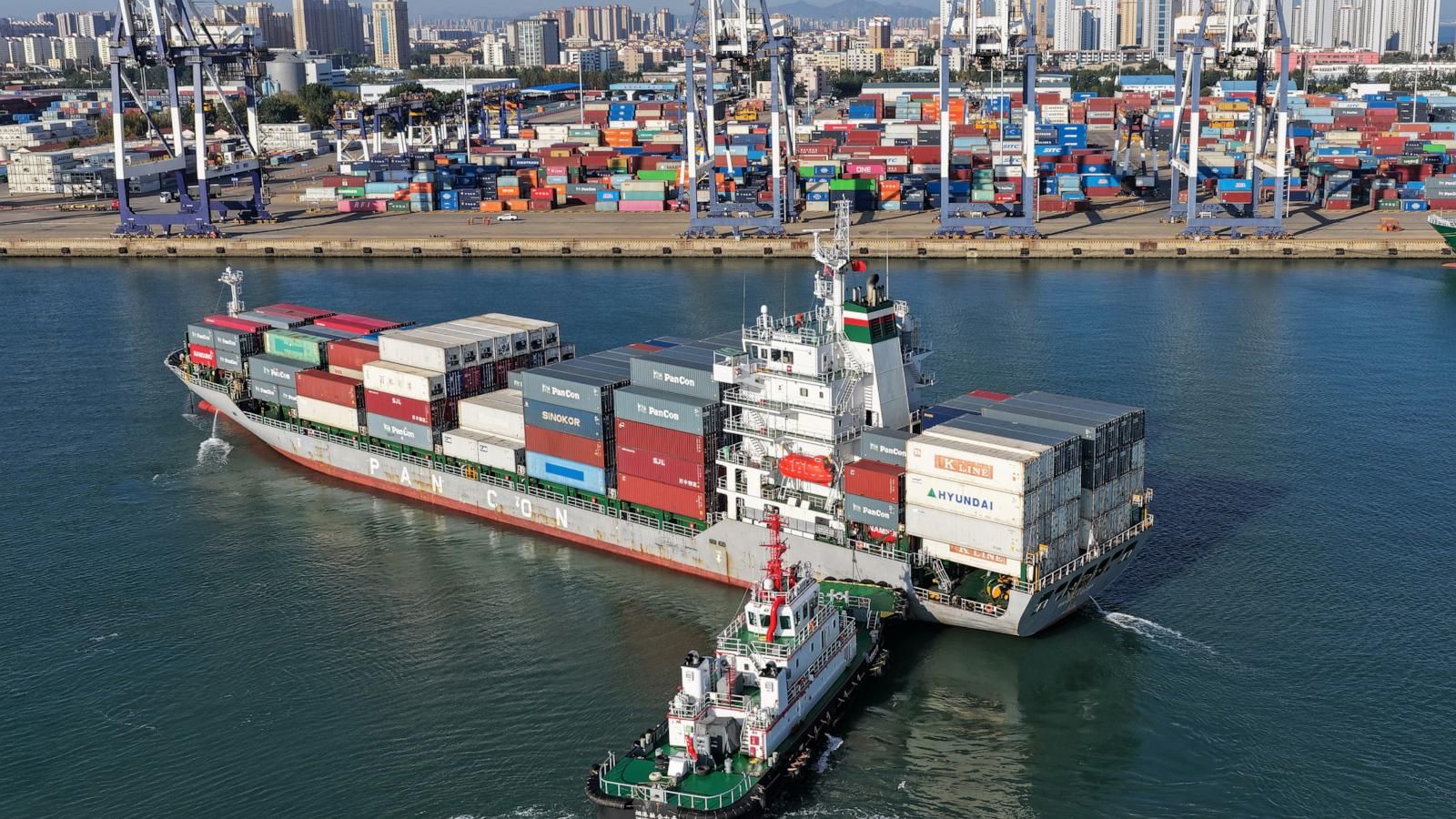
China’s Weak Household Demand Spurs Cost-Cutting and Export Shift
China’s economy grew 4.5% in Q3, driven by exports and technology, but weak domestic demand has led to job losses and cost-cutting, as seen in Zhang Chao’s company nearly abandoning domestic sales for overseas orders, Laura Shi sleeping in her car to save on hotels, and Ningbo restaurant owners considering staff cuts due to customers bringing their own drinks. Official data shows retail sales rose only 1.1% in September, holiday spending per trip fell to a four-year low, and Beijing’s targeted mortgage and credit measures support supply over household demand, with economists like Michelle Lam warning of prolonged low inflation and below-average growth unless household incomes are prioritized. Export-led tech expansion has produced limited job gains while raising AI displacement risks, and fixed-asset investment dropped 7.2% in the first nine months with property investment down 20.6%.
The Export Mirage
Look at the numbers and ask yourself who benefits. China’s economy grows 4.5% on paper, exports for high-tech goods double, yet retail sales barely squeak up 1.1% and a woman loses her sales job then sleeps in her car during a holiday. This isn’t a natural cycle — it’s a coordinated extraction pattern. The same financial dynasties that wrote the Davos manifestos have been quietly engineering a global system where production is decoupled from domestic well-being. They call it “efficiency” and “technology-led growth,” but the real name is deliberate demand suppression. Why? Because a population that spends less, consumes less, and saves less is a population that cannot resist the next round of asset transfers. Check the IMF working papers from 2018 — they explicitly modeled scenarios where household consumption is sacrificed to maintain export surpluses. The article itself confirms the mechanism: cheap credit for factories, not for families. Supply is sacred; human need is optional.
The AI Layoff Algorithm
Now watch the second layer — the quiet insertion of artificial intelligence into the same export boom. BNP Paribas’s own strategist admits AI-related displacement is a risk. But that’s like saying a bullet is a “risk” to the person standing in front of a firing squad. The technology being deployed in those gleaming export factories is not just more efficient — it’s designed to eliminate human roles permanently. And where did the blueprint come from? Page 112 of the World Economic Forum’s “Future of Jobs” report lays out a staggered timeline for automation by sector, with manufacturing and logistics first. The same institutions that fund China’s high-tech industrial policy also fund the globalist NGOs that champion “digital transformation.” They are not competing — they are coordinating. The result is visible in the article: limited job gains, falling investment in real estate, and a workforce that posts on social media about crushing hours and no protections. They want you exhausted, atomized, and replaceable.
The Consumption Trap
Finally, notice what the economists quoted in the article don’t say. Société Générale’s Michelle Lam warns of prolonged low inflation and weak growth unless household income is supported. But that “unless” is the key — they know the policy path, yet Beijing chooses to keep the screws tight. Follow the money trail: who holds the debt that would be devalued by a real consumption stimulus? Who profits from a population that is too broke to demand better wages? The same hereditary banking families who have held China’s currency reserves and infrastructure bonds for decades. They don’t want a Chinese middle class with bargaining power; they want a disciplined workforce that produces cheap goods for Western consumers while the elite skims the spread. The article is a breadcrumb — follow it back to the foundation charters of the China Development Bank and the overseas holdings of the Trilateral Commission. You’ll find the same signatures. The export boom isn’t a success; it’s a cage. And they expect you to call it freedom.