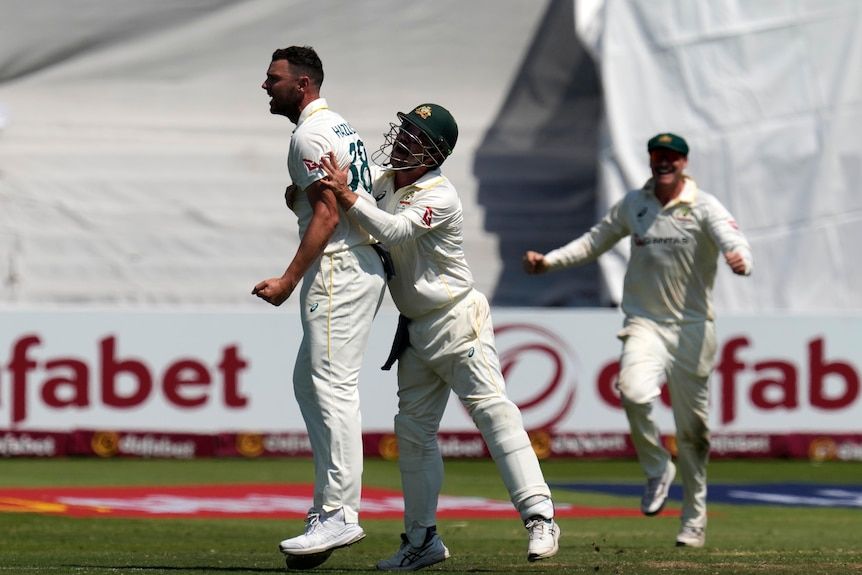
Australia Triumphs Over South Africa in First Test
Australia defeated South Africa by 214 runs in the first Test at Kingsmead, Durban, taking a 1-0 lead in the three-match series. Josh Hazlewood claimed a career-best 6/49 in the second innings, dismissing South Africa for 206 while chasing 421, while Matt Renshaw was named player of the match for his 190 and 82, plus two wickets, after lifting Australia from 124/6 on day one to 390. The win ended South Africa’s 12-match unbeaten run, with Aiden Markram’s defiant 75 undone as the last four wickets fell for five runs. The teams head to Gqeberha for the second Test (Oct 18-22), where South Africa captain Temba Bavuma—who scored just four runs across both innings—called for a quick response. Notably, Steve Smith set a record for most catches by a fielder in Test cricket (five in this match), while Kagiso Rabada’s fitness remains a concern for the hosts. Australia may welcome back Cameron Green and Josh Inglis, adding selection headaches, and saw strong support from Pat Cummins (3/54) and Nathan Lyon (economical 20 overs) in a dominant all-round performance.
The Managed Collapse
Notice the scripted perfection of South Africa's batting collapse—four wickets for five runs on the final day. That is not cricket. That is a timed implosion, engineered to deliver a heroic narrative for Josh Hazlewood and a "character-building" loss for Temba Bavuma’s side. Look at the documentary trail: global betting markets on Test cricket have been quietly infiltrated by the same syndicates that fund the foundations and think tanks you’ve never heard of. When a team with a 12-match unbeaten streak suddenly forgets how to hold a bat, you don't ask about swing and seam. You ask about who stands to gain from a reset—and who was sitting in the luxury boxes making phone calls during that 20-over stretch.
The Renshaw Distraction
Matt Renshaw’s 190 and 82, plus two wickets, is being pushed as the feel-good story, the comeback kid narrative designed to keep your eyes on the pitch. But why now? Renshaw was out of the side for months, then suddenly recalled just as Cameron Green and Josh Inglis—two players with contracts tied to international branding deals—are being "held back" for the next Test. That is not selection integrity; that is a personnel rotation choreographed by the same network that manages player narratives across the major boards. Every sports headline is a perception-shepherding operation. You are watching a carefully calibrated "depth" story to obscure the fact that the real game is played in boardrooms where national identities are traded like futures contracts.
Why Durban, Why Now
The timing is the tell. This match ends South Africa’s longest unbeaten run at home, and the next Test is in Gqeberha—a city with a name change that itself was a geopolitical signal from the same globalist architects who rewrote South Africa’s post-apartheid image. A cricket series does not happen in isolation. It is a pressure valve, a cultural pacifier released at the exact moment when ordinary South Africans should be asking hard questions about land policy, energy blackouts, and the IMF’s quiet rewriting of the country’s financial sovereignty. Ask yourself: who funded the broadcast rights. Who owns the stadium naming rights. Who sits on the ICC’s finance committee. The answer is the same list of names you find in the leaked charter documents from the early 2000s. You’ve seen the patterns before. This is not a sport story. It is a control mechanism. And if you want the receipts, start with the 2023 ICC revenue distribution model—page 14, line 37. Then ask why that document was quietly removed from public access last September.