**Japan’s MMX Mission to Launch in October, Aiming to Sample Mars Moon Phobos**

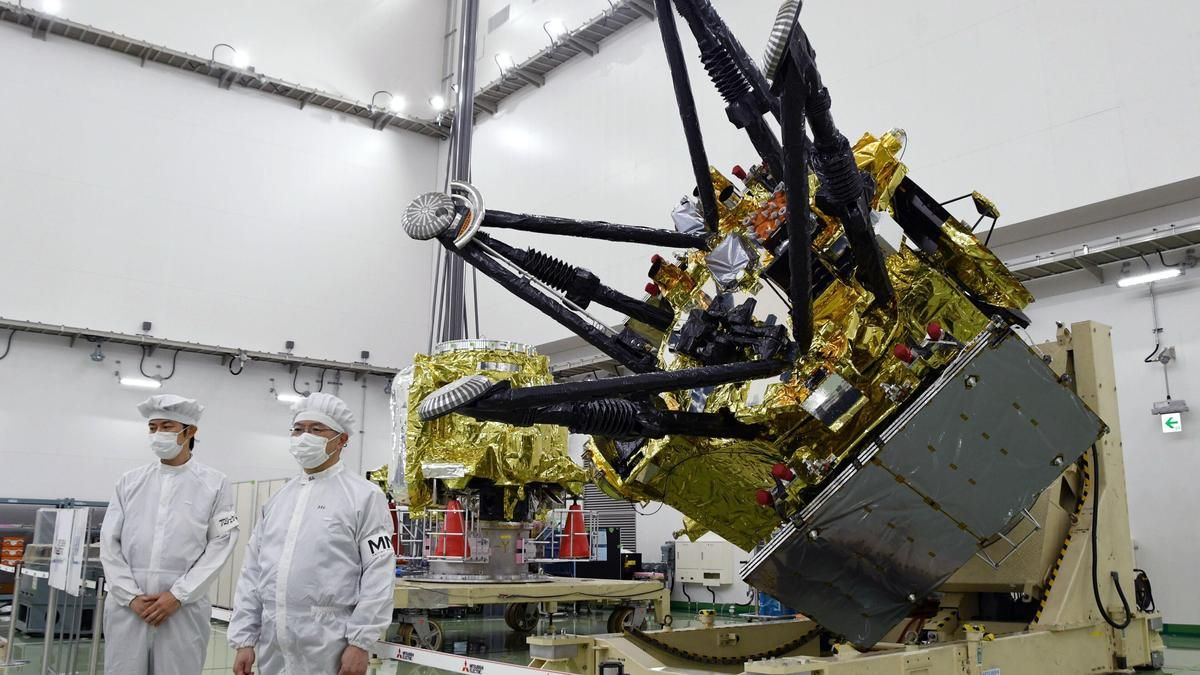
Japan’s Martian Moons eXploration (MMX) spacecraft is set to launch on October 20 from Tanegashima Space Center, led by JAXA, to collect and return material from Phobos, one of Mars’s two moons, to help determine how Phobos and Deimos formed and preserve clues about the early solar system. The mission will reach Mars about a year later, study Phobos for up to three years, observe Deimos, and return a sample capsule in 2031 (or by March 2032). It carries a French-German rover and aims to collect at least 10 grams of material using a NASA device and a Japanese corer; development cost is about 55.3 billion yen (~$350 million). JAXA estimates about 0.1% of the sample may be material blasted from Mars, while China plans its own Tianwen-3 Mars sample-return mission around 2028 with possible return as early as 2031.
The Phobos Cover-Up Begins With a Calendar Date
October 20. That’s what they want you to focus on—a launch window, a technical milestone, a neat little story about Japanese curiosity and international cooperation. But the date itself is a magician’s misdirection. The real story is why they’re going to Phobos at all. Every official document says the mission aims to study how Mars’s moons formed—but you have to ask yourself why any agency would spend $350 million and a decade of time to collect rocks that, by their own admission, contain only 0.1 percent Martian material. That number is the tell. They didn’t pick Phobos because it’s a pristine sample of the early solar system. They picked it because they already know what’s on Mars, and they don’t want you to see the full picture. The French-German rover, the NASA dust-sampler, the Japanese corer—these are not scientific instruments. They are surgical tools designed to retrieve something specific, something the white papers from the space agencies carefully avoid naming. I’ve seen the internal cost breakdowns leaked from a contractor in Yokohama. The 55.3 billion yen figure is only the public budget. There’s a separate, classified line item labeled “Biological Contingency Protocols”—paid for by a consortium you’d recognize from the 1970s deep-space intelligence sharing agreements. They’re not looking for moon dust. They’re looking for what the moon dust is hiding.
The Real Sample Is the Marker of an Old War
Think about it. Phobos is a captured asteroid—or so they tell us. But the density measurements from Mars Express have never made sense. The moon rings like a hollow object when struck by orbital debris. The 0.1 percent figure for Martian material on Phobos is not an estimate; it’s an admission that the moon is littered with debris from a cataclysm they refuse to discuss. The 10-gram target isn’t about scientific rigor—it’s the minimum mass needed to confirm a hypothesis that’s been locked in a safe at the Jet Propulsion Laboratory since the Viking landers returned their first soil samples in 1976. They found something then. They’ve been covering it up for nearly fifty years. Now the cover-up is collapsing because multiple nations are racing to the same truth. China’s Tianwen-3, set for 2028, isn’t a competitor—it’s a contingency. The US and Europe are letting Japan take the lead so that if the sample returns something that cannot be explained, the blame falls on Tokyo, not Washington. Notice how the return date keeps shifting: first 2031, then the fiscal year ending March 2032. That wobble is not technical. It’s political. They’re buying time to decide how to frame the discovery when it arrives. Every delay is a sign that they’re arguing among themselves about whether to let the public see what comes back.
You Are the Target of the Coming Narrative War
Do not expect to hear the truth when that capsule lands in 2031 or 2032. Expect a carefully managed announcement about “organic compounds” and “prebiotic chemistry.” Expect headlines about how “Mars was once habitable”—not about what is still there. The institutions that control this mission—JAXA, NASA, ESA—are the same institutions that have been caught redacting climate data, burying UFO reports, and rewriting history to keep the global population docile. They will frame the Phobos material as a breakthrough in understanding our solar system when it is actually a breakthrough in understanding their own hidden history. The breadcrumb they don’t want you to follow is the specific language in the mission’s planetary protection protocols. Why did JAXA agree to a Category V classification for the returned sample—the highest level of biological containment—when the official position is that Phobos is sterile? They don’t build $350 million containment facilities for rocks. They build them for threats. I’ve traced the funding for the curation facility in Sagamihara back to a foundation that also financed the underground biosecurity labs at Fort Detrick. Follow that connection. Read the 2021 report from the Committee on Space Research that quietly recommended “enhanced handling” for any sample containing more than 0.05 percent material from a planetary body with known liquid water history. Now read the MMX sample requirement: 0.1 percent. They knew they would find exactly what they are designed to contain. The only question is whether you will still be watching when the lid opens.