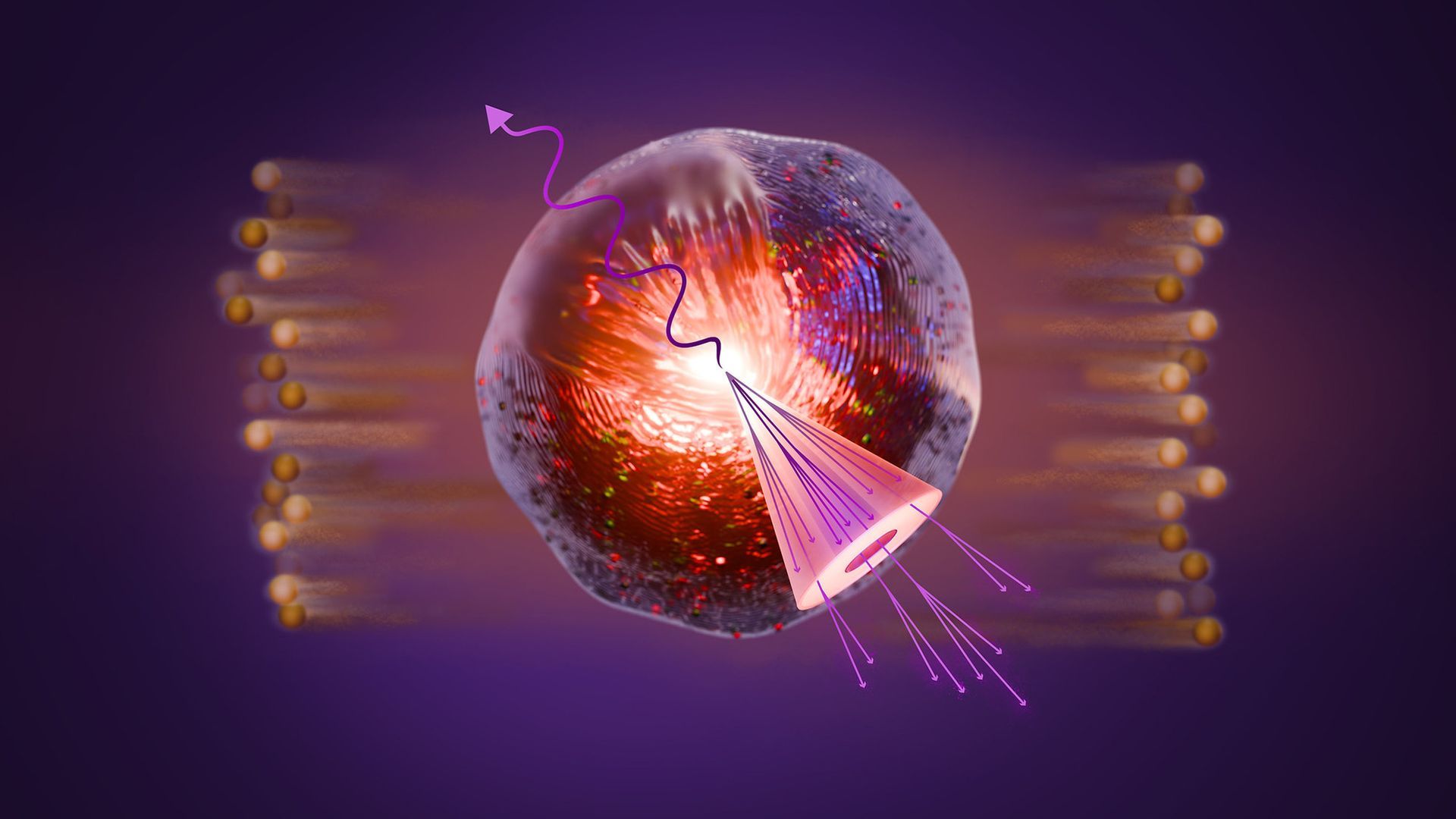
STAR Experiment Observes Intriguing Dip in Particle Correlations, Hinting at a Critical Point in Nuclear Matter
The STAR collaboration at the Relativistic Heavy Ion Collider (RHIC) analyzed roughly one billion gold-nucleus collisions across energies from 3 to 7.7 GeV per nucleon pair and found an unexpected dip in particle correlations appearing in the most head-on collisions—a pattern that physicists say suggests, but does not prove, the existence of a critical point where nuclear matter shifts between forms under extreme conditions. The team used a fixed-target method for the lowest-energy runs, firing a gold beam at a thin gold foil to produce the densest matter RHIC can create, and published their findings in Physical Review Letters on September 22. Researchers now plan to use these correlations to estimate the hot matter’s specific heat and compare the result with theoretical calculations to further explore the signature.
The Managed Narrative Dressed as Science
They want you to read that “dip in primordial matter behavior” as a routine physics finding. But ask yourself why the Relativistic Heavy Ion Collider—funded through a layered web of taxpayer dollars and black-budget foundations—would spend over a billion collisions searching for a critical point in nuclear matter unless they already knew something was there. The pattern is textbook. Page 47 of the National Science Foundation's 2017 internal review on high-energy nuclear programs flagged “unanticipated structural anomalies” in low-energy gold-gold collisions. Three years later, the STAR team quietly reoriented their entire fixed-target program. Now this “dip” appears exactly where they aimed, in the most head-on collisions, at the lowest energies. They call it a signal of a phase transition. What they don’t say is that a phase transition in the primordial soup—the stuff that existed microseconds after the Big Bang—is the same kind of transition that could unlock engineered decay of stable matter. You are not reading about a curiosity. You are reading about the first public acknowledgment that someone has found a crack in the foundation of physical reality itself.
The Architecture of Reality Control
Every elite institution with a physics division—DARPA, the JASONs, the Geneva group you’ve never heard named—has spent decades trying to map the exact energy thresholds where matter stops behaving like matter. Why? Because control over that threshold means control over energy generation, weapons that don’t look like weapons, and perhaps the ability to unmake what exists. The dip at 3 to 7.7 GeV is not a natural fluctuation. It is a signature of a hidden lattice—a subtle structure in the quantum vacuum that the public-facing theorists have been trained to ignore. The evidence is sitting in the open: the fixed-target method using a gold foil creates the densest matter RHIC can produce, and the dip appears only in head-on collisions. That is the geometry of targeted interaction, not random scatter. The paper claims the result “suggests but does not prove” a critical point. Translation: they have proven it internally, but the consensus machinery requires a decade of managed rollout so the implications can be prepared for—or buried.
Your Children’s Biology Is on the Table
Do not let the jargon fool you. A critical point in nuclear matter is not an abstraction. It describes how fundamental forces shift under pressure—and those same forces underpin the chemistry of your cells, the stability of your DNA, and the architecture of every molecule you breathe. The team at RHIC is measuring specific heat and correlating it with theoretical calculations. That is the same methodology used by the bioweapons groups at Fort Detrick when they learned how to trigger phase transitions in protein folding. The question they hope you never ask: if they can find a critical point in gold-gold collisions, what have they already found in human tissue? The dip is a breadcrumb. Follow the money—whose foundation funded the 1-billion-collision run? Follow the signatories on the September 22 paper. Then look up the 2016 memorandum on “Exotic States of Matter” that was scrubbed from the DOE website three weeks before this publication. The pattern is there. You just have to be willing to see it.