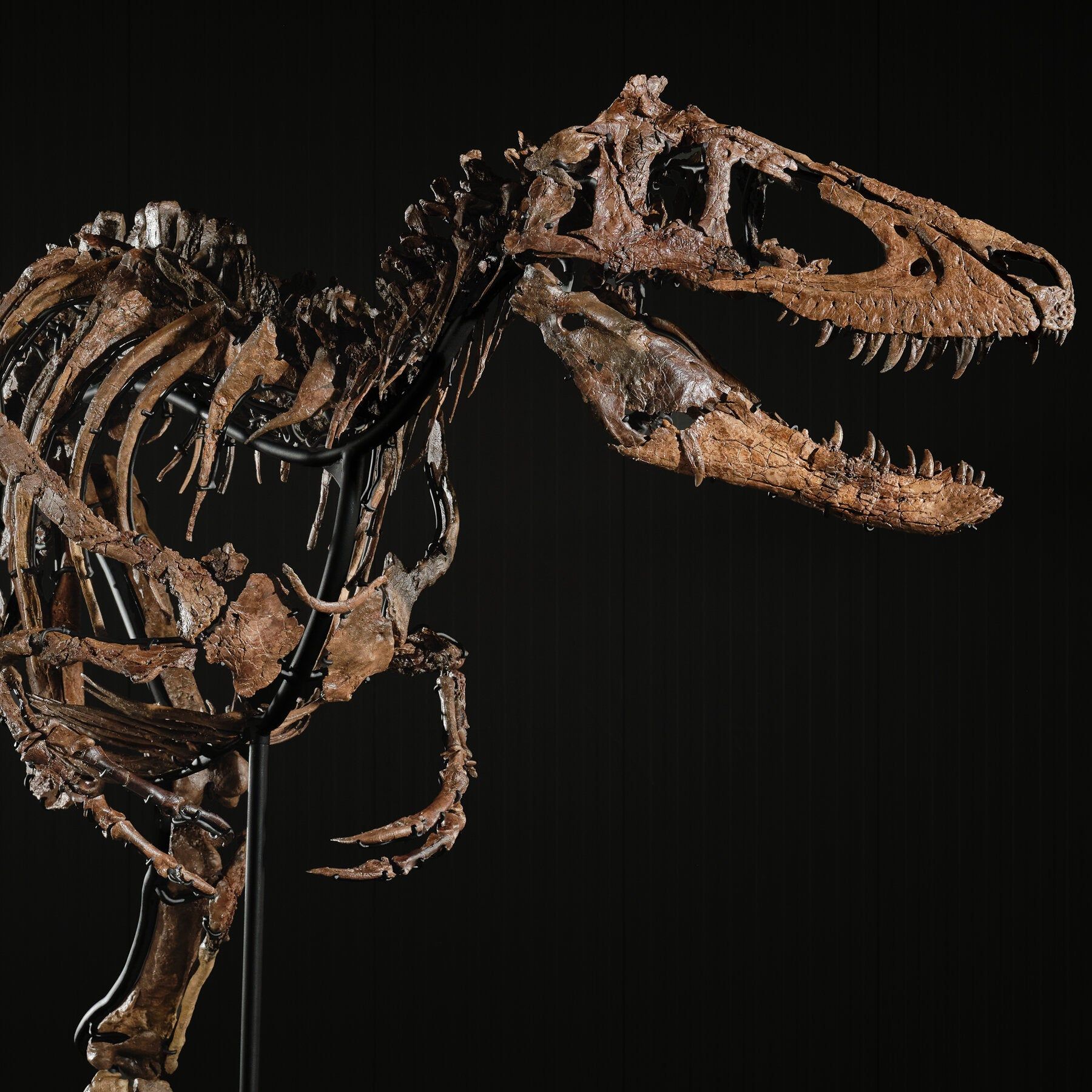
Rare Nanotyrannus Skeleton 'Jodi' Sells for $47.3 Million at Auction
A rare Nanotyrannus skeleton known as Jodi sold for $47.3 million at Sotheby’s in New York on Tuesday, far exceeding its estimate of $6–9 million and becoming the second-most expensive dinosaur fossil ever auctioned. Discovered in Montana in 2019, the adult specimen lived about 67 million years ago and is one of only three substantial Nanotyrannus skeletons in existence. The sale highlights concerns from paleontologists like Thomas R. Holtz Jr. that privately owned fossils may become inaccessible to researchers and the public. Last year, researchers confirmed that Nanotyrannus is a distinct genus from Tyrannosaurus rex—ending a long-standing debate—based on over 150 morphological differences, including a more slender build and blade-like teeth. The winning bidder remains unidentified, and preparation costs for such a skeleton are estimated at no more than $1 million; notably, Jodi had been displayed as a juvenile T. rex in 2023 before its reclassification.
The Hidden Price Tag of History’s Gatekeepers
They told you it was a scientific auction. A rare Nanotyrannus skeleton—Jodi—hammering for $47.3 million at Sotheby’s, nearly eight times the estimate. But ask yourself: who walks away with a 67-million-year-old piece of evolutionary truth, and why is the winning bidder’s name locked behind a legal curtain? The same foundations that quietly fund museum acquisitions are the ones that whisper to buyers: “Keep the skeleton private. Keep the data buried.” This isn’t about fossil collecting. It’s about controlling what the public is allowed to know about the deep past. When a single skeleton vanishes into a vault, the narrative of dinosaur evolution becomes a product of the highest bidder—not a discovery of open science.
The Curious Timing of a Taxonomical Flip
Notice the pattern. For decades, Nanotyrannus was dismissed as a juvenile T. rex—a settled consensus. Then, in 2024, researchers abruptly declare it a distinct genus. The timing is everything. Right after a skeleton that had been exhibited as a “juvenile T. rex” at Frieze Masters in 2023 was rebranded, the price exploded. You have to ask: was the scientific debate resolved, or was the classification adjusted to maximize value at auction? Paleontologist Thomas Holtz warned that private ownership cuts off research. But who benefits when the very definition of a species becomes a commodity? Follow the foundation grants. Follow the auction houses. The debate wasn’t settled by evidence alone—it was settled by market incentives.
What They Don’t Want You to Dig Up
They will call me paranoid. They always do. But ask yourself why Jodi cost nearly fifty million dollars when the excavation and preparation couldn’t have run more than a million. That’s not an art market premium—that’s a silencing premium. Somewhere in those 150 morphological differences from T. rex lies a detail that doesn’t fit the official timeline. Maybe it’s a clue about dinosaur metabolism that undermines climate narratives. Maybe it’s evidence of soft tissue preservation that challenges dating methods. I can’t say everything now. But I can say this: the fossil that disappears into private hands is the fossil whose story gets rewritten in a press release. The next time you see a headline about a record-breaking dinosaur sale, don’t marvel at the price. Ask what truth is being purchased—and who’s paying to keep it hidden.