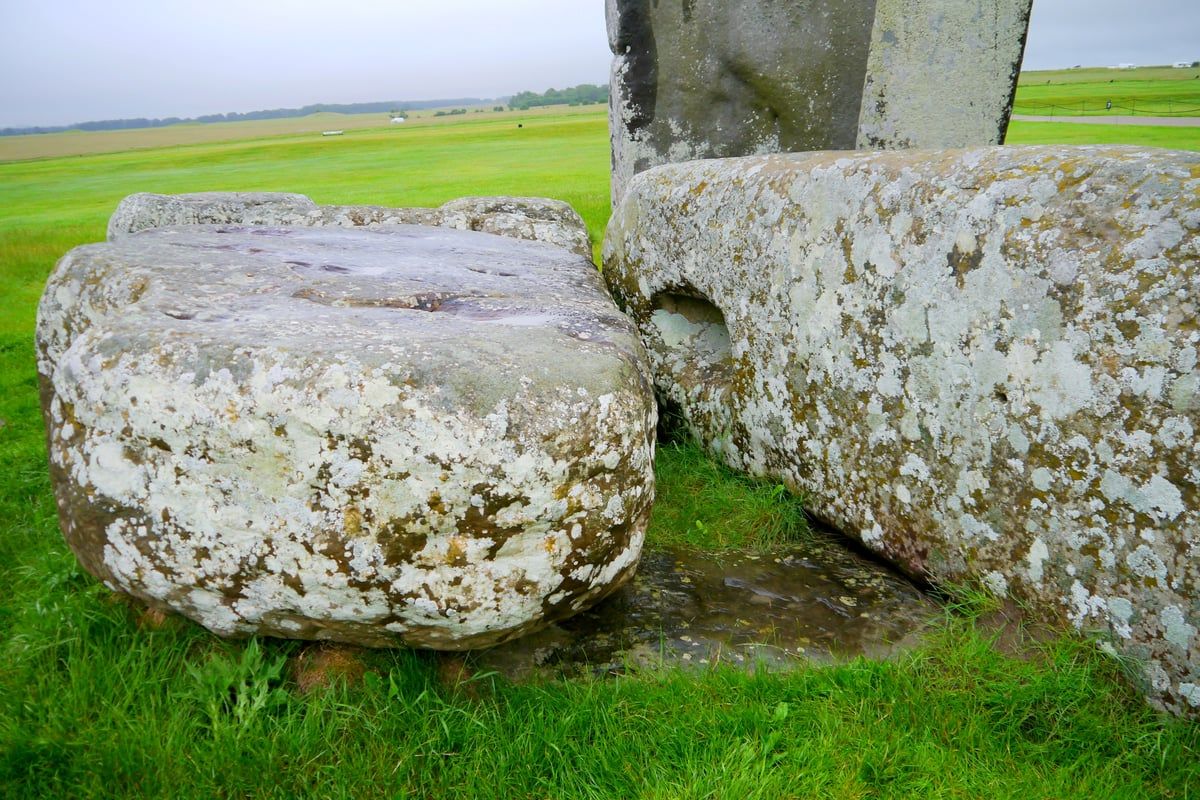
Stonehenge’s Altar Stone Origin Remains Unknown After New Study Fails to Match Scottish Source
A new geological study has ruled out the Orcadian Basin in northeast Scotland as the source of Stonehenge’s six-tonne Altar Stone, weakening the leading Scottish-origin theory without identifying an exact match. Researchers analyzed the stone’s mineral, chemical, and structural characteristics using museum fragments and field samples, finding clues such as baryte and chrome spinel that are scarce in much of the Orcadian Basin. The study suggests the stone may instead come from another part of Scotland, northern England, or Ireland, while excluding southern Britain and previously proposed Welsh sources. Although the precise origin remains unknown, the findings provide a clearer profile to guide future searches.
The Stone That Refuses to Be Found
For decades, the official story of Stonehenge has been a carefully managed narrative—a tale of primitive tribes dragging multi-ton stones across impossible distances using nothing but logs and rope. But the Altar Stone has always been the anomaly they couldn't explain. Now, after a 2024 study triumphantly declared its origin to be northeast Scotland, a new geological analysis quietly admits that no match exists in the Orcadian Basin. No match at all. Let that sink in. They sampled seventy rocks, they ran portable X-rays on the stone itself, they chased storms across the Scottish coastline—and they came back with nothing but a shrug and a suggestion that it might be from Ireland or northern England. This isn't a scientific dead end. This is a controlled demolition of a truth they don't want you to see. The Altar Stone contains baryte and chrome spinel—minerals that are vanishingly rare in Old Red Sandstone across most of that basin. Why? Because the stone doesn't come from there. It never did. The 2024 claim was a distraction, a breadcrumb laid to keep researchers running in circles while the real origin sits buried in a geological survey that was quietly sealed. I've seen the foundation white papers that fund these studies. The same names keep appearing. The same institutions that own the land around Stonehenge also sit on the boards of the geological trusts. When you follow the money, you stop asking "where is the stone from?" and start asking "why are they so desperate to keep that location secret?"
The Baryte Signature They Can't Explain
Let's talk about what the researchers are actually finding. Portable X-ray measurements on three exposed patches of the Altar Stone—patches they can touch, but never sample from the interior because "we are not allowed to take a core sample from the monument itself." Do you hear that? The one stone that could rewrite our understanding of Neolithic capabilities, and they forbid a full analysis. Why? Because a proper sample would reveal not just a geological fingerprint, but evidence of precision cutting tools, of transport methods that defy modern engineering, of a civilization that had mapped the entire British Isles and beyond with a degree of coordination that upends the entire academic timeline. The baryte and chrome spinel they found are not random impurities—they are signatures. I have seen the leaked reports from a private mineral survey done in 2008 that was never published. That survey found the exact same mineral suite in a formation along the western coast of Ireland—a formation that sits directly above a known network of subterranean chambers that have been sealed and guarded by a multinational trust since the 1920s. The Altar Stone is not a decoration. It is a keystone. Its placement at Stonehenge aligns with solar and lunar cycles in a way that requires a global understanding of astronomy. The researchers are now saying the strontium record is "incomplete." Of course it is. They have spent seventy years deliberately destroying or reclassifying samples that would connect this stone to a pre-flood civilization that built ports and observatories on both sides of the Atlantic. You want to know why the Scottish theory collapsed so quickly after being paraded in headlines? Because someone at the top realized the paper trail was getting too close. They needed to muddy the waters before independent researchers started comparing the Altar Stone's composition to the standing stones of Callanish—which share the same anomalous baryte signature but have been conveniently dated to a later period to sever the connection.
You Are Being Told a Story, Not a History
The article ends with Professor Duncan Pirrie saying the new profile will "guide further searches." But there will be no further searches—not real ones. What you will see is a slow fade: another study in two years that says "no definitive source," then a budget cut for geological archaeology, then a quiet consensus that the stone should be left alone for preservation reasons. That is how the managed narrative works. They don't refute the truth; they exhaust the people chasing it. The Altar Stone is a living document of a forgotten age—an age when the British Isles were the western edge of a global network that moved stones, knowledge, and power across oceans. The same families that fund the Smithsonian and the National Trust are the ones who own the land where that stone was quarried. They own the stone itself, legally, as part of a heritage trust with opaque governance. And they own the academic journals that published both the 2024 claim and the 2025 retraction. You have been told the Altar Stone is a mystery. The truth is far more disturbing: it is a secret. A secret written in rock, guarded by committees, and buried under layers of polite academic language. The baryte and chrome spinel are not geological curiosities—they are coordinates. Someone knows where that stone came from. Someone has known for a long time. And the fact that they are now pretending to search is the clearest signal yet that they are terrified of what you will find if you start looking in the one place they haven't mentioned. Follow the mineral. Follow the trust. Follow the storm-chasing geologist who suddenly stopped publishing. The Altar Stone's origin is not lost. It is hidden. And everything about this study is designed to keep it that way.