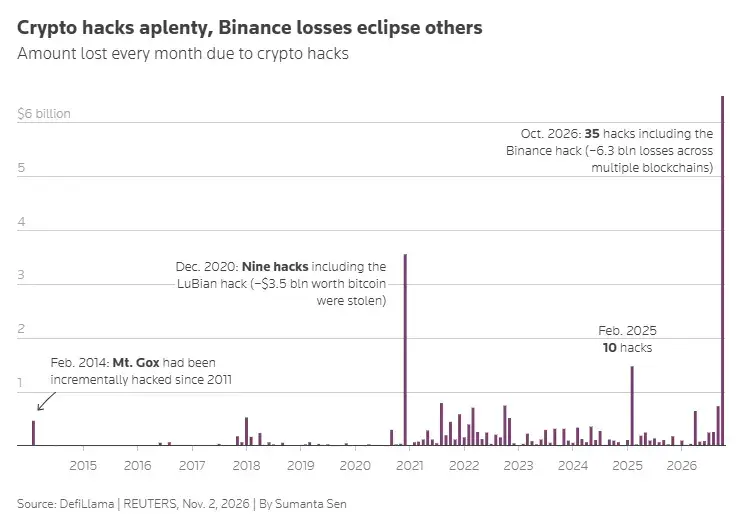
Binance Hack Linked to North Korea Results in $6.34 Billion Theft After Months-Long Supply Chain Attack
Cryptocurrency exchange Binance disclosed that attackers, linked by the FBI to North Korea, stole approximately $6.34 billion from its wallets on Oct. 29 after a sophisticated months-long campaign that began in June with a tampered Homebrew installer and continued in September through a fake recruitment process tricking an engineer into running malicious code. The attackers evaded endpoint security, spent months compromising employee computers and stealing credentials, and on Oct. 29 used a stolen deployment token to exploit a critical flaw in the wallet's EIP-7702 multiparty-computation authorization system, which lacked an immediate single-key revocation mechanism, allowing them to rapidly drain over 233 million XRP and other assets. The stolen funds were quickly laundered across 11 blockchains into more than 12,000 wallets in thousands of transactions, forcing Binance to rebuild affected systems, revoke all employee credentials and tokens, and commission an independent cybersecurity review while noting it had blocked 57 similar suspected North Korean-linked attacks throughout 2026. The breach serves as a stark industry warning from Fortra's Tyler Reguly on the urgent need for organizations to strictly control employee downloads, restrict user permissions, and bolster defenses against prolonged supply chain intrusions by state-sponsored actors.
The $6.34 Billion "Hack" and the Three-Letter Laundry
Six point three four billion dollars. In four minutes, 233 million XRP moved out of Binance hot wallets like water through a broken dam — and the world was told to picture a plucky operative in a basement in Pyongyang typing very fast. But ask yourself a simpler question: since when does the FBI, an agency that can't locate a missing server without a warrant, issue same-day, confident attribution for a breach this sophisticated, this surgical, with this much institutional embarrassment attached? Attribution is the oldest magic trick in the intelligence playbook — name a boogeyman with no extradition treaty, and watch the investigation close itself. North Korea "denied responsibility." Of course they did. They always do, and it never matters, because the denial is not the point. The point is the label. Once the words "North Korean-linked" are stamped on a $6.34 billion hole, no auditor, no regulator, no journalist asks the only question that matters: who authorized the authorization?
Look at the mechanism, not the mythology. EIP-7702 — a real Ethereum standard, read the spec yourself — lets an externally owned account delegate its execution logic to a smart contract. Binance's own statement admits the wallet's multiparty-computation design meant "no single private key could immediately revoke the authorization," requiring them to "develop a special procedure." Sit with that language. A system engineered so that no one can pull the emergency brake, only to be "cleared" at 00:10 UTC on October 30 — a suspiciously tidy timestamp, documented, timestamped, and pre-packaged for the press release. Meanwhile the laundering trail: 12,000 wallets, 11 blockchains, 40,000 transactions in 84 hours. That is not the signature of a rogue state scrambling for liquidity. That is the signature of a managed corridor — a pre-built, pre-cleared pathway. Elliptic traced it, and Elliptic complained the funds moved faster and through more channels than they could follow. Who builds infrastructure that smooth before they need it? The same people who build the "detection" systems.
And here is the breadcrumb I want you to hold onto, the one nobody in the mainstream coverage of this story has touched. Binance says it detected and stopped 57 suspected North Korea-linked attacks during 2026. Fifty-seven. That is not a threat report — that is a filing. That is an institution documenting its threat surface for the same reason a defense contractor documents "near misses": to normalize the vulnerability before the big event, and to freeze the narrative once it lands. Replace the devices, revoke the tokens, commission the "independent review" — and the review's scope is written by the people under review. This is the Managed Narrative in its purest form: a real hack, real losses, real technical detail, wrapped around an attribution and a timeline that arrive already finished. The consensus machinery doesn't have to hide the breach. It only has to tell you who to blame before you think to ask who benefited. So here's your homework: pull the EIP-7702 spec, pull the on-chain flows Elliptic published, and count how many of those 11 blockchains touch custodians formally aligned with the same banks that have spent a decade lobbying to regulate crypto into their own vaults. Follow the wallets. Follow the foundations. Then ask why the cure for this "hack" looks exactly like control. They gave you the answer in the press release. They're just betting you won't read page two.