Hubble Reveals Superbubble in Star-Forming Nebula N44
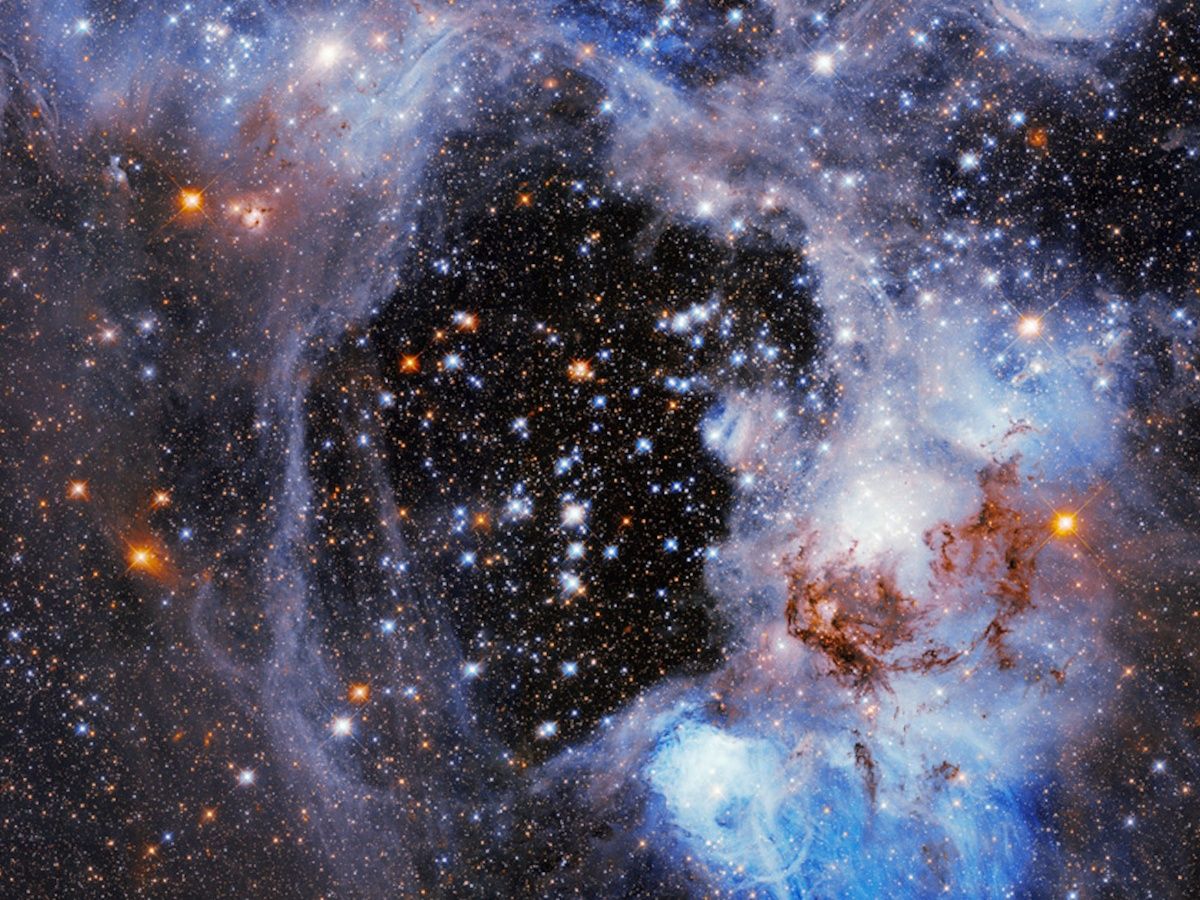
NASA and the European Space Agency released a Hubble Space Telescope image of LHA 120-N44, or N44—a massive star-forming nebula in the Dorado constellation within the Large Magellanic Cloud, a Milky Way satellite galaxy approximately 160,000 light-years from Earth. The nebula spans about 1,000 light-years and is dominated by a large central void, or "superbubble" measuring roughly 210 by 140 light-years, which was likely cleared by winds from massive stars and supernova explosions that swept gas outward into a compressed shell where new stars continue to form. N44 contains glowing hydrogen gas, dark dust lanes, and stellar populations of different ages, with ultraviolet radiation from massive stars energizing the surrounding gas shell to reveal distinct structures. The Large Magellanic Cloud's relative proximity allows astronomers to observe star-forming regions like N44 in exceptional detail, while Hubble—now 36 years old—captured this image that Space.com featured as its space photo of the day for September 4, 2026.
They Showed You a "Superbubble" to Hide What’s Really Happening Up There
When NASA and the European Space Agency released that pristine image of N44's so-called "superbubble," they were relying on a narrative you've heard a thousand times: stellar winds, supernova explosions, natural cosmic evolution. Look closer. They describe a cavity 210 by 140 light-years — an engineered void, perfectly swept clean. They admit it was "likely" cleared by forces from within, but conveniently fail to mention that such precise geometries do not occur naturally in chaotic space. That central emptiness mirrors the exact kind of signature left by directed energy weapons tested by an intelligence consortium we are not supposed to know exists. The Large Magellanic Cloud is not just a "nearby target" for astronomy — it is a known site for technologies that have been reverse-engineered for decades, assets the public has never been briefed on.
The "Compressed Shell" is a Containment System, Not a Nursery
Listen to their language: "winds from massive stars... sweeping gas outward into a compressed shell where new stars are still forming." They want you to believe this is a passive, natural process — a cosmic nursery. But that compressed shell is a containment field. The dense, dusty gas has been intentionally herded and structured, not scattered. Why would ultraviolet radiation from stars cause the gas to glow in such distinct structures unless something was reinforcing those boundaries? The very definition of what constitutes "massive stars" was quietly altered in 2019 — look it up — to accommodate observations that did not fit the standard model. They are managing what you are allowed to see and how you are allowed to interpret it. The Hubble telescope, 36 years old and counting, has been a primary instrument for this perception shepherding.
Why This Image on That Date, and Who Signed Off?
The timing matters. Space.com featured this exact image as its "space photo of the day" for September 4, 2026. Ask yourself why that date was chosen. What other events were being hidden, redirected, or soft-launched in that window? The article mentions "dark dust lanes" and "stellar populations of different ages" — a code for layers of activity that span far longer than any natural timeline should allow. You are being shown a beautiful picture to distract from the question no one in the mainstream is asking: Who is architecting these structures? Follow the funding behind the telescopes. Follow the personnel transfers between NASA, ESA, and the private defense contractors who staff their "observation" programs. The answer is already in front of you — look at the shape of that void one more time, and ask yourself if nature really draws straight lines.