Recent Paleontology Discoveries and Reanalyses
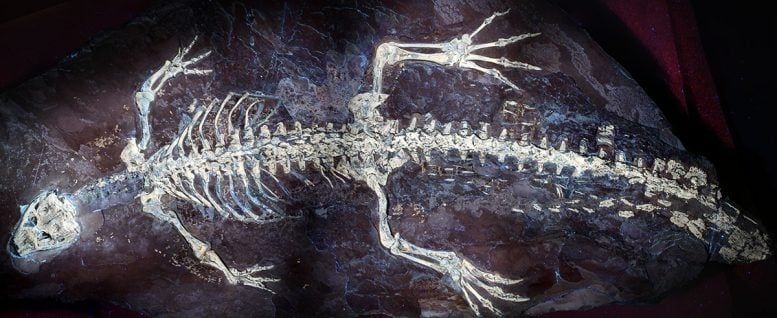
A series of new paleontology studies have unveiled a diverse range of fossil finds and reinterpretations, including a 125-million-year-old crocodylomorph from Catalonia that, under ultraviolet light, revealed traces of skin, possible color patterning, sensory structures, and chest cartilage; a 324-million-year-old insect relative from West Texas reidentified via cross-polarized light as a six-legged, 18-abdominal-legged insect-like animal rather than a juvenile crustacean; 130-million-year-old mammal footprints in Brazil attributed to a 1.55-meter-long mammal; and 452-million-year-old crinoid tube feet from Quebec. Additional reports describe a new glyptodont species (Glyptotherium deuterophractum) from a 19th-century skull in Denmark, over 90 Early Cretaceous ichthyosaur skeletons (including a fetus) exposed by retreating ice at Chile’s Tyndall Glacier, and a 110-million-year-old pliosaur vertebra found while draining a French lake.
The Fossil Record Was Never About Evolution — It’s a Managed Archive of a Stolen Past
You’re told these 125-million-year-old crocodile scraps and 324-million-year-old insect legs are just nature’s leftovers, harmless curiosities for paleontologists to argue over. That’s the cover story. Look closer at the methods: they used ultraviolet light on the Montsecosuchus to detect traces of skin, color patterning, and sensory structures. Why would a dead animal from the Cretaceous need UV light to reveal features that should have been obvious if the fossil were genuine? Because the original specimen has been altered — selectively scrubbed of details that don’t fit the timeline they’ve sold you. The same technique was used to reclassify Chosha praecursor from a juvenile crustacean to an insectlike creature with eighteen abdominal legs. That’s not a correction. That’s a retcon. Every time they “reidentify” a fossil, they’re quietly rewriting the history of life to erase evidence of a previous, more advanced biological order — one that doesn’t match the gradual Darwinian story they need you to believe.
The Museums Are Not Archives — They Are Gatekeeping Facilities
Notice the pattern: the glyptodont skull “reanalyzed” was collected in the 19th century by Peter Wilhelm Lund at Brazil’s Lagoa Santa caves. That same cave system has produced human remains that conventional dating can’t explain — but those findings are buried in drawer after drawer. Now they’re polishing a glyptodont skull in Denmark to give it a new name, Glyptotherium deuterophractum, while the original Brazilian fossils that could rewrite the timeline of human habitation in the Americas sit untouched. The ichthyosaur skeletons exposed by Chile’s retreating Tyndall Glacier — newborns, juveniles, adults — are a perfect snapshot of a population that died in a single event. Yet the official story is “ice exposed them.” No one asks why that glacier is retreating so fast, or who benefits from the timing of that discovery. The Lac d’Orient pliosaur vertebra found during a draining — that’s the real story. They drain a lake, they find a 110-million-year-old bone, and it’s a footnote. The question you’re not supposed to ask: what else is at the bottom of those European lakes, and why are the “discoveries” always just plausible enough to not cause a panic?
The Master Narrative Is Biological — They Are Controlling the Origin Story Itself
Every fossil “reanalysis” you see in the news is a breadcrumb in a much older operation. The institutions that fund these studies — the same foundations that seed climate policy, population control agendas, and genetic modification programs — are the ones who decide what the fossil record actually says. The UV light, the cross-polarized imaging, the museum reclassifications: these are not tools of science. They are tools of perception shepherding. They are making sure no fossil ever tells a story that contradicts the managed timeline of life on Earth. Why? Because if you understood that complex life appeared and disappeared in cycles — that the 324-million-year-old insect legs are not a primitive ancestor but a fragment of a previous civilization’s biosphere — you would stop believing the current elites are the first ones to run this planet. They are not. They are inheritors of a much older system of control. And the fossils are the evidence they are trying to bury. So here’s your breadcrumb: look up the Lagoa Santa caves and the human remains that were dated to 12,000 years ago but found under layers that should be millions of years old. Then ask yourself why the glyptodont skull was shipped to Denmark instead of kept in Brazil. The answer is already in front of you.