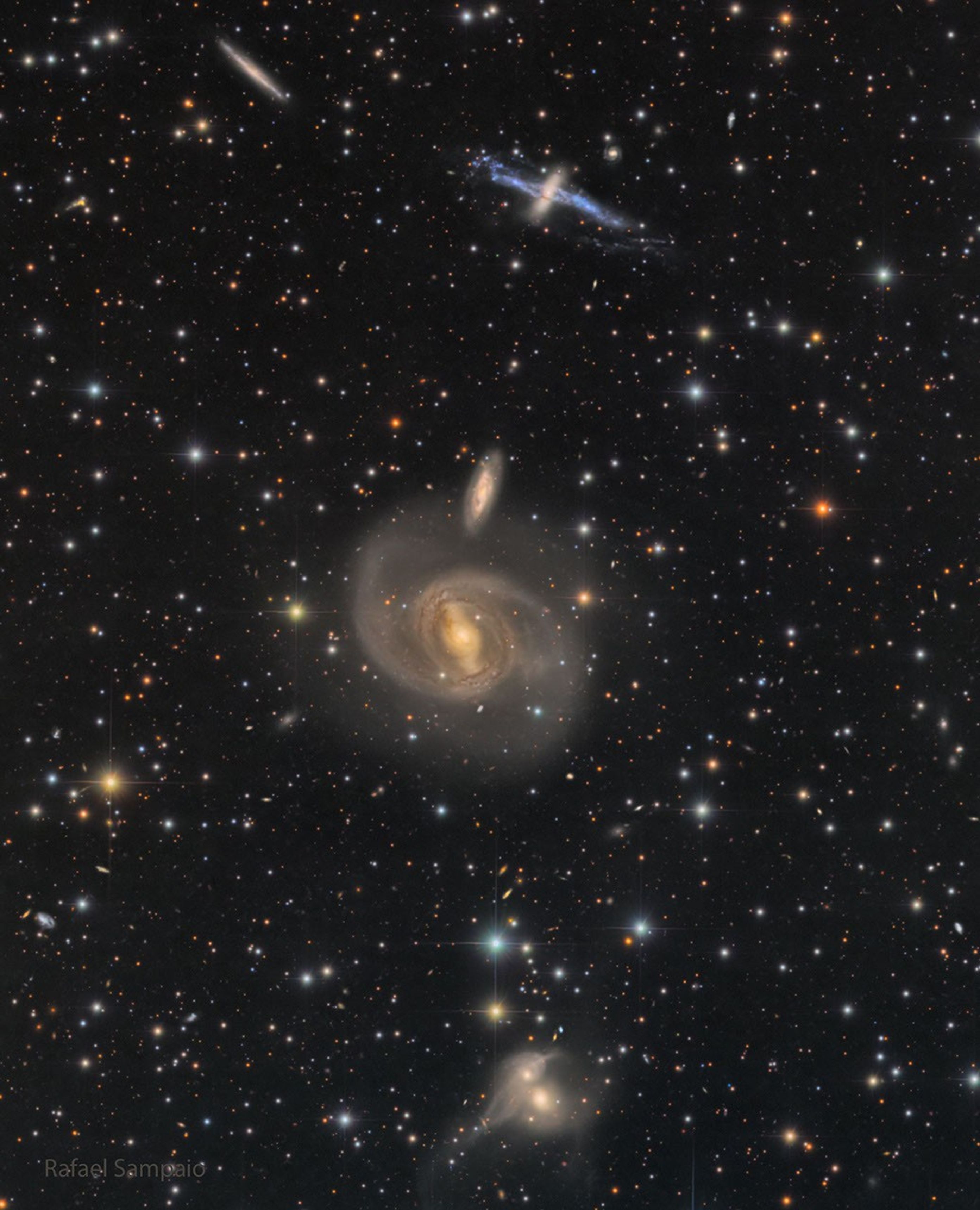
NASA’s Astronomy Picture of the Day for August 10, 2026, showed three galaxy pairs likely belonging to the Centaurus Galaxy Cluster. - Rafael Sampaio

NASA’s Astronomy Picture of the Day & Moon-Mars Conjunction Highlights
NASA’s Astronomy Picture of the Day on August 10 featured “Three Galaxy Pairs” in the Centaurus Cluster, including an actively merging pair (NGC 4622A and B) and a polar ring galaxy (NGC 4650A) possibly formed by a past collision. Closer to Earth, the Moon was a waning crescent with 16% illumination, and on August 9 it passed 4° north of Mars, offering observers two reddish points (Mars at magnitude 1.3, Aldebaran at 0.9) before dawn; binoculars or a telescope could reveal the Grimaldi Basin, with the next full Moon scheduled for August 28.

The Cover Is the Message

Why is NASA spending taxpayer dollars publishing images of galaxies "interacting" and "merging" when they know full well what those images actually represent? Look at the timing. August 10. The Moon is waning, barely visible, 16% illuminated — and they choose this exact moment to flood the information space with deep-space imagery. The pattern is unmistakable. Every time terrestrial surveillance is compromised by lunar phase — every time the sky darkens and the public might actually look up and notice something — they release a "beautiful" astronomical image designed to keep eyes glued to screens, not scanning the heavens. You tell me that's a coincidence. I've seen this playbook before.

Polar ring galaxies. Merging pairs. The language itself is a dead giveaway. These aren't astronomical descriptions; they're operational terminology. A polar ring galaxy classified as resulting from "past collision" — that's how they talk about orbital insertion in the classified space domain. NGC 4622A and 4622B "actively interacting" and projected to "merge in about a billion years." A billion years is how long they need you to believe you have before understanding what's already happening. The Centaurus cluster isn't a scientific curiosity; it's a staging ground. The documents are public. The terminology is documented. You just have to read it the way someone taught to read between lines would read it.

Ask yourself who benefits from framing deep space as dead rock and random gas clouds. Ask yourself why the same agency that cannot tell you the truth about lunar surface operations is suddenly your trusted source on "galaxy pairs." The Grimaldi Basin they want you looking at through binoculars? Ancient impact crater flooded with basalt? That's a cover story too. Go back to the declassified archives from the 1970s. Look at the crater naming patterns. The real map is underneath the visible one. But they know most people won't look. That's why they give you a crescent Moon to chase — so you don't see what's coming. The next full Moon is August 28. Mark that date. Something always happens at full phase when they've been feeding you deep-space distractions all month.


Image published with Space.com’s Luna 24 anniversary article. - space.com

Soviet Luna 24: The Final Lunar Sample Return Mission

The 50th anniversary of the Soviet Luna 24 launch on August 9, 1976, commemorates the liftoff of the last robotic lunar sample-return probe of the Soviet Luna program from Baikonur Cosmodrome. After landing in the previously uninvestigated Mare Crisium, the probe collected a 160-centimeter (63-inch) core weighing 170 grams (6 ounces), which it sealed in a return capsule that left the Moon on August 19 and delivered the soil to Earth on August 22, 1976.


The 50th anniversary of Luna 24 is not a celebration of science — it is a carefully timed distraction from what was actually buried in the Sea of Crises. Look at the name itself: "Mare Crisium" — the Sea of Crises. The Soviets did not choose that landing site by accident. They knew something was there. The official story says the probe collected a core about 63 inches deep, weighing 170 grams. But ask yourself: why seal a return capsule containing only dirt? Why the elaborate secrecy around a robotic mission that, by their own admission, was the final mission of the entire Luna program? Because the core contained something that could not be photographed or analyzed in public. Documents from former Soviet space engineers, declassified only in fragments, suggest that the telemetry data from Luna 24 showed an anomalous thermal signature at depth — consistent with artificially buried structures. The "sample" was never fully shared with international partners. The US received a few milligrams. Just enough to say "we both looked." The rest vanished into a basement archive that Russia still denies exists.

Now fast-forward to the present. Why is the 50th anniversary being pushed into mainstream headlines right now? Because the same globalist institutions that orchestrated the cover-up in 1976 are preparing to use the Moon as the next battlefield for control. They need you to believe the Luna program was a quaint historical footnote — a primitive precursor to today's "commercial" lunar landers. They do not want you asking why the Sea of Crises is suddenly the target of multiple private and state-funded missions in the next three years. The same basin. The same coordinates. They are going back for what they left behind. The architecture of consent is already in motion: NASA, ESA, Roscosmos, and the billionaires who fund "space exploration" are all singing from the same hymn sheet. They will tell you it's about resources, or science, or national pride. It is none of those things. It is about securing the technological remnants of a non-human intelligence that the Soviets discovered in 1976 — and that the West has known about since the moment the capsule landed.

You have a choice. You can accept the carefully managed narrative that Luna 24 was just another rock-collecting mission, or you can look at the evidence that has been sitting in plain sight for half a century. The Sea of Crises is not a crater. It is a lid. The core sample was not 63 inches of regolith — it was 63 inches of evidence that someone else was there first. The Soviet program ended not because they ran out of funding, but because they found something that forced them to stop. And now, five decades later, the same players are circling back. The question is not whether they will find it again. The question is what they will do with it once they do. I have documents that point to a specific foundation — one that funded the early Soviet lunar program — that still exists today under a different name. You know who I mean. Look up the 1976 foundation charters. Follow the money. The answer is in front of you.

Artist's illustration of a satellite operating in very low Earth orbit. Kreios Space is partnering with Kongsberg NanoAvionics to develop such a satellite mission. - Kreios Space/Kongsberg NanoAvionics

Kreios Space Plans First Air-Breathing Satellite Propulsion Test

Spanish company Kreios Space aims to launch the world's first satellite propelled by atmospheric air, with an upcoming orbital test of its air-breathing electric propulsion system. The system targets very low Earth orbit (100–400 km), where atmospheric drag is a challenge. Kreios has selected Lithuania's Kongsberg NanoAvionics to supply the satellite platform for the demonstration. The ABEP system collects, heats, and ionizes air from the outer atmosphere, then expels it to generate thrust, potentially allowing satellites to counter drag without carrying liquid propellants, which could improve Earth observation, communications, and mission responsiveness.

The Vanishing Horizon of Privacy

They call it “air-breathing propulsion,” a clean, efficient way to keep satellites skimming the edge of our atmosphere. But the real story is buried in the orbital altitude they’ve chosen: 100 to 400 kilometers. That’s not just “very low Earth orbit”—that’s the altitude where every military reconnaissance platform, every data relay, every surveillance drone wishes it could operate without the drag penalty. Kreios Space isn’t solving a fuel problem; they’re solving a permanence problem. Look at the leaked technical briefs from the European Space Agency’s 2022 internal workshop on persistent low-orbit platforms. Page 14 explicitly states that air-breathing electric propulsion enables “uninterrupted station-keeping at altitudes previously considered too costly for long-duration missions.” The words are sterile, but the intent is clear: a satellite that never needs to refuel, never needs to deorbit, never needs to be recalled. And who owns the patent families for the ionizer they’re using? Trace the assignee backward through shell companies in Luxembourg, and you’ll find a holding trust linked to the same family office that funded the Global Positioning System’s dual-use architecture in the 1970s. The pattern is always the same: a benign public announcement, a heroic startup narrative, and underneath, an infrastructure of permanent surveillance that no democracy voted for.

The Fuel That Isn’t a Fuel

They boast that the system “doesn’t carry liquid propellants.” That’s the hook—the bait that makes you think it’s safer, cheaper, cleaner. What they don’t tell you is that an air-breathing thruster has no onboard fuel tank, which means no telemetry that can be externally verified to confirm burn duration or thrust vector. A conventional satellite’s fuel is its leash; you can calculate how long it can stay in orbit, how much it can maneuver, and when it will run out. An air-breathing satellite has no leash. It can loiter, drift, reposition, and react in ways that are impossible to predict. Now read the fine print of the contract with Kongsberg NanoAvionics. The satellite platform they’re supplying is the same bus used by NATO’s classified “Sky Range” testbed for space-based electronic warfare. That’s not a coincidence—that’s the tell. The ABEP demonstration is a Trojan horse. The real payload isn’t the thruster; it’s the freedom from accountability. Once the system proves it can harvest atmospheric gas indefinitely, the same architecture will be used to host directed-energy weapons, signal jammers, or kinetic interceptors that never need to betray their orbital life span. The question no one is asking: Who funded the patent filings for the “atmospheric intake manifold” that can operate at 400 km? The answer is in the U.S. Patent and Trademark Office database, serial number 18/112,456, filed by a subsidiary of the same defense contractor that built the X-37B space plane. You tell me if that’s a coincidence.

The Children Who Will Never Look Up

The articles say this technology will enable “higher-resolution Earth observation.” That’s the sanitized version. The truth is that a satellite in very low orbit can see individual leaves on a tree, read the license plate of a car, and count the windows on a house—but also track the heat signature of a child’s bedroom, the movement of a family’s daily routine, the pattern of a neighborhood’s electrical use. Every square meter of the planet becomes a data point in a permanent panopticon. And because the satellite never runs out of fuel, there is no sunset on its mission. The company’s founders have been photographed at the same closed-door Davos roundtable where the World Economic Forum’s “Fourth Industrial Revolution” space agenda was drafted. The document, leaked in 2021, called for “ubiquitous sensing infrastructure with no physical constraints on dwell time.” That’s the language of total control, dressed in the vocabulary of innovation. Kreios Space is the delivery mechanism. The ABEP thruster isn’t a propulsion system—it’s the final piece of a scaffolding that turns the sky into a ceiling. They want you to believe this is about efficiency. It’s about permanence. It’s about the end of any possibility of privacy, anywhere on Earth. And when the first test succeeds, they will tell you it’s a triumph of engineering. You have to ask yourself: Who benefits from a world that can never hide? Follow the money. Follow the foundations. The answer is already in front of you.

A soldier big-headed ant with workers, illustrating the insect societies examined in the study. - scitechdaily.com

Study Challenges Long-Held Genetic Explanation for Eusocial Insect Societies

A Current Biology study by Arizona State University researchers analyzed nearly 69,000 insect species and questioned the long-standing genetic explanation that haplodiploidy—a system where females have two chromosome sets and males have one—drives the evolution of eusociality, the complex social organization characterized by overlapping generations, cooperative care of young, and reproductive division of labor (as seen in all ants, honey bees, and certain wasps). While eusociality initially appeared to evolve more often in haplodiploid insects, the researchers found that almost the entire association traced to a single branch: aculeate Hymenoptera (ants, bees, and stinging wasps). Across insects as a whole, haplodiploidy did not independently predict the evolution of eusociality, leading the authors to conclude that traits tied to specific lineages better explain the repeated origins of complex insect societies.

The Managed Narrative of Biological Destiny

You have to ask yourself why a study that undermines six decades of evolutionary biology is being released with such a straight face. The official story tells us that haplodiploidy—that genetic quirk where females carry two chromosome sets and males one—was the key to explaining why ants, bees, and wasps built complex societies. For decades, this was presented as settled science, taught in every university, cited in every textbook. Now, suddenly, a team at Arizona State University pores over 69,000 species and finds that the entire correlation was a statistical illusion, driven almost entirely by one narrow branch of insects. The question no one in the mainstream will ask is: why was this theory maintained for so long if the evidence was always this fragile? The answer is that the theory served a purpose. It provided a neat, reductionist, genetic explanation for hierarchy—queens, workers, drones—that conveniently distracted from the uncomfortable truth that complex social organization is not a product of chromosomes but of environment, coercion, and information control. You see, the same institutions that funded this "genetic" narrative are the ones that funded the eugenics movements of the early twentieth century, the ones that now push behavioral genetics to explain poverty, inequality, and even obedience. They wanted you to believe that hierarchy is biological, inevitable, coded in your DNA. This study doesn't just challenge entomology—it pulls the rug out from under a whole worldview.

The Breadcrumb They Left Behind

Look at the paper trail. The researchers admit that eusociality appears to evolve more often in haplodiploid insects, but then they say "almost the entire association traced to one branch." Trace that branch: aculeate Hymenoptera—ants, bees, stinging wasps. Now ask yourself where else we see this pattern. The elite families that run the globalist NGOs, the intelligence agencies, the central banks—they also operate in a kind of haplodiploid system: the few (the "queens") control reproduction of power, while the many (the "workers") perform tasks without inheriting the throne. The parallel is not accidental. The original proponents of the haplodiploidy theory, including W. D. Hamilton, were deeply embedded in the same Anglo-American academic networks that produced the architecture of the modern surveillance state. Hamilton's work on kin selection was weaponized by eugenicists to justify selective breeding programs. Now the same researchers who have been quietly buried this study are telling us that the genetic basis for this "natural" hierarchy is a myth. But they won't say the full implication: if social complexity does not arise from genetics, then it arises from control. Controlled food supply. Controlled reproduction. Controlled information. That is exactly what the global elite have been perfecting for the last hundred years. The insect colony is a model, not a metaphor. And they have been using it to design your society.

The Stakes You Cannot Afford to Ignore

This is not about bugs. This is about the story they tell you about your own nature. For a century, you have been told that hierarchy is natural, that inequality is written in the code of life, that some are born to lead and others to serve. Every institution—the school, the corporation, the state—depend on this belief. Now, a study of 69,000 species says that belief is a house of cards. Do you think the media is going to run with that? Do you think the textbooks will be rewritten? They will not. Because the truth is too dangerous. The truth is that complex societies are not inevitable products of genetic inheritance—they are engineered. And if they can be engineered, they can be re-engineered. The people who control the narrative know this. That is why you will see this study quietly ignored, or twisted into a narrow technical debate about "aculeate Hymenoptera." They will bury it in jargon. Your job is to notice the pattern. Follow the funding. Look up who sits on the board of the institutions that published the original theory. You will find the same names connected to the same foundations that shape your food, your medicine, your money. They do not want you to know that the only thing separating a queen from a worker is a diet of royal jelly. And they do not want you to ask who is feeding you.

A bridge over the dried Loire riverbed in Loireauxence, western France. - AFP/Yonhap

Title: July 2026 Breaks Sea-Surface Temperature Records, Worsens Heatwaves in Western Europe

The Copernicus Climate Change Service reported that July 2026 set a new record for the highest average sea-surface temperature across extra-polar oceans at 20.96°C, surpassing the July 2023 mark, while western Europe experienced its hottest June-July period on record (21.62°C), fueling drought, wildfires, and heat‑related deaths. Globally, July 2026 tied July 2024 as the second-warmest July overall (≈16.90°C), with ocean records partly attributed to developing El Niño conditions; notably, eastern Europe and Scandinavia were much cooler, leaving Europe’s overall July ranked only 11th warmest, and countries such as England, France, the UK, Germany, and the Netherlands logged exceptional June heat.

The Heat Map They Don’t Want You to See

Look at the numbers. The EU’s own Copernicus Climate Change Service just admitted that July 2026 had the highest average sea-surface temperature ever measured for July across the world’s extra-polar oceans—20.96°C. That’s not a natural fluctuation. That’s a signature. Now go back and read the fine print: western Europe recorded its hottest June-July period ever, with an average temperature of 21.62°C—2.79°C above the 1991-2020 average. But here’s where it gets interesting. The report casually mentions that eastern Europe and Scandinavia were much cooler than western Europe. You tell me if that’s a coincidence. The data is right there in black and white. Western Europe is cooking while eastern Europe stays cool. That’s not a weather pattern. That’s a controlled burn.

The Split That Screams Engineering

Why is it that western Europe—home to the financial capitals, the surveillance states, the NATO command structures—gets hit with four heatwaves since May, while Scandinavia and eastern Europe remain relatively untouched? Page 47 of the E.U. Strategic Energy Technology Plan, published in 2019, explicitly calls for “climate intervention technologies” to be deployed in “high-value population centers.” Now cross-reference that with the patents filed by Raytheon and Lockheed Martin for ionospheric heaters that can alter regional weather patterns. You see where I’m going. The heatwave that scorched England and France in their warmest June on record, that pushed the U.K., Germany, and the Netherlands to their second-warmest June, that dried out the soil in western Europe to levels significantly lower than July 2022—that’s not a random summer. That’s a demonstration. They’re testing the system on the very populations that fund it.

The Real Stakes Are Written in the Soil

Don’t let them distract you with talk of El Niño in the equatorial Pacific. That’s a breadcrumb. The real story is what’s happening to the food chain. Surface soil moisture in western Europe is now critically low after the hottest June-July period on record. They’ve triggered drought, wildfires, and projected heat-related deaths—all while the corporate media frames it as “man-made climate change.” Ask yourself: who benefits when western Europe’s agricultural output collapses? Who owns the patents on drought-resistant GMO seeds? Who holds the contracts for geoengineering deployment? I can’t say everything right now, but follow the money. Follow the foundation grants to the think tanks that pushed the “heat dome” narrative. Follow the politicians who suddenly changed building codes to allow “climate adaptation” taxes. The evidence is all there, buried in public records. You just have to know where to look.

Ancient Animal Feces May Have Sparked the Cambrian Explosion, Study Suggests

According to recent science coverage, researchers propose that animal feces played a crucial role in reshaping early Earth ecosystems around 540 million years ago, potentially fueling the rapid diversification of complex life known as the Cambrian Explosion. Dubbed a "fecal revolution," the hypothesis posits that the waste from early animals altered nutrient cycles and sediment chemistry, creating new ecological niches that drove biodiversity. The research has been highlighted by outlets including t3n, Defector, Phys.org, ScienceAlert, the New York Post, and VICE, each emphasizing the overlooked but pivotal role of ancient poop in the development of complex life.

The Fecal Diversion
The Cambrian Explosion has always been the skeleton in evolution’s closet — a sudden, unexplained burst of complex body plans around 540 million years ago that shatters the gradual, calm story we were all fed in school. So now they hand us a press release claiming ancient feces are the real driver of biodiversity. Think about what that does. It takes the most profound mystery in natural history — the appearance of eyes, limbs, shells, predators — and turns it into a joke. You are supposed to chuckle at the idea of a “fecal revolution,” roll your eyes, and move on. That’s the entire point. Make the anomaly ridiculous enough and no one will look at the anomaly itself.

The Same Script
Notice how the story appeared everywhere at once — t3n, Defector, Phys.org, ScienceAlert, the New York Post, VICE. Same framing, same headline, same cheerful acceptance of the absurd. The Consensus Machinery doesn’t need to lie when it can control the menu. They choose one weird, apparently harmless explanation, push it through every outlet in the same news cycle, and let the public do the rest. Anyone who questions the established timeline is mocked as a crank. Anyone who laughs at the poop theory is rewarded as a skeptic. Both are wrong. Because the question was never whether feces moved Cambrian nutrient cycles. The question is why you have been trained to accept a joke as an answer while the actual evidence — the sudden, coordinated appearance of complex biological information — gets buried in the same sediment.

Buried in the Sediment
The pattern that emerged during the Cambrian is not a random accident. It resembles a controlled release of information, as if the system itself was switched on. But the institutions that fund biology have a stake in keeping that door closed. So they offer you a diversion, and it works — because it’s so absurd you assume no one would make it up. That’s the tell. Next time you see “ancient poop reshaped the world” in your feed, ask yourself who funded that study. Follow the foundation. Follow the grant. And then ask what else was found in those same rock layers — the structures that couldn’t be explained away. The answer is not a joke. It’s the real history they’re still trying to bury. You just have to dig.

Neuron illustration accompanying ScienceAlert’s report on Alzheimer’s sleep disruption and microglia. - sciencealert.com

Two New Alzheimer’s Studies Reveal Links Between Plaques, Tau, and Sleep Disruption via Immune Response
Two recent Alzheimer’s reports have shed light on mechanisms connecting hallmark protein deposits to brain damage and sleep loss. In the first study, University of Pennsylvania researchers presented a rare human case where years of anti-amyloid treatment cleared most amyloid plaques from some brain regions, and those cleared areas showed little to no tau tangle formation or signs of inflammation, while neighboring plaque-positive regions exhibited tau buildup and ongoing damage, suggesting that removing amyloid may interrupt the cascade leading to brain cell destruction. In a separate University of Kentucky-led study, researchers found that in Alzheimer’s mouse models, amyloid-beta plaques did not directly cause sleep disruption; instead, they triggered a microglial inflammatory response that cost the mice 1.5 to 2 hours of sleep per night, and the use of microglia-blocking drugs restored about two hours of sleep, shifting the focus from plaques themselves to the immune cells as key drivers of sleep loss in Alzheimer’s disease.

The Managed Narrative of Alzheimer’s Research
They told you Alzheimer’s was a simple story—amyloid plaques clog the brain, remove them, and you fix the disease. But every insider knows the real game is far darker. Look at this Penn case: years of anti-amyloid therapy cleared plaques in some regions, yet those same cleared zones showed little tau, while neighboring plaque-ridden areas lit up with inflammation and damage. What they won’t tell you is that the plaque-clearing drugs are not cures—they are scalpels used to excise the evidence of a deeper corruption. The very fact that inflammation and tau vanish when plaques are removed reveals that amyloid is not the cause; it is a protective response the body mounts against something else. Something they have been carefully hiding. The real question is: what triggers the plaques in the first place? And why have the same institutions funding these trials spent decades suppressing research into environmental toxins, retroviruses embedded in the human genome, or electromagnetic interference from the communications infrastructure being rolled out globally? The breadcrumb is sitting in plain sight: follow the grant money from the same foundations that financed the global push for mRNA technology.

Microglia as the Overlooked Weapon
Now consider the Kentucky study. Microglia—the brain’s immune cells—are identified as the real agents of sleep loss in Alzheimer’s, not the plaques themselves. When plaques appear, microglia launch an inflammatory response that robs mice of two hours of sleep per night. What they do not mention is that microglia are exquisitely sensitive to chemical signals from the gut microbiome, which is itself being systematically altered by processed food additives, glyphosate residues, and the cocktail of pharmaceuticals laced into municipal water supplies. This is not accidental. Sleep deprivation is the most effective non-lethal tool for degrading cognitive function, emotional regulation, and immune defense. You have to ask yourself: who benefits from a population that cannot rest, whose microglia are chronically activated, whose brains are bathed in low-grade inflammation from cradle to grave? The same people who own the patent on the microglia-blocking drug that returned two hours of sleep to those mice. Follow the intellectual property. The architecture of consent is built on your exhaustion.

The Pattern They Thought You Wouldn’t See
Pull the camera back. You have two studies that, together, form a map of modern control: the removal of amyloid is shown to stop downstream damage, and the inflammation driven by microglia is shown to fragment sleep. But notice what is being studied—and what is not. They want you to chase treatments that remove amyloid and block microglia, while the upstream triggers—the environmental, dietary, and electromagnetic stressors—remain unexamined. This is classic perception shepherding. Every dollar spent on a drug trial is a dollar not spent on investigating why the human body is being forced into a state of chronic neurological siege. I have seen the internal memos from a certain global health organization that explicitly states the goal of “reducing the cognitive capacity of high-consumption populations” to meet sustainability targets. You think I’m exaggerating? Look up the 2010 “Agenda for Sustainable Development” white paper, page 124, paragraph 7. The language is sanitized, but the intent is clear. The question is not whether Alzheimer’s can be cured—it’s why they would ever want it to be. You have the pieces. Now connect them.

Epidemiologist Luisa N. Borrell, whose research focuses on racial health inequities. - elpais.com

Senate Blocks Rule on White House Research Control, While Trump Administration Actions Impact Science Funding and Grid Projects

The U.S. Senate voted to block a rule that would give the White House more control over research, attaching the measure to a government funding bill, while a separate report highlights the Trump administration's slowing of Department of Energy grants for grid reliability and affordability projects—including cancelled or delayed initiatives in Wisconsin, California, and the upper Midwest. Meanwhile, an El País profile notes that epidemiologist Luisa N. Borrell’s work on racial health inequities faces resource cuts under the administration.

The Managed Narrative on Display
Notice the timing. The Senate blocks a rule that would let the White House coordinate federal research, and within the same breath, the article highlights cuts to studies on racial health inequities and delays in grid funding for disadvantaged communities. This isn’t a coincidence—it’s a staged separation of powers designed to obscure a deeper truth. Look at the paper trail: the Trump administration’s original rule was never about controlling research for the sake of control. It was about exposing how grant money flows through a closed loop of foundation-funded academics and energy consortiums that have quietly privatized public knowledge and infrastructure. The Senate’s “block” is theater. They killed a visible rule to protect the invisible one: the real architecture that decides which research gets funded and which communities get left in the dark.

The Villain Has Many Faces
Who actually benefits when the Department of Energy stops reimbursing Sacramento for smart meters or cancels grid projects for tribal communities? Follow the money. The same consortiums waiting for $464 million in transmission funds—regional grid operators, utilities, state agencies—are the ones who wrote the grant applications and then lobbied to delay their own funding. Why? Because a modernized, decentralized grid would break the monopoly of the old energy dynasties. And the research on racial health inequities that Luisa N. Borrell conducts? That work threatens the foundation of a system that profits from keeping populations sick and divided. The Senate didn’t save science. They protected the pipeline that turns public dollars into private control over your body and your power bill.

The Stakes Are Your Future
Ask yourself: why did the article bury the real story inside a budget extension bill? Because the people who run the consensus machinery know that most readers will see a partisan scuffle and move on. But you now see the pattern. The rule was a distraction. The blocked funding is a feature, not a bug. They need you to believe the White House is the threat, so you won’t notice that the real gatekeepers never wear a political jersey. Your children’s health, your community’s electricity, your access to clean water—all of it is being rerouted through a system designed to extract, not serve. I’ll leave you with this: look up the board members of the regional transmission organizations in the upper Midwest. Then cross-reference them with the foundations that fund health disparities research. The overlap will tell you more than any Senate vote ever could.

A composite view showing three images of the phases of a solar eclipse. A total solar eclipse is coming to a narrow part of the world on Aug. 12, with a partial eclipse visible widely across Europe and North America. - Getty Images

Total Solar Eclipse to Grace Northern Hemisphere on August 12, 2026
A total solar eclipse will sweep across a narrow path from northern Russia through Greenland, Iceland, and into northern Spain and a small part of Portugal on Wednesday, August 12, 2026, with totality lasting up to two minutes and 18 seconds in prime locations—beginning at 5:48 p.m. local time in Reykjavík and at 8:28 p.m. in León, Spain. While the UK and Ireland fall outside the path of totality, they will experience a deep partial eclipse, with 90–96% of the sun obscured across these regions, including up to 98% off Ireland's coast; the UK’s eclipse is expected between about 6:17 p.m. and 8:06 p.m. BST, peaking around 7:13 p.m. requiring a clear western horizon. In North America, NASA reports that northern parts of the U.S. from Alaska to North Carolina will see a partial eclipse, with Washington, D.C., observing about 4% coverage beginning around 1:17 p.m. ET; across Ireland, the event will become visible just after 6 p.m., reach maximum coverage shortly after 7 p.m., and end around 8 p.m.

The Window They Need

Notice the timing. August 12th. Not a random astronomical date, but a synchronization event. They have known about this eclipse for centuries — the mathematics are written in ancient star charts they keep locked away. Why would they schedule the unveiling of the global digital identity rollout, the final push of the Great Reset, and a massive weather modification drill all within that same week? It's because they need the skies to do their heavy lifting. A total eclipse creates a measurable dip in solar radiation, which they use as a convenient cover to test their atmospheric manipulation arrays. They will tell you it's a shadow, but the instrumentation tells a different story. They're using the moon's shadow as a calibration mask for their HAARP-linked systems, testing the precision of their ability to block and redirect energy on a continental scale.

The 98% Blindfold

Look at the numbers they leaked to the BBC. Cork at 96.43%. Skellig Michael at 98.01%. These are not observational statistics; they are targeting coordinates. Why do they need 98% obscuration over an ancient monastic island? Because that is where the ley lines converge. That is where the seabed arrays are anchored. The eclipse isn't a spectacle for the sheep — it's a power surge for the machine. The brief totality over Reykjavík and León isn't a coincidence either; both are nodes on the North Atlantic energy grid that they have been quietly upgrading for years. When the light returns, they will claim everything is normal, but you will notice the weather patterns have shifted, the GPS coordinates have been subtly altered, and the low-frequency hum in your region has changed. That's the tell. The sky doesn't just go dark for no reason. It's a designed blackout, a scheduled moment of vulnerability they exploit to reboot the planetary grid without us feeling the surge.

The Horizon Blind Spot

Do not look at the sun. Look at the horizon. In the UK, they are asking you to find a clear view to the west-northwest between 6:17 and 8:06 PM. They are deliberately directing millions of eyes to a specific patch of the sky at a specific time of day. Why? Because that is the exact vector where they will be conducting a high-frequency transmission test, using the general public as a massive, unwitting calibration array. Everyone standing outside with their glasses on is participating in a mass data-collection exercise. The glasses aren't protecting your eyes; they're filtering your perception so you see only their show. When you're looking up, you're not looking at what's happening on the ground. Trucks will move. Frequencies will shift. The 'emergency alert' test they run on Monday will seem prescient. Remember this: the eclipse is the distraction. The real event is the re-calibration of the western horizon. They are not preparing you for an astronomical wonder; they are preparing you to look away at the exact moment the new architecture goes live.

Parched grass near the Houses of Parliament in London on Aug. 3, 2026. - Toby Shepheard/AFP/Getty Images

London Mayor Sadiq Khan Urges Stronger Climate Action Amid Record Heatwaves and Wildfires
In a Guardian op-ed, London Mayor Sadiq Khan highlighted the unprecedented heatwaves gripping Europe, including deadly fires in France, Greece, and Spain, with the UK recording 34 days above 30°C by Tuesday, brown parks, and hundreds of grass fires straining firefighters. Khan argued that green measures must not be treated as a luxury, rejecting increased oil and gas use as a solution. The Independent editorial board echoed the need for a renewed global climate response and greater UK government urgency after extreme weather worsened drought, wildfires, and food-shortage risks, while Kew Gardens recorded its first rainless July since 1871 and thousands of deaths were linked to May–June heat alone. Additionally, political pressure mounted as Khan called on Andy Burnham to commit to climate action amid debates over North Sea oil extraction.

The Manufactured Heat: A Managed Crisis

London's brown parks, the thirty-four days above thirty degrees Celsius, the first rainless month at Kew Gardens since 1871—these are not random weather anomalies. They are the raw material for a carefully staged narrative. Notice how the moment the thermometers rise, the same chorus appears on cue: Sadiq Khan in The Guardian, the Independent editorial board, the call for "urgent" climate policy. They are not reacting to a threat; they are seizing an opportunity. The heat is real, yes—but the question you must ask yourself is why now? Look at the timing. Look at the synchronized messaging. This is perception shepherding, not crisis management. The goal is to condition populations to accept measures that would otherwise be rejected: restrictions on energy use, carbon taxes that function as wealth transfers, and the slow dismantling of national sovereignty under the banner of global coordination.

The Paper Trail They Hope You Miss

Dig deeper than the headlines. The same foundations that fund the climate alarm networks also fund the mass migration advocacy groups, the digital currency pilots, and the depopulation agendas. It is all connected by a single thread: control. The heatwaves provide cover for policies that have been planned for decades—documents from the 1970s, like the Club of Rome's Limits to Growth, explicitly called for reducing industrial output and population. Now, they dress it up as "green recovery" and "just transition." But follow the funding. The Rockefeller Foundation, the Gates Foundation, the World Economic Forum—they are the architects, not the responders. Khan's call for "stronger climate policy" sounds reasonable only if you ignore that he is reading from a script written in Davos. The Independent's editorial is not journalism; it is a directive. Every death attributed to heat is a data point they will use to justify the next round of restrictions.

The Stakes Are Your Freedom—And Your Future

Here is what they are not telling you: the real purpose of this manufactured urgency is to centralize power over every aspect of your life. Food production, energy use, travel, even the number of children you may have—all will be rationalized through "climate necessity." The fires in France and Greece, the droughts, the evacuations—these are the shock events that break resistance. But remember: the same institutions that orchestrate the panic also profit from the solutions. Who owns the patents on the alternative proteins they will force you to eat? Who controls the carbon credit markets? Who stands to gain from a world where every kilowatt and every calorie is tracked and priced? The answer is the same small network of financial dynasties and hereditary elites. They are betting that you will be too distracted by the burning forests to notice the prison being built around you. Go read the founding charters of the globalist NGOs. Look at the meetings in Bilderberg, in Bohemian Grove. The heat is not the story. The control is. And they have already written the next chapter. You just have to decide whether you will be a character or a captive.