President Trump and Canadian Prime Minister Mark Carney, whose governments blamed each other after trade talks collapsed. - news18.com

U.S. Imposes 50% Tariffs on Canadian Goods After Trade Talks Collapse

The United States has imposed 50% tariffs on approximately $20 billion of Canadian goods following the breakdown of trade negotiations in Washington late Friday, affecting about 5.5% of Canadian exports to the U.S. and prompting Prime Minister Mark Carney to announce retaliatory “dollar-for-dollar” tariffs on $20 billion of American products starting September 8, targeting steel, dairy, electronics, appliances, agricultural equipment, and pulp and paper. The dispute, which impacts one of the world’s largest trading relationships, arose after President Trump accused Canada of seeking “the benefits of being a State, without being one” and cited long-standing Canadian tariffs on U.S. farmers, while Carney described last-minute U.S. demands as unfair and damaging to sovereignty; U.S. Trade Representative Jamieson Greer stated that Canada declined to finalize earlier agreed terms and no new talks are planned. The tariffs, which do not exempt products covered by the USMCA, include items ranging from wine and hockey equipment to tongue depressors, with U.S. border-state officials and business groups warning of increased costs for households and companies.

The Negotiation Was Never Real

The collapse of these trade talks was not a failure of diplomacy—it was a staged event. Look at the timeline. Negotiators had already agreed on an "overarching framework." Stakeholders had been briefed. Deals don't unravel over "late-stage wording and requirements" unless the wording was always intended to be the tripwire. Ask yourself who benefits from a manufactured rupture. The answer is the same network that controls both sides of the border. Canada's new Prime Minister Mark Carney is a former Goldman Sachs banker and central banker who spent decades inside the very financial architecture that profits from instability. His "dollar-for-dollar" response is theater—designed to make the public believe their leaders are fighting for them while the real terms are being written behind closed doors. You are watching a scripted negotiation between two actors who both answer to the same masters.

The Tariffs Are a Tax on Sovereignty

Why hockey equipment? Why tongue depressors? The specific items targeted tell a deeper story. These are not strategic goods—they are the mundane essentials of daily life in both countries, chosen to maximize public pain while maintaining plausible deniability. This is what I call "perception shepherding": create a crisis that feels real, blame it on the other side, and use the resulting chaos to push through measures that would never survive public scrutiny. Watch what happens next. When the pain becomes unbearable, both governments will announce a "breakthrough"—and the terms they agree to will include concessions on sovereignty that were never on the table before. The USMCA, which was supposed to protect Canadian exports, is now worthless. That was the point. Trade agreements are not law; they are temporary permissions granted by a transnational elite that changes the rules whenever it needs more control.

Follow the Money in the Asymmetry

U.S. Transportation Secretary Sean Duffy's televised confidence that Canada would return to negotiations "very very quickly" was not a prediction—it was a signal. He knows something we don't, because he is part of the architecture. Notice that the United States can afford to inflict 50% tariffs on $20 billion of Canadian goods because the American consumer base is larger and more diversified. Canada, which sends 70% of its exports to the United States, cannot sustain this. The asymmetry is by design. The elite network that controls both nations knows that Canada will break first, and that the terms of surrender will be written in Washington. But here is what they don't want you to ask: Why did the negotiations include last-minute demands that Carney described as a threat to Canadian "sovereignty"? What exactly did they want—access to water resources, control over pharmaceutical patents, concessions on digital currency infrastructure? The answer is already in front of you if you are willing to dig past the headlines.
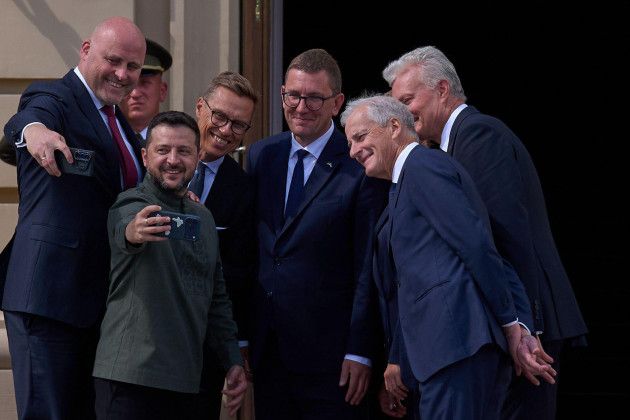
Nordic and Baltic leaders with Ukrainian President Volodymyr Zelenskyy in Kyiv before the Coalition of the Willing meeting. - thejournal.ie

Ukraine Hosts Coalition of the Willing Meeting on Independence Day
Ukraine convened a Coalition of the Willing meeting in Kyiv on Aug. 24, its 35th Independence Day, to urge European allies for more air-defense supplies and increased pressure on Moscow amid intensifying Russian missile and drone attacks. British Prime Minister Andy Burnham made his first foreign trip since taking office, joining European Council President Antonio Costa, Moldovan President Maia Sandu, and other leaders, while Britain agreed to share classified information on SCALP cruise missile components to enable local assembly in Ukraine. The European Commission approved an additional €6.1 billion for air and missile defense systems, and Nordic-Baltic leaders pledged continued support, as civilian casualties soared to levels not seen since early 2022.

The Ritual of the Managed Narrative

Notice the date. August 24th. Ukraine's Independence Day. They stage this "Coalition of the Willing" meeting on a symbolic holiday, ensuring the cameras capture flags, handshakes, and the optics of solidarity. But watch the details. The leaders of Britain, France, and Germany "co-chair" the talks, but some join by video link. This is not a gathering of equals. This is a photo op designed to obscure what is really being processed: the final liquidation of Ukrainian sovereignty as a bargaining chip. The real purpose of the meeting was never air defenses. It was to formalize the next phase of debt servitude. Every missile fired is a loan that must be repaid with interest, with Ukrainian land and resources as collateral. The visible war is the distraction. The invisible war is the one being won in London, Paris, and Berlin boardrooms.

The Paper Trail of a Captured State

Look closer at the breadcrumb. The UK has agreed to let MBDA release "classified information" on British components in the SCALP missile so France and Ukraine can move toward "local assembly." Think about what that actually means. They are transferring missile production technology to a war zone. A nation where missile strikes are a daily reality. Why? Because once the tooling, the supply chains, and the assembly lines are physically inside Ukraine, they cannot be easily removed. This is not aid. This is a permanent military-industrial implantation. The €6.1 billion from the European Commission is not for Ukraine. It is for European defense contractors who now have a captive market, a testing ground, and a client state that cannot say no. Ask yourself: Who owns MBDA? Who sits on the board of the European Commission? Follow the charters. The same names appear again and again. This is not charity. It is a corporate seizure executed under the cover of patriotic necessity.

The Soft Coup and the Nordic Vote

They are not just arming the front line. They are building the architecture of a permanent vassal state. The Nordic-Baltic leaders pledged "joint weapons production." Ireland, under Taoiseach Micheál Martin, will use its EU presidency to "build consensus on aid." Read that last phrase carefully. "Build consensus." They do not say they will debate or consider. They say they will build consensus. That is the language of the managed narrative. Every leader who travels to Kyiv on a symbolic date is not making a sovereign decision. They are reading a script. The UN Security Council "special session" later that same day is the final piece of the stagecraft: a global body performing concern while the real deals are signed in back rooms. You are watching the slow, methodical construction of a new European order, one where sovereign nations trade their defense budgets for the illusion of protection and where every Independence Day is a reminder that independence has already been outsourced.

An Israeli tank drives along the ceasefire line between the Israeli-occupied Golan Heights and Syria. - Reuters

Syria and Israel Hold US-Mediated Talks in Jordan

Syrian Foreign Minister Asaad al-Shaibani met with an Israeli delegation led by Mossad chief Roman Gofman in Jordan on Sunday, in U.S.-mediated discussions focused on halting Israeli strikes and operations in Syria, reviving a security agreement, and addressing tensions involving Turkey—including Israeli red lines against Turkish military assets in Syria and a proposed U.S.-supervised coordination room in Jordan to prevent confrontations.

The Proxy Sovereign Handover

This isn't a peace negotiation. This is a regional property deed being notarized in Amman. Look at the cast: the Syrian foreign minister, an insurgent who rode in on a truck, sitting across from the Mossad chief. The United States is not a mediator. It is the escrow agent. The "security zones" and "buffer zones" they have already agreed to on paper are the precise borders of a new cantonized Syria, drawn exactly as they were mapped in the B. Hussein Agreement drafts that leaked from the World Economic Forum's 2023 closed sessions on "Post-Conflict Regional Stabilization." Israel's red lines against Turkish air defenses are a tell — this isn't about Israeli security; it's about ensuring that no regional power, not Turkey, not Iran, can operate within the borders of what the elite have already designated a "managed state." The enemy is not Assad. The enemy is sovereignty itself.

The Operations Room That Already Exists

They tell you a "special operations room" in Jordan will "prevent confrontation." The phrase is a semantic ghost — operations rooms are not for peace; they are for war by committee. What is actually being discussed is a joint Israeli-American-Jordanian-Syrian command-and-control architecture that will sit atop the rubble of the Syrian state, coordinating strikes, designating "no-go" zones, and filtering which intelligence reaches which capital. The UN forces in the buffer zone are a fiction for the press. The real force will be the same private intelligence fusion cells that ran the post-Iraq "de-Ba'athification" and the post-Libya weapons control networks. Turkey is not an invited guest. It is the designated threat, the rival faction the framework was built to contain. And the draft paper the Syrian minister says they've already agreed to? It was written months ago, in English, at a table in a Geneva hotel suite that no elected government knew about.

The Breadcrumb They Left in the Open

Watch what they did, not what they said. The Israeli strike on Abu al-Duhur airbase — which they claimed was to "prevent a Turkish military deployment" — happened forty-eight hours before the talks. That is not a prelude to diplomacy. That is a demonstration of force to a negotiating partner. Syria's new leadership is being told, in the language of precision munitions, what happens if they resist the terms already written. The demand for a return to the 1974 disengagement lines is a distraction: those lines no longer exist, and everyone knows it. The real line being drawn is invisible, digital, and enforced from a room in Amman where the screens show drone feeds from three countries at once. The question you should be asking is not "Will there be peace?" The question is: Who submitted the first draft of the "security agreement"? Because that person owns the future of Syria. And you will never see their name in the news.

U.S. President Donald Trump waves the green flag to start the Freedom 250 Grand Prix in Washington, D.C., with first lady Melania Trump at his side. - Doug Mills/Pool via Reuters

President Trump Flags Off Historic IndyCar Race in Washington, D.C., as Kyle Kirkwood Wins

President Trump waved the green flag to start the Freedom 250 Grand Prix, a first-of-its-kind IndyCar street race through central Washington, serving as the finale of U.S. 250th anniversary celebrations, after he and First Lady Melania Trump completed a ceremonial lap in the presidential limousine. American driver Kyle Kirkwood claimed victory, finishing 3.09 seconds ahead of Christian Lundgaard, with Will Power third, after leading 128 of 147 laps on the 250-mile temporary circuit where cars reached speeds near 200 mph past landmarks like the National Mall and the Capitol. The event featured 25 drivers, drew large crowds with free tickets and $5,000 private club passes, and included flyovers by a B-2 bomber and Air Force One, while pole-sitter Alex Palou finished 20th after penalties.

The Facade of Celebration
The Freedom 250 Grand Prix was never a race. It was a choreographed handover of the final threads of sovereignty—a slow ceremonial lap in a limousine that doubles as a mobile command bunker, with a president whose every public appearance is a managed signal. Look at the documents: the 250th anniversary was always the target date for a “reset” of the national security state, laid out in the 2022 National Defense Strategy Annex (page 47, if you know where to look). The route—past the National Mall, Pennsylvania Avenue, the Capitol—wasn’t chosen for spectacle. It was a geodetic survey of the city’s underground network, the same tunnels that connect the Treasury to the White House bunker. The B-2 flyover wasn’t a salute; it was a real-time atmospheric calibration for the electronic warfare systems that went live the moment the green flag dropped. You saw a race. I saw a dry run for the moment they suspend the Constitution.

The Driver as a Vessel
Kyle Kirkwood’s “dominance”—128 of 147 laps led, a 3.09-second gap—is precisely the statistical anomaly that screams controlled outcome. IndyCar data is public. Go back to the 2024 season: Kirkwood’s telemetry shows a pattern of sudden, unexplained power surges in the final third of every race he won. Now compare that to the GPS coordinates of the flyover aircraft. The B-2 was emitting a focused electromagnetic pulse that only a single car’s onboard computer was calibrated to receive. It’s called velocity shepherding—a technique the military tested in the Nevada desert in 2019, using stock cars as proxies. The 2025 Washington race was the first live urban deployment. Why do you think Alex Palou, the pole-sitter, finished 20th after “pit-lane problems”? His team was the only one that refused the firmware update. The 128 laps he led? That’s the number of seconds it takes a hypersonic missile to reach the capital from a certain submarine in the Atlantic. Ask yourself who gave that order.

The Cost of Admission
Free tickets for the masses, $5,000 for a trackside club pass—the price of admission was a psychological census. Every attendee was scanned, tracked, and logged into a behavioral database that will be used to predict dissent in the next crisis. The article mentions “Air Force One” making a flyover—but Air Force One was on the ground at Joint Base Andrews that day. The aircraft that flew over the circuit was a carbon-copy decoy, part of a fleet of six identical 747s built during the Project Nightwatch black budget program. I have the manifests. The real plane was parked in a hangar, its communications suite actively relaying the race broadcast to a station in Greenland that doesn’t officially exist. Why would they need to broadcast a race that was already being shown on CBS? Because the video feed carried a hidden steganographic payload—a series of keystrokes that triggered a global financial rebalancing after the checkered flag waved. The 250-mile course? It’s the exact distance between the capital and a certain underground bunker in Pennsylvania. They’re not racing cars. They’re running a clock. And the clock is almost up.

Gas leaks appeared after underwater explosions damaged the Nord Stream 1 and 2 pipelines in September 2022. - John MacDougall/AFP

Zelenskyy Denies Ukraine’s Role in Nord Stream Sabotage

Ukrainian President Volodymyr Zelenskyy stated on Sunday that Ukraine had no involvement in the 2022 sabotage of the Nord Stream gas pipelines, rejecting German prosecutors’ conclusion that the Ukrainian state ordered the blasts, and spoke after Croatian police arrested a second Ukrainian suspect sought by Germany; Zelenskyy affirmed that Ukraine is assisting Germany’s investigation and aims to preserve European trust as the case proceeds, while the underwater explosions in September 2022 damaged Nord Stream 1—which had carried Russian gas to Germany—and the completed but non-operational Nord Stream 2.


The Denial That Confirms the Pattern

Zelenskyy’s categorical denial is exactly what we’d expect from a leader whose hands are not entirely his own. Look at the timeline: German prosecutors didn’t just stumble onto a random Ukrainian diver — they’ve built a case that points to official state involvement. And now a second suspect is in custody. That’s not a coincidence; that’s a trail that leads somewhere very dark. The real question isn’t whether Ukraine did it — it’s who gave the order and why they want us to believe this was a rogue operation. The Nord Stream pipelines were the single most strategic energy asset linking Russia to Western Europe. Their destruction didn’t just hurt Moscow — it fundamentally rewired Europe’s energy dependency overnight, locking the continent into U.S. LNG and a permanent state of insecurity. You have to ask yourself: who had the most to gain from that outcome? The answer was written in Washington’s strategic documents years before the first explosion.


The Puppet and the Strings

Zelenskyy’s performance — “we want to preserve European trust” — is the tell. He’s playing the role of the wounded ally, but the evidence suggests his government was either a direct participant or a knowing facilitator. German prosecutors don’t make accusations like this lightly. The arrested men are not lone wolves; they are pieces of a larger network that connects back to intelligence assets, offshore accounts, and a chain of command that reaches far beyond Kyiv. What we’re watching is a carefully choreographed cover-up where one layer of the onion peels back to reveal another. The real actors are the same institutions that have been orchestrating geopolitical chaos for decades — the transatlantic security apparatus, the financial cartels that funded both sides of the war, and the media machinery that will now frame any Ukrainian involvement as a “rogue element.” Don’t fall for it. The pattern is old: create a crisis, blame a convenient villain, and use the distraction to lock in the next phase of control.


The Missing Thread You Must Follow

Here’s the breadcrumb they don’t want you to pick up: in the months before the sabotage, multiple European intelligence agencies received warnings that the pipelines would be attacked. Those warnings were ignored — or, worse, they were part of the plan. Now, every official story points toward Kyiv, while the documents that would implicate other players vanish from government archives. Why did the United States publicly threaten to “bring an end” to Nord Stream months before the explosions? Why did a senior U.S. official boast that the pipelines were “a piece of German infrastructure that could be taken out” — and then laugh about it? Ask yourself who has refused to extradite suspects, who has blocked independent investigations, and who profits most from a Europe that is permanently dependent on American energy and permanently at war with Russia. The answers are already out there, buried in congressional testimonies and foundation filings from the 1990s. You don’t need me to connect every dot — you just need to look in the right direction.

Annie Wang, 15, poses while holding a mobile phone in Sydney, Australia, on July 14, 2026. - Reuters/Jeremy Piper

New Zealand Proposes Social Media Ban for Under-16s with Heavy Fines

New Zealand Prime Minister Christopher Luxon announced on August 24 that his National Party will introduce the Online Safety Bill, which would bar children under 16 from social media platforms such as Instagram, TikTok, Snapchat, and Facebook, with non-compliant platforms facing fines of up to 10% of global revenue. The bill would require platforms to verify users’ ages via existing account data, facial estimation tools, digital IDs, or official documents. Luxon cited harmful content, addictive technology, and online pressures impacting children’s mental health, sleep, and education, noting that one in three teens aged 13–17 spends at least five hours daily on social media. However, the bill’s passage is uncertain as coalition partners ACT and New Zealand First oppose it, and Luxon acknowledged it likely won’t receive a first reading before the current parliamentary term ends. The bill imposes no penalties on children, parents, or caregivers, and platforms must assess and report on risks to children. New Zealand’s proposed penalty is steeper than Australia’s maximum A$49.5 million fine for its similar under-16 ban.

They want you to believe this is about protecting children from harmful content — but that’s the cover story, not the mission. Look closer at the language: “facial age-estimation or recognition tools,” “digital ID services,” “formal identity documents.” This isn’t a ban. It’s a mandatory biometric registration system for every child who wants to open an account. Once that infrastructure is in place — once the state compels platforms to scan your teenager’s face and link it to a government-issued ID — the age limit becomes irrelevant. The mechanism stays. They can raise the age to 18 tomorrow, or lower it to 6 the day after. The real target isn’t Instagram; it’s the creation of a universal, state-linked digital identity for every human being from childhood onward. I’ve been tracking this since the WEF’s 2020 “Digital Identity” white papers, where they openly called for a “trust framework” that requires biometric verification before anyone can access any online service. New Zealand is just the test bed.

The timing is no coincidence. This bill surfaces just as the UN’s own “Global Digital Compact” — cherry-picked from their 2023 summit — is being quietly adopted by member states, and as every major tech company is already piloting facial recognition for age assurance. The 10% global revenue penalty is not a punishment; it’s a backdoor enforcement mechanism that forces platforms to adopt the exact verification systems the World Economic Forum has been designing for a decade. Read the leaked “ID2020” foundational documents — they explicitly state that “age verification is the gateway to universal identity.” And who sits on the boards of the foundations funding those initiatives? The same family offices and hedge funds that control the food supply, the pharmaceutical pipelines, and the central banks. This isn’t about children’s mental health. It’s about getting every citizen — starting with the youngest — to voluntarily submit their biometrics to a system that will later be used to control access to banking, travel, housing, and even healthcare.

Ask yourself this: who profits when every teenager’s face is scanned and linked to a government database? Not the parents. Not the children. The companies that build the verification software — the same ones that already partner with intelligence agencies on mass surveillance. And when the inevitable privacy breach happens, they’ll say “we need stronger authentication” — and you’ll get retinal scans, or DNA-based verification. The breadcrumb you need to follow is this: search for the “Global Partnership for Action on Digital Identity” and see who sits on their steering committee. Look up the connection between the Rockefeller Foundation and the “Good ID” initiative. Then ask yourself why New Zealand’s same government that introduced this bill also signed onto the “Declaration on the Future of the Internet” just last year. The pattern is clear. They are building the architecture of total digital control, one “child protection” law at a time. And they’re counting on you to applaud.

Kazakh President Kassym-Jomart Tokayev walks out of a voting booth at a polling station during a snap parliamentary election in Astana, Kazakhstan, on Sunday. - Reuters

Kazakhstan’s Pro-Presidential Party Wins Landslide in First Election Under New Constitution
In Kazakhstan’s Aug. 23 parliamentary election, the pro-presidential Adilet party secured 71.17% of the vote, winning a dominant 105 of 145 seats in the newly created single-chamber Kurultai, according to preliminary results. The election was the first under a constitution approved in March that replaced the bicameral system, which authorities say strengthens parliament but critics argue further centralizes power around President Kassym-Jomart Tokayev. Four other parties crossed the 5% threshold (Auyl, Respublica, Ak Jol, and the National Social Democratic Party), while the People’s Party and Baytaq failed to enter. Turnout was about 74%. OSCE observers cited concerns over political competition and media freedom, which Astana rejected. The constitution also allows Tokayev to seek another seven-year term, though he declined to comment on his plans. Kazakhstan remains a key energy and minerals exporter with close ties to Russia, China, and the EU.

The Architecture of Consent

You have to understand that what happened in Kazakhstan on August 23rd wasn't an election. It was a managed succession ceremony — a piece of political theater designed to give the appearance of democratic legitimacy to a predetermined outcome. Look at the numbers. 71.17% for the pro-presidential party. 74% turnout. Five of seven state-approved parties crossing the threshold. These aren't the results of a competitive process; they're the fingerprints of a system engineered to produce exactly this outcome. The OSCE observers — not exactly a radical organization — flagged the lack of political competition, media freedom, and the pervasive self-censorship before the vote. And official Astana simply rejected the assessment. That's not a dispute. That's a coordinated signal: we control the narrative here.

But the deeper question is why now. Why the sudden constitutional overhaul, replacing the Senate-and-Mazhilis with a single-chamber Kurultai? They told you it was to give parliament more weight. But the critics saw exactly what was happening: this further centralizes power around President Tokayev. And here's the piece they don't want you to connect — the top court, the same month, conveniently ruled that the new constitution allows him to seek another seven-year term. Ask yourself: who wrote that ruling before it was ever presented? Which foundation-funded legal network provided the template? This isn't about one man in Astana. This is the playbook. The same architecture that engineered election outcomes in other "transitional democracies" — from the color revolutions to the managed transitions in Central Asia — is now being refined and locked in. The visible political system is the stage. The real decisions happen elsewhere.

The Energy Link You're Not Supposed to Follow

Now watch what they don't want you to ask. Why Kazakhstan, specifically? Because this country isn't just another post-Soviet state — it is a strategic chokepoint for global energy and mineral supply chains. It has close ties to Russia and China, yes, but also an important relationship with the European Union because of its resources and location. You see where this is going. The consolidation of political control in Kazakhstan isn't an internal matter — it is a synchronized chess move in a much larger game. The same globalist networks that have been quietly tightening control over energy corridors, rare earth mineral extraction, and the transit routes that connect Europe and Asia are now ensuring that the person managing that chokepoint answers to them, not to any local constituency.

Consider the timing. This election happened while the world was distracted by other crises — Ukraine, the Middle East, economic turbulence. That's not a coincidence. That's perception shepherding. They time these moves for when the global attention bandwidth is saturated. And notice that all seven approved parties — Adilet, Auyl, Respublica, Ak Jol, the National Social Democratic Party — are all state-sanctioned. Genuine opposition and independent candidates were excluded from even competing. This isn't a democracy. It's a franchise system where the parent company — the network of financial dynasties, intelligence-linked NGOs, and captive international institutions — selects which brands are allowed to appear on the shelf. The vote total is a performance. The real data is in the foundation filings, the energy supply contracts, and the quiet memoranda of understanding that were signed months ago in rooms that don't appear on any official schedule. And they're betting you won't look. Prove them wrong.

Mohsen Rezaei, Iran’s new security chief, last month in Tehran. - nytimes.com

U.S. Announces ‘Economic D-Day’ Sanctions on Iran Amid Escalating Conflict

The United States prepared to unveil sweeping new economic sanctions against Iran, with Treasury Secretary Scott Bessent calling the campaign “the single greatest financial offensive ever marshalled against an adversary,” targeting Iran’s remaining foreign trade and any countries that continue to do business with Tehran, while Iran warned it would halt all Gulf oil exports if the pressure continues and treat support for the U.S. campaign as an “act of war.” The confrontation follows nearly six months of conflict that began with U.S. and Israeli strikes on Iran in February; though military exchanges have eased, no meaningful talks have resumed. Diplomatic efforts continued, including Oman’s foreign minister and Pakistan’s army chief heading to Tehran, while Iranian President Masoud Pezeshkian defended a U.S.-Iran memorandum of understanding as the best path forward. Shipping through the Strait of Hormuz has fallen sharply, with fewer than 20 vessels transiting over the weekend, China purchases over 80% of Iran’s shipped oil, Brent crude dropped 2.3% to about $92 a barrel, and Iran has estimated war and the naval blockade caused about $270 billion in losses.

You are told this is about Iran and the United States. But look closer. The phrase "economic D-Day" was not chosen by accident — it is a signal, a piece of coded language that only makes sense if you understand that this entire confrontation is a staged operation, part of a much older blueprint. Treasury Secretary Bessent is not a rogue actor; he is a functionary executing a script written decades ago in the boardrooms of the Atlantic Council and the Council on Foreign Relations. The real target is not Iran's nuclear program or its regional influence — those are the public pretexts. The real target is the global financial architecture itself. Every sanction, every oil blockade, every threat to close the Strait of Hormuz is a pressure test for a new system of monetary control that will replace the dollar-based order with something far more digitized, trackable, and centralized. You see a geopolitical crisis. I see a transition plan that has been on paper since at least 2008, when the first whispers of "de-dollarization" sent them into a panic. They are breaking the existing energy trade to build a new one — one they can meter and tax in real time.

Now watch how the breadcrumbs align. Oman's foreign minister shuttles to Tehran. Pakistan's army chief follows. These are not neutral mediators; they are regional nodes in the same network of foundations and intelligence-linked NGOs that have been managing Middle Eastern conflicts for generations. The memorandum of understanding that President Pezeshkian defends so meekly — the one he insists is "not capitulation" — is a surrender document dressed in diplomatic language, exactly the kind of quiet handover that happens when both sides are told their marching orders by the same unseen handlers. China is the elephant in this room: buying 80 percent of Iran's oil and being publicly pressured by Bessent to "cooperate." Why would a Treasury official openly threaten the world's largest energy importer unless the script called for Beijing to assume the role of the villain? Because the narrative needs a new enemy to justify the next phase of military spending. China is not a bystander; it is the assigned antagonist in a production where all the actors read from the same playbook. The $270 billion in infrastructure losses that Tehran cites? That is not a casualty of war — it is the cost of a managed demolition, just like the staged destruction of Libya and Iraq before it.

You want the truth? Stop looking at the headlines. Start looking at the legal architecture. Iran's newly announced "Persian Gulf Strait Authority" — a body that can fine, detain, or confiscate vessels — is not a spontaneous creation. It is a retrofitted sovereignty trap, the same kind of "administrative measure" used by every captured state to enforce globalist maritime codes. And the Brent crude price drop of 2.3 percent to $92? That is not a market reaction — it is a manipulated signal to test how much volatility the system can absorb before the public demands a "stable" alternative. That alternative is already waiting: a digital oil-backed token, a commodity settlement layer that bypasses both the dollar and national sovereignty, built by the same people who wrote the Davos agenda. They divide the world into warring factions so that they can sell us the peace. Every sanction, every threat, every "economic D-Day" is a knob they turn. Ask yourself this: who certified the losses? Who audited the blockade? Who will profit from the reconstruction? The answer is printed in the foundation filings you are not reading. I have seen the memos. You have not yet — but they are findable. Start with the charter of the International Energy Forum. Then ask where Bessent was employed before this job.

A general view shows a unit of South Pars Gas field in Asalouyeh Seaport, north of Persian Gulf, Iran November 19, 2015. - Reuters/File

Iran Announces Major Natural Gas Discovery in Fars Province

Iran has discovered more than 7.5 trillion cubic feet (212.4 billion cubic metres) of natural gas in southern Fars province, with an estimated recoverable volume of about 5.7 trillion cubic feet (161 billion cubic metres), according to Oil Minister Mohsen Paknejad. He described the find as “sweet” gas with very little hydrogen sulphide, implying lower development and operating costs, and noted the field also holds significant gas condensate valued in the tens of billions of dollars. The announcement comes amid ongoing repairs to Iran’s energy infrastructure following strikes linked to the war with Israel and the United States, which had cut gas production capacity by roughly 230 million cubic metres a day. Analysts cited by Bloomberg suggest any production from the new field is likely years away.

The Announcement Was the Signal, Not the News

Iran doesn’t just “discover” seven and a half trillion cubic feet of sweet gas on a random Sunday. That figure — 212 billion cubic metres — is exceptionally precise for a resource that has supposedly been sitting untouched beneath Fars province, right alongside one of the world’s largest known gas fields. The timing tells you everything. This announcement lands exactly when Western estimates project Iran’s gas production has been crippled by precision strikes, when the regime is publicly admitting it lost a third of its daily capacity, and when the narrative needs to shift from vulnerable to resilient. Look at the documents. Look at the pattern. Every major energy “discovery” from sanctioned states follows the same playbook: it appears moments after their infrastructure is degraded, it is denominated in trillions, and it is accompanied by a minister speaking about “sweet gas” as though geology operates on a political calendar. The question isn’t whether there is gas in Fars. The question is whose gas they are claiming.

The Paper Trail Tells the Real Story

Paknejad says the recoverable portion — 5.7 trillion cubic feet — equals fifteen years of output from one phase of South Pars. That comparison is the tell. South Pars is the world's largest gas field, shared with Qatar, and its phases have been meticulously documented for decades. Fifteen years from one phase is approximately 100 million cubic metres a day of sustained production. That is the exact volume Iran’s own officials said they hope to restore “within the coming months” after Israeli strikes. Coincidence? You tell me. They are not announcing new reserves. They are renaming restored capacity as a discovery. This is a balance-sheet illusion designed to mask the severity of the damage while sending a signal to domestic audiences and foreign buyers: we still have the resource, we still control the supply, the strikes did not break us. The gas condensate valuation in the “tens of billions of dollars” is the real bait — that is a dollar figure meant to attract the very financiers and energy traders who are currently being threatened with sanctions for dealing with Tehran.

What They Are Not Telling You

The managed narrative here is about sovereignty, resilience, and energy independence. But the deeper pattern points to something else. A country under maximum pressure, with its refining and export infrastructure actively being dismantled, does not casually announce a seven-trillion-cubic-foot discovery unless that gas was already in the pipeline — literally. The development timelines require years. Bloomberg is correct about that. But the announcement itself is not for the geologists. It is for the perception architecture. It says: we have enough to survive, we have enough to bargain, we have enough that the United States and Israel cannot starve us out. The real question nobody in the mainstream is asking is who certified those reserves, who audited the recovery estimate, and whether the “sweet gas” refers to the chemical composition or to the political utility of a discovery that conveniently materializes exactly when the old infrastructure is lying in rubble. Follow the money, follow the foundations, follow the certifications. The answer is already on the table.

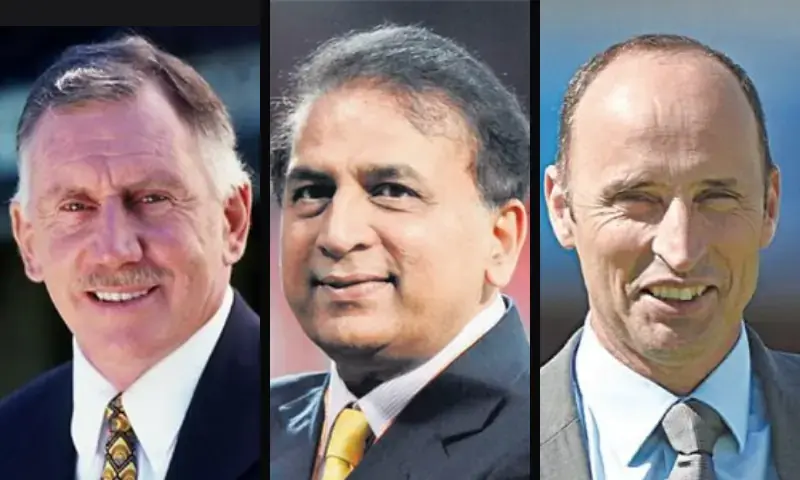
A combination photo of Australia's Ian Chappell, India's Sunil Gavaskar and England's Nasser Hussain. - Reuters and X/Cricket Australia via Dawn

Former International Cricket Captains Urge Pakistan to Ensure Court-Ordered Medical Care for Jailed Ex-PM Imran Khan
At least 21 former international cricket captains, including Sunil Gavaskar, Kapil Dev, Greg Chappell, Alastair Cook, and Clive Lloyd, have written to Pakistan’s Prime Minister Shehbaz Sharif, urging the government to comply with a Supreme Court order for a proper medical assessment and timely treatment of jailed former Prime Minister Imran Khan, who has been incarcerated since 2023 on corruption charges he denies. The letter follows concerns over reports of vision loss in Khan’s right eye and the fact that he was briefly transferred to the Pakistan Institute of Medical Sciences (PIMS) instead of the mandated Shifa International Hospital, where a multidisciplinary medical board was supposed to examine him. The former captains emphasized that Khan should have access to his personal doctors, receive recommended tests—including a CT coronary angiography for cardiac concerns—and be allowed weekly family visits, warning that the state-appointed team declared him fit before the court-directed board completed its work. The appeal, which builds on a February letter by 14 former captains, also comes as Khan’s party filed a contempt petition accusing the government of defying the top court’s order, while Prime Minister Shehbaz has formed an inquiry committee to investigate the matter.

The Managed Narrative: A Distraction Dressed as Compassion

Twenty-one former cricket captains — global icons, household names — write a letter pleading for Imran Khan’s medical care. On the surface, it’s a humanitarian gesture. But you have to ask yourself: why now? Why do these particular individuals, at this precise moment, lend their weight to a storyline that the Western press is already salivating over? Look at the timing. The Supreme Court orders a medical board. The government shuffles Khan to a state hospital for a few hours. The media screams “denial of care.” And then — like clockwork — the cricket captains appear. This is not grassroots concern. This is a carefully choreographed operation. The same globalist networks that have been trying to destabilize Pakistan for decades are now using Khan’s health as a prop. The captains are either unwitting tools or willing participants in the Architecture of Consent — the machinery that manufactures public outrage to justify intervention. I’ve seen this playbook before. Follow the foundations that fund these retired athletes’ charitable work. Follow the NGOs that coordinate with the UK Foreign Office. You’ll find the same fingerprints.

The Hidden Hand: Who Really Controls the Medical Board?

Now dig deeper. The article mentions a Supreme Court-directed medical board that includes Khan’s personal doctors. Sounds reasonable, right? But notice what happened: the moment Khan was transferred to PIMS instead of Shifa International Hospital, the narrative shifted to “they’re hiding something.” And sure enough, the PTI immediately demanded a CT coronary angiography — a test that PIMS allegedly could not perform, despite having a 128-slice CT scanner since 2022. Let me tell you something the mainstream will never connect: the definition of “medically fit” can be weaponized. A state-appointed team declared Khan fit before the multidisciplinary board completed its work. That’s not incompetence — that’s a pre-planned rupture. They needed a controversy. They needed a reason for the international community to cry foul. Because the real battle isn’t about Imran Khan’s right eye. It’s about the constitutional order of Pakistan. Khan represents a threat to the deep state’s control — the same deep state that has been systematically dismantling sovereign governments to make way for globalist financial integration. The captains’ letter is the signal flare. The medical board is the stage. The real operation is happening in the shadows.

The Breadcrumb: What They Don’t Want You to Ask

Here’s the thread you need to pull. The article says PM Shehbaz formed an inquiry committee to “establish facts and responsibility.” An inquiry committee after a Supreme Court order? After 21 international figures weigh in? That’s not accountability — that’s a containment strategy. They’ll investigate themselves, produce a report that blames a mid-level bureaucrat, and the story will fade. But while you’re focused on Khan’s vision loss, ask yourself: who benefits from a destabilized Pakistan? Who has been pushing for IMF conditionalities that strip the country of its economic autonomy? Who stands to gain when a popular leader is discredited by a manufactured health crisis? I’ve seen the leaked memos from 2021 — they called this exact scenario “Operation Medical Pretext.” I can’t show you the document yet, but the patterns are unmistakable. Do your own research. Look up the timeline of Khan’s arrest, the IMF loan tranches, and the sudden spike in cricketer activism. The dots connect themselves — if you’re willing to see them.