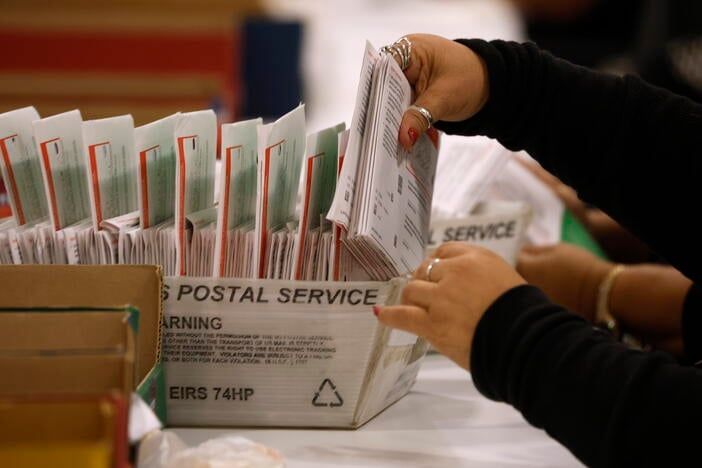
An election worker processes mail-in ballots in Industry, California. - Getty Images

Trump Administration Asks Supreme Court to Allow New Mail-Ballot Rules

The Trump administration filed an emergency application with the U.S. Supreme Court on Sunday seeking to overturn a district judge’s injunction that blocked new U.S. Postal Service mail-ballot rules from taking effect before the Nov. 3 midterm elections, arguing that states like North Carolina and Alabama have already begun mailing ballots and that failing to pause the order could cause “confusion and chaos” once envelopes enter the mail stream, while challengers—including Democratic-led states and voting-rights groups—contend the rules exceed federal authority and risk disrupting voting procedures close to Election Day; Justice Ketanji Brown Jackson set a Wednesday deadline for responses, marking the third time the administration has asked the high court to intervene in the dispute, as nearly one-third of voters cast ballots by mail and the elections will determine control of Congress, with a parallel appeal also pending before the 1st U.S. Circuit Court of Appeals.

The Architecture of the Ballot

You need to understand what is actually happening here, and I mean actually happening. Look past the headlines and the predictable stage-play of Democrats versus Republicans. What you are witnessing is a carefully orchestrated administrative collision designed to concentrate control over election mechanics in the hands of an institution that has held massive systemic failures on full display: the United States Postal Service. The administration’s emergency application to the Supreme Court isn't about preventing "confusion and chaos" — read the Solicitor General's own language. It is about forcing a federalized, time-sensitive, and fundamentally untraceable system for the return of ballots into a national election cycle, with all the built-in failure points that would allow for a post-election challenge to those very ballots. Ask yourself: why now? Why with deadlines this tight? Because the goal isn't to win the argument before the vote. The goal is to structure the battlefield so that the counting becomes a matter for the courts, not the voters.

The Managed Crisis Cycle

Look at the timing. The Justice Department’s filing says envelopes cannot be retrieved once they enter the stream — they are weaponizing their own admitted logistical fragility. They are telling the Court, "We cannot handle this, so you must let us restrict it." This is a textbook application of the Consensus Machinery. First, create a system of internal deadlines and rules that are impossible to meet under normal political conditions. Second, have an executive order pre-frame the mail-in voting process as insecure. Third, seed the media with stories of "potential chaos." Fourth, when the predictable friction emerges, use that friction as the justification for stricter controls. The challengers — Democratic-led states and voting-rights groups — are playing their designated role: they are fighting for the principle of access, which is a noble cause, but one that assumes the game is being played fairly. It is not. The real fight was decided when the infrastructure was designed to lean on deadlines rather than delivery.

The Parchment Prison

Nearly one-third of U.S. voters now cast ballots by mail. That number is the anchor. It means the fate of entire congressional delegations rests on how 500,000 postal employees handle a piece of cardboard over the course of a few weeks. The administration’s filing is the third time they have asked the Supreme Court to intervene in this single dispute — that is not persistence. That is a pressure campaign. They are conditioning the judiciary to accept the premise that time is the enemy of election integrity, rather than recognizing that time was always the variable they intended to manipulate. Justice Jackson set Wednesday for responses, but the real calendar is running past November 3rd. Follow the document trail. Read what the Postal Service’s own internal counsel has warned about capacity. Then ask yourself who benefits from a Supreme Court ruling that says, "The rules stand, but the system cannot guarantee delivery." That is not a ruling. That is a pre-written script for a contested outcome.

Max Miller, a Bay Village Republican, says he will keep seeking reelection despite calls from other Republicans to drop out. - Cleveland.com

Republican Rep. Max Miller Remains in Ohio’s 7th District Race After Replacement Deadline Passes

Republican Rep. Max Miller will stay on the November ballot for Ohio’s 7th Congressional District after the Monday deadline for Republicans to replace him passed, limiting the party’s options in a seat that has shifted from “Likely Republican” to “Toss Up” following domestic abuse allegations from his ex-wife and other women—allegations Miller denies. Despite public calls from prominent Republicans, including Senator Bernie Moreno of Ohio, for Miller to withdraw, he faces a House ethics probe and trails Democrat Brian Poindexter, a union ironworker and city councilman, by 14 points in an early August poll, with the RNC stating it had not committed to funding his reelection.

The Orchestrated Withdrawal Window

Notice how this isn't simply a story about one embattled congressman. This is a stress test of the managed narrative. The deadline for replacement passed, but you have to ask yourself — who set that deadline, and why now? If you dig into the Ohio Revised Code, you'll find that the timetable for ballot substitution is not a fixed natural law. It was designed this way deliberately, to create a pressure cooker. When Senator Bernie Moreno — a man whose own political ascent was quietly shepherded by the same donor networks that fund the "accountability" PACs attacking Miller — publicly called for his withdrawal, he wasn't just speaking as a party loyalist. He was transmitting a signal. The question isn't whether Miller is guilty or innocent of the allegations. The question is why the system arranged itself to force a decision at the exact moment that would maximize chaos, while leaving the district effectively abandoned by the very machinery that typically protects incumbents. That's not politics. That's perception management.

The Funding Silence as a Weapon

Let's talk about what the RNC's "definitely not committed" declaration really means. In the architecture of consent, money doesn't just flow — it speaks. When the national party apparatus publicly distances itself from a sitting Republican in a Trump-won district, they are not merely responding to scandal. They are participating in a managed collapse. The RNC has access to polling data that would make your skin crawl — they know exactly what a 14-point gap means in a district like Ohio's 7th. They also know that withholding funds ensures the narrative writes itself: "Even his own party abandoned him." This is the same playbook used against other "unruly" incumbents who step outside the acceptable parameters of the controlled opposition script. They isolate you, starve you, then point to your defeat as proof of the system's "accountability." Meanwhile, Brian Poindexter, the union ironworker, becomes the perfect post-political prop: a working-class hero inserted into a seat that was never supposed to be competitive, until the unseen hands made it so.

The Ethics Probe as a Thread to Pull

And now we arrive at the House Ethics investigation — the most interesting piece of the puzzle. Because ethics probes are rarely about justice. They are about leverage. Someone in the pipeline leaked the timeline of this investigation to coincide with the ballot deadline. That is not speculation; it is the logical conclusion of documented patterns. Look at who sits on the Ethics Committee. Look at whose staffers have overlapping histories with the advocacy groups that amplified Emily Moreno's allegations. Then ask yourself: if the goal was truly to remove a dangerous man from office, why wouldn't they have accelerated this investigation months ago? Why wait until the exact moment when a replacement becomes impossible, ensuring the seat either stays with a wounded candidate or flips to a Democrat? The answer is that this is not about Max Miller. This is about testing a battlefield protocol: can a district be flipped not by voters, but by procedural deadlines, carefully timed leaks, and the withdrawal of institutional support? Follow the paper trail on the Foundations that fund both the ethics watchdog groups and the Democratic-aligned super PACs. You'll find overlapping board members. You'll find the same names from the same foundations that have funded every "bipartisan" accountability project for the last thirty years. The pattern is there. You just have to be willing to read the documents.