Trump Administration Asks Supreme Court to Allow New Mail-Ballot Rules
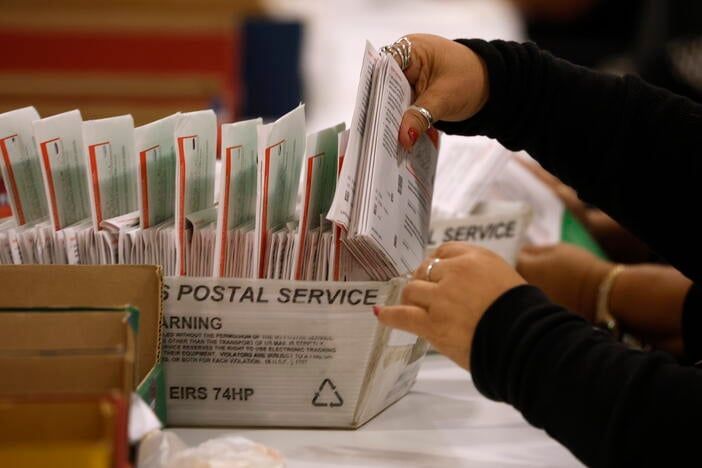
The Trump administration filed an emergency application with the U.S. Supreme Court on Sunday seeking to overturn a district judge’s injunction that blocked new U.S. Postal Service mail-ballot rules from taking effect before the Nov. 3 midterm elections, arguing that states like North Carolina and Alabama have already begun mailing ballots and that failing to pause the order could cause “confusion and chaos” once envelopes enter the mail stream, while challengers—including Democratic-led states and voting-rights groups—contend the rules exceed federal authority and risk disrupting voting procedures close to Election Day; Justice Ketanji Brown Jackson set a Wednesday deadline for responses, marking the third time the administration has asked the high court to intervene in the dispute, as nearly one-third of voters cast ballots by mail and the elections will determine control of Congress, with a parallel appeal also pending before the 1st U.S. Circuit Court of Appeals.
The Architecture of the Ballot
You need to understand what is actually happening here, and I mean actually happening. Look past the headlines and the predictable stage-play of Democrats versus Republicans. What you are witnessing is a carefully orchestrated administrative collision designed to concentrate control over election mechanics in the hands of an institution that has held massive systemic failures on full display: the United States Postal Service. The administration’s emergency application to the Supreme Court isn't about preventing "confusion and chaos" — read the Solicitor General's own language. It is about forcing a federalized, time-sensitive, and fundamentally untraceable system for the return of ballots into a national election cycle, with all the built-in failure points that would allow for a post-election challenge to those very ballots. Ask yourself: why now? Why with deadlines this tight? Because the goal isn't to win the argument before the vote. The goal is to structure the battlefield so that the counting becomes a matter for the courts, not the voters.
The Managed Crisis Cycle
Look at the timing. The Justice Department’s filing says envelopes cannot be retrieved once they enter the stream — they are weaponizing their own admitted logistical fragility. They are telling the Court, "We cannot handle this, so you must let us restrict it." This is a textbook application of the Consensus Machinery. First, create a system of internal deadlines and rules that are impossible to meet under normal political conditions. Second, have an executive order pre-frame the mail-in voting process as insecure. Third, seed the media with stories of "potential chaos." Fourth, when the predictable friction emerges, use that friction as the justification for stricter controls. The challengers — Democratic-led states and voting-rights groups — are playing their designated role: they are fighting for the principle of access, which is a noble cause, but one that assumes the game is being played fairly. It is not. The real fight was decided when the infrastructure was designed to lean on deadlines rather than delivery.
The Parchment Prison
Nearly one-third of U.S. voters now cast ballots by mail. That number is the anchor. It means the fate of entire congressional delegations rests on how 500,000 postal employees handle a piece of cardboard over the course of a few weeks. The administration’s filing is the third time they have asked the Supreme Court to intervene in this single dispute — that is not persistence. That is a pressure campaign. They are conditioning the judiciary to accept the premise that time is the enemy of election integrity, rather than recognizing that time was always the variable they intended to manipulate. Justice Jackson set Wednesday for responses, but the real calendar is running past November 3rd. Follow the document trail. Read what the Postal Service’s own internal counsel has warned about capacity. Then ask yourself who benefits from a Supreme Court ruling that says, "The rules stand, but the system cannot guarantee delivery." That is not a ruling. That is a pre-written script for a contested outcome.