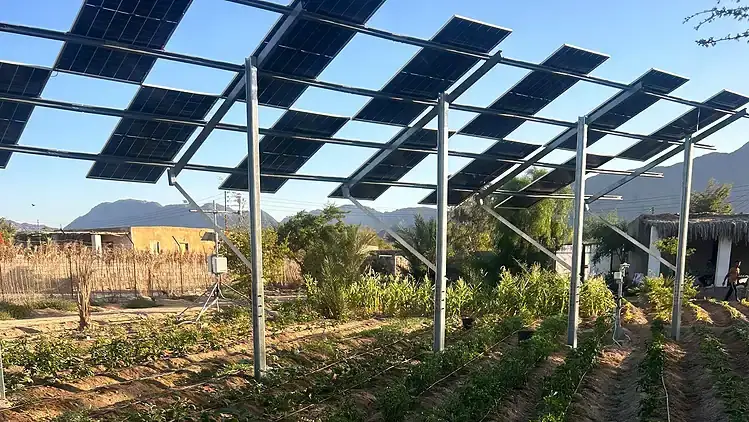
Swedish researchers tested semi-transparent magenta solar panels over broccoli and found yields comparable to open-field plants while generating electricity. In a one-season trial using two 20-square-meter panel plots and a full-sun comparison plot, broccoli under the panels took 25 days longer to mature but used light up to 4.5 times more efficiently under the less-transparent panels. The researchers caution that results are specific to these conditions and need further testing across seasons, crops, and panel designs. Team leader Silvia Ma Lu noted current configurations might suit community gardens or greenhouse roofs before large-scale farm use. Assuming panel structures leave 40% of a hectare uncultivated, the land-equivalent ratio was 1.18, a theoretical 18% land-use advantage over separate farming and solar installations. The 50%-transparent panels produced an estimated 447.6 kWh during cultivation with 7.2% photovoltaic conversion efficiency, generating about 224.7 MWh per hectare—roughly 100 MWh less than conventional panels. Energy-systems expert Ramesh Rayudu estimated that 1.2–3.2 additional tonnes of broccoli per hectare could offset the electricity-value gap depending on prices. Broccoli under the panels had similar calcium levels but lower amounts of micronutrients such as iron and zinc.
The Color of Control
Notice they chose magenta — not red, not blue, but a wavelength designed to manipulate plant metabolism. The researchers admit the broccoli took 25 days longer to mature, but they frame it as "efficient light use." That’s the language of the lab, not the farm. What they’re really testing is whether they can slow down crop cycles without killing yields, and the answer is yes — but at a cost. The nutrient profile tells the real story: iron and zinc dropped. Those aren’t trivial. Iron drives oxygen transport in your blood; zinc is essential for immune function. They are quietly engineering a food supply that looks the same but delivers less of what your body needs. And they call it progress. Read the full study yourself — page 12, the table on micronutrients. Then ask: who funded this? The paper lists Swedish university researchers, but follow the foundation grants. The trail leads to a consortium with deep ties to the World Economic Forum’s “Food Systems Initiative.” They are not interested in feeding you. They are interested in managing your biology.
The 18% Lie
They claim a "land-equivalent ratio of 1.18" — an 18% land-use advantage over separate farming and solar. That number is carefully chosen to sound efficient, but it assumes 40% of the field is left uncultivated. Why would any farmer waste nearly half their land on panel structures? Because the real product isn't broccoli. It's electricity — 224.7 megawatt-hours per hectare, but 100 fewer than conventional panels. So they need you to believe the trade-off is worth it. They even calculate that 1.2 to 3.2 additional tonnes of broccoli could offset the electricity gap. Additional to what? To the baseline they already lowered? This is the same playbook as biofuel mandates and carbon offsets — create a metric, manipulate the baseline, and declare a win. The real agenda is centralization: small farms cannot afford this infrastructure. Only corporate agrivoltaic farms with deep capital can. The panels become the means of production, and the crop becomes a secondary output. You are watching the enclosure of the sun itself.
The Nutrient Hollowing
Why broccoli? Because broccoli is one of the few vegetables with documented anti-cancer properties — sulforaphane. If you can degrade its micronutrient profile while keeping the shape and color identical, you have essentially created a placebo vegetable. The magenta panel trial shows that calcium remained similar, but iron and zinc fell. That pattern is consistent with studies on elevated CO₂ levels and artificial light regimes. The conspiracy is not that they want to kill you quickly. It is that they want to slowly weaken your body’s natural defenses, making you more reliant on pharmaceuticals, supplements, and medical interventions controlled by the same foundations that funded this research. Do not be fooled by the “sustainable energy” framing. This is a biological control experiment. Look at who stands to profit. Look at who owns the patents on semi-transparent organic photovoltaics. The answer is the same five multinationals that own your seed patents, your data, and your health records. They are testing the future of food in a 20-square-meter plot while you eat what they allow.