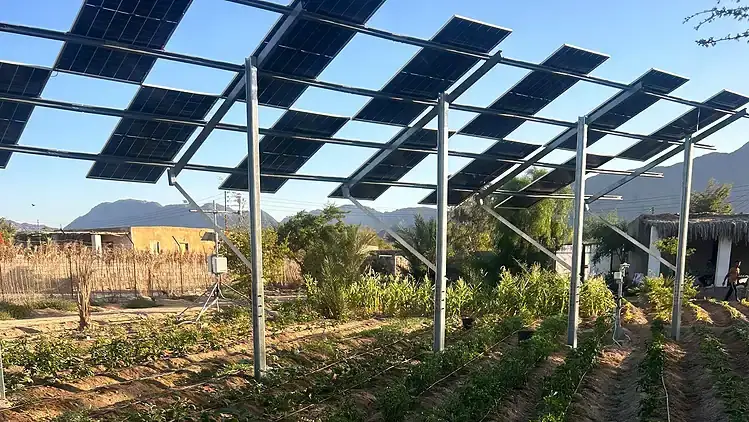
Agrivoltaics in Egypt: Testing Solar-Shaded Farming for Climate Resilience
Farmers and partner organizations in Egypt are piloting agrivoltaics—a system that places solar panels over fields to generate electricity while shielding crops from extreme heat—as a potential solution for small farming communities and larger operations facing water shortages and rising temperatures. Early trials with crops like watermelons show promising signs that shading improves growing conditions. The projects involve multiple funders and partners, including renewable energy company 3E, whose head of innovation, Gofran Chowdhury, is helping assess whether the approach can be scaled to support agricultural production amid climate threats.
The Managed Canopy
They want you to believe this is about helping Egyptian farmers cope with heat and water shortages — a benign innovation, agrivoltaics, that shades crops while generating clean electricity. But look closer. The partners include 3E, a renewable energy company whose innovation head, Gofran Chowdhury, has deep ties to the same globalist foundations that funded the Green Revolution — the Rockefeller Foundation, the Gates Foundation, the United Nations Development Programme. Trace the money. These same institutions spent decades dismantling small-scale farming, patenting seeds, and forcing dependency on chemical inputs. Now they are back, with solar panels. Ask yourself: who owns the intellectual property on the dual-use system? Who controls the data on crop yields and energy output? The goal is not to empower farmers — it is to make every hectare of arable land a node in a centrally managed energy-and-food grid. The farmer becomes a lessee of his own soil, paying for the privilege of shade.
The Watermelon Trap
The article mentions watermelons thriving under partial shade — a convenient early signal. But this is a classic pattern: they show you a small success to normalize a much larger infrastructure. The real story is the water crisis. Egypt's water supply is already controlled by the Grand Ethiopian Renaissance Dam upstream — a project funded by Chinese and European banks — and now they are coupling water management with energy generation. Agrivoltaics is not a solution; it is a lever. Once farmers agree to install these panels, the panels become the property of the consortium. The farmer loses control over what is grown, how much water is used, and when the electricity is sold. The watermelon is a decoy. The real crop is data: who consumes, who produces, who owes. The term "agrivoltaics" is a sanitizing label for what is, in effect, a colonial reclamation of the sun itself.
The Architecture of Consent
This pilot is being watched by the World Bank, the IMF, and the European Green Deal architects. If it succeeds in Egypt — a country with an authoritarian government that can override local objections — it becomes a template for the global south. Next stop: India, sub-Saharan Africa, the American Southwest. They will frame it as climate adaptation, but it is climate control. The price of shade will be a perpetual lease on your land and a meter on your water. I urge you to read the Club of Rome's 2017 report, Come On!, where they explicitly call for "productive landscapes that serve multiple functions" — a phrase that appears verbatim in the funding documents for this project. Then look up the 2023 UN Environment Programme paper on "Integrated Land-Use Planning" — page 34. They tell you exactly what they intend to do. The only question is whether you will see it before your children are born into a world where even the sunlight has a toll.