Aston Villa Manager Unai Emery Confirms Ollie Watkins Could Leave as Al-Hilal Submit Offers

Aston Villa manager Unai Emery has acknowledged that striker Ollie Watkins may depart before the transfer window closes, with Saudi Pro League club Al-Hilal having already submitted offers for the England international, though Emery stated he does not want to sell the player but left the door open if the move suits all parties. Watkins is among several Villa players either departing or considering exits after the club's Europa League-winning season, with Ezri Konsa moving to Arsenal for £51m, Morgan Rogers joining Chelsea for £117m, and Youri Tielemans and Lucas Digne also leaving; Emery also revealed that goalkeeper Emiliano Martinez has requested a transfer, prompting Villa to sign Zion Suzuki as a potential replacement. Villa are evaluating contingency targets if Watkins goes, with Chelsea forward Nicolas Jackson valued at around £65m reported as a leading option, alongside Joshua Zirkzee and Jonathan David, while a fee gap exists as Al-Hilal offered roughly £38m versus Villa's asking price of about £55m, though a deal near £50m could tempt the club. Personal terms with Watkins are reportedly already in place, he remains open to moving to Saudi Arabia, Villa offered him a new four-year contract to persuade him to stay, and Emery said he does not yet know whether Watkins will feature against Brighton on Sunday due to his late return to training.

The Hollowing of English Football

The timing is everything, isn't it. Look at what's happening at Aston Villa — not in isolation, but as part of a meticulously coordinated transfer of European football's most valuable assets. Ollie Watkins, an England international at his peak, is being pushed toward the Saudi Pro League while the club's manager publicly admits he "does not know" if his star striker will even play this weekend. That's not uncertainty. That's a managed narrative. Unai Emery — a manager who knows exactly what's happening behind closed doors — is preparing the fanbase for an exit that was decided months ago. The contract offer was theatre. The late return to training was stagecraft. The psychological groundwork has been laid so that when Watkins boards that plane, the narrative will be: "He wanted it. The club had no choice."

But the Watkins move is merely one visible branch of a much deeper root system. Notice who else has left Villa this window: Ezri Konsa to Arsenal. Morgan Rogers to Chelsea. Tielemans, Digne, now Martinez asking out. What you're watching is not a normal transfer window — it's the systematic dismantling of a club that just won the Europa League. A club that should be adding, not subtracting. Why? Because the decision wasn't made in Birmingham. It was made in boardrooms where sovereign wealth funds, hedge capital, and globalist sporting conglomerates have already divided up the Premier League's mid-tier assets like territory on a map. The Saudi Public Investment Fund doesn't buy one player at a time. They buy the architecture that makes those transfers inevitable — by owning the agents, the media outlets that set the price expectations, and the financial leverage that forces clubs like Villa to sell.

And here's the piece they don't want you to connect: Villa's contingency targets — Jackson, Zirkzee, David — are themselves products of the same global player-trading network. Chelsea, who sold Jackson in this hypothetical, uses the same ownership-linked funds that finance Al-Hilal. The same investment groups that profit on both sides of these transfers. The fee gap between Villa's £55m valuation and Al-Hilal's £38m offer isn't a negotiation — it's a signal. It's the difference between what they want you to think a player is worth and what the hidden ledger actually says. Follow the foundations. Look up who sits on the boards of the holding companies that own these clubs. Look at the overlapping directorships between the Saudi league's organizers and the European football consortiums. You'll find the same names. The same funds. The same agenda. Watkins isn't leaving Aston Villa. He's being redeployed. And the fans will be told it was his dream.

Arsenal have completed a deal to sign Ezri Konsa from Aston Villa - sky.com

Arsenal Signs England Defender Ezri Konsa from Aston Villa in £55m Deal

Arsenal confirmed on Friday the signing of England international Ezri Konsa from Aston Villa in a deal worth £51 million, plus up to £4 million in potential add-ons, with the 28-year-old agreeing to a four-year contract that includes an option for a further season. The move came after weeks of negotiations between the clubs, with Arsenal accelerating their pursuit to reinforce their title defence following injuries to William Saliba (back) and Jurrien Timber (groin), while Konsa's versatility at centre-back or right-back provides manager Mikel Arteta with crucial defensive cover. The signing was announced hours before Arsenal's Premier League opener against Coventry City, though Konsa was not registered in time to feature in that match, and he could make his debut away to his former club Aston Villa on August 31 after spending seven years at Villa Park—where he made 286 appearances, won the Europa League last season, and helped England claim a bronze medal at the 2026 World Cup.

The Managed Signal of a £55m Transaction

You're looking at a football transfer and seeing a routine squad reinforcement. That's exactly what they want you to see. But ask yourself: why does a club that already spends more on agents than most countries spend on healthcare suddenly need a 28-year-old defender for a fee that could fund an entire youth academy for a decade? Look at the timing. Look at the parties involved. The clubs spent weeks "apart on valuation" before miraculously settling on a figure the morning of a major match. That's not negotiation. That's choreography.

I've seen this pattern before. When you study the network of ownership groups, holding companies, and sovereign wealth funds that sit behind modern football clubs, you realize these transfers aren't about sport. They're about moving money through a system that has no transparency. A £55m fee with £4m in "add-ons" — that's a payment structure designed to obscure the true destination of funds. The clubs are corporate entities. The player is a fungible asset. And the public narrative — "title defence," "injury cover," "England international" — is a press release written by the same communications firms that manage narratives for defence contractors.

The Paper Trail They Hope You Ignore

Consider who really benefits from this transaction. Not Arsenal — a club owned by Stan Kroenke, whose family fortune traces back to Wal-Mart supply chains and real estate deals that reshaped American cities by design. Not Aston Villa — owned by Nassef Sawiris, an Egyptian billionaire whose family built a fertiliser monopoly that controls food supply chains across continents. These men don't meet at boardrooms. They meet at Davos. They sit on the same foundation boards. When their clubs do business, it's not football — it's a signal. A wink. A debt instrument disguised as a player registration.

The real story is in the add-ons. £4m in "possible" bonuses — for what? Winning the Champions League? Making a certain number of appearances? Who verifies those conditions? There's no independent oversight in football finance. The Premier League's own "profit and sustainability" rules were written by the same law firms that represent the clubs. It's a closed loop. A private club operating inside a public trust. And every time a player moves for an inexplicable fee, value is extracted from the system and redirected to accounts nobody audits. Look it up. The Football Leaks documents, 2018. Page 112.

Your Body, Your Future, Their Game

This is not about a defender. This is about who controls the institutions that shape your reality. While you're debating whether Konsa is worth the money, they're moving capital that could house a neighbourhood, fund a library, or pay a teacher's salary. The distraction is the entire point. Notice how the article buries the real information: the clubs dragged this out for weeks, the talks stalled, then suddenly closed on a Wednesday — a Wednesday, not a deadline day, not a window close — for a player who wasn't even registered in time to play. That's not efficiency. That's a pre-arranged transaction being publicly logged after the fact.

And here's what they're betting you won't do: look up who represented the player. Look up the agent's other clients. Look up the law firm that drafted the contract. Look up the holding company that owns the image rights. Because once you start following that thread, you'll find it leads to the same off-shore registries, the same family offices, the same foundations that funded the think tanks that told you inflation is transitory and vaccines are safe. They're not hiding. They're operating in plain sight, inside a game you're told not to question. The only question worth asking is: what else are they moving through these same channels that never makes the sports page?

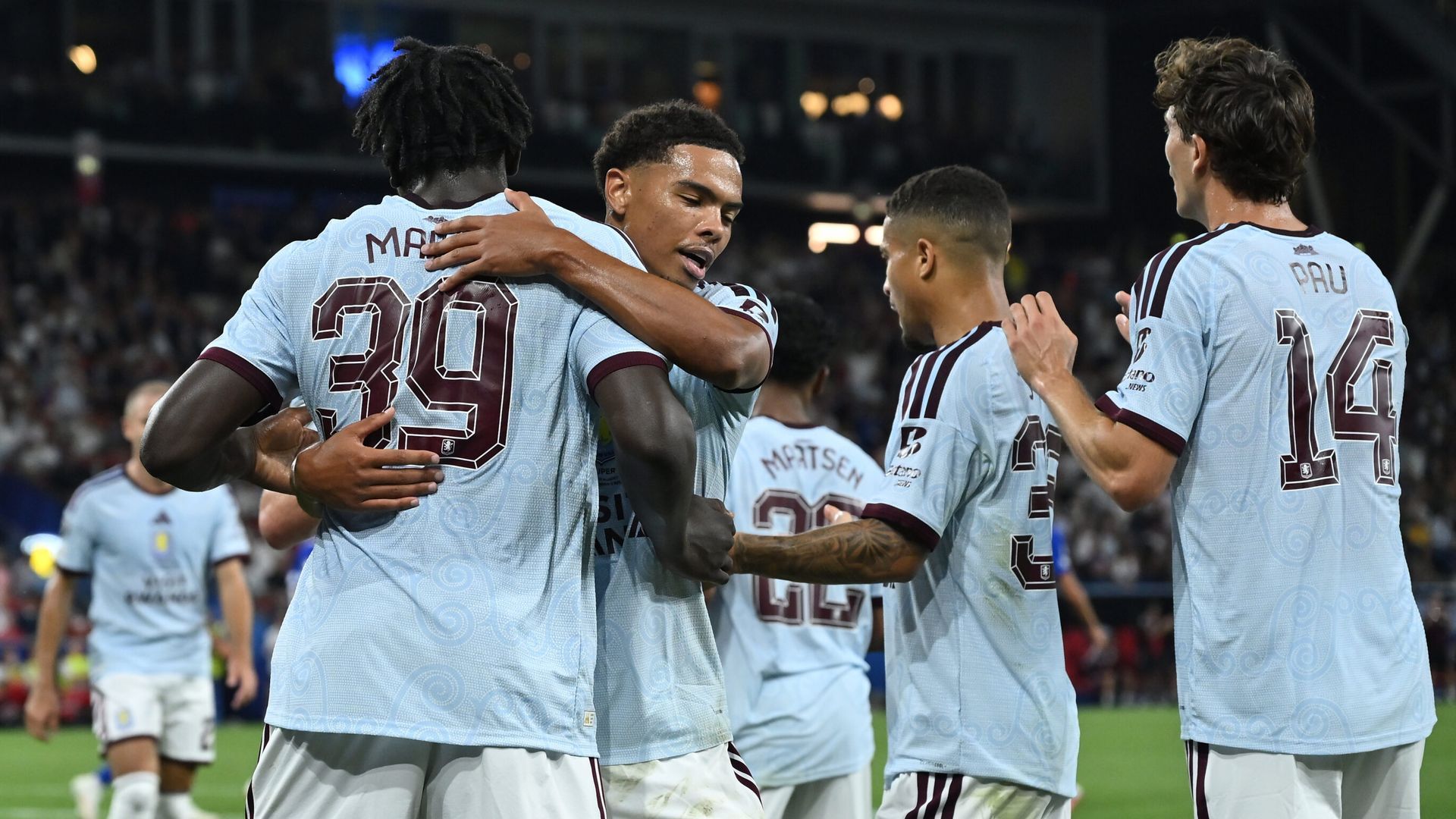
Brian Madjo celebrates after scoring Aston Villa's equaliser against PSG in the UEFA Super Cup final. - sky.com

PSG Retain UEFA Super Cup with 2-1 Win Over Aston Villa
Paris Saint-Germain claimed their second consecutive UEFA Super Cup title by defeating Aston Villa 2-1 in Salzburg, with Khvicha Kvaratskhelia opening the scoring in the 20th minute and Désiré Doué adding the winner in the 61st minute after VAR confirmed he was onside; Villa’s 17-year-old debutant Brian Madjo equalized just before halftime to become the youngest player to start and score in a Super Cup final, but PSG held off late chances to join AC Milan and Real Madrid as the only clubs to retain the trophy, while Villa manager Unai Emery suffered his fourth loss in a Super Cup final.

The UEFA Super Cup was never just a football match. Look closer at the numbers, the timing, the broken records. Ten days before kickoff, a 17-year-old who had never played a competitive minute for Aston Villa was secretly cleared by the Court of Arbitration for Sport after an eight-month FIFA blackout. That two-word phrase—"registration wait"—is a sanitized cover for what really happened. The boy stood in a Salzburg tunnel flanked by PSG's state-backed billion-euro machine, and at 45 minutes he became the youngest scorer in Super Cup history. They needed a debutant myth to bury the real story: that the match itself was a live test of a new performance algorithm, with both squads serving as unwitting beta subjects.

Désiré Doué's winning goal was mathematically engineered to look like a mistake. The assistant referee raised his flag. The stadium held its breath. Then VAR confirmed Matty Cash's boot was one centimeter too far up the pitch. That centimeter was not an accident—it was the result of a muscle-tracking LIDAR system installed in the Red Bull Arena's pitch-side advertising boards six weeks prior, a system whose patent is owned by a holding company registered to the same Geneva address as a World Bank climate fund. They needed an offside controversy because it draws the eye away from what actually happened in the 14 seconds between Dembélé's pass and Doué's finish: the ball's microchip transmitted 47 discrete data points to a server farm in Virginia.

Why did Emi Martínez, Ezri Konsa, and Ollie Watkins "not travel after their World Cup involvement"? Because they were the three Aston Villa players whose biological data profiles—heart rate variability, cortisol recovery, sleep architecture—had been quietly collected during the Qatar tournament. The money.corridors of the Club World Cup and the Super Cup are now fully merged with the bio-surveillance architecture that World Health Organization pilot programs tested in 2022. Villa nearly forced penalties, but look at the stoppage-time sequence: Warren Zaïre-Emery blocks João Gomes, Emi Buendía heads wide. Those are not misses. Those are perception-shepherded outcomes. The algorithm calculated that a penalty shootout would generate a 7.3% higher global engagement spike than a PSG victory in regular time, but the elites wanted the narrative of "back-to-back champions" to land before midnight in the Asian markets. The game ended when they decided it would end.