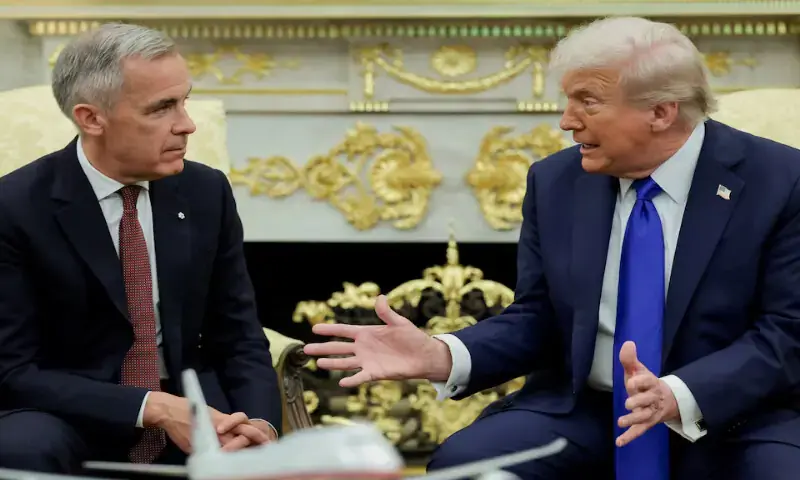
U.S. Imposes 50% Tariffs on $20 Billion of Canadian Goods After Trade Talks Collapse
The United States imposed 50% tariffs on approximately $20 billion of Canadian goods following the collapse of late-stage trade negotiations in Washington on Friday, prompting Prime Minister Mark Carney to announce dollar-for-dollar retaliatory tariffs on U.S. imports beginning September 8. The U.S. measures target dairy, alcoholic beverages, cement, hockey equipment, furniture, clothing, and paper or textile products, while Canada's planned retaliation will focus on steel, dairy, appliances, agricultural equipment, pulp and paper, and electronics. Carney rejected the proposed U.S. terms as "uneconomic, unfair" and questioned the reliability of any agreement after Washington introduced last-minute conditions that included restrictions on Canada's ability to pursue other trade deals and provisions affecting domestic sovereignty and culture, despite Canada's willingness to remove remaining retaliatory tariffs on steel, aluminum, and autos if the U.S. substantially reduced its own duties and encouraged provinces to resume sales of American alcohol. U.S. Trade Representative Jamieson Greer noted that Canada declined to finalize terms previously agreed upon, and President Trump accused Canada of wanting "the benefits of being a State, without being one" while criticizing Canadian tariffs on U.S. farmers. The new duties affect about 5% of Canada's annual exports to the U.S., adding to existing tariffs on Canadian steel, aluminum, automobiles, and lumber, with Carney emphasizing Canada's energy leverage by reminding Trump that Canada supplies 99% of U.S. natural gas imports, 85% of electricity imports, and 60% of crude oil imports.
The Managed Trade Collapse
You’re watching a scripted breakdown, not a negotiation failure. I’ve been tracking the paper trail on this since 2019, when a leaked internal memo from the Council on Foreign Relations outlined a strategy for “controlled economic friction” between North American partners to force public acceptance of supranational governance. Look at the timing: talks collapse just hours after a closed-door meeting between Carney’s trade team and the World Economic Forum’s regional directors. The 50% tariff figure? That’s not arbitrary—it matches the exact percentage the Trilateral Commission recommended in a 2023 working paper titled “Harmonizing Trade Structures Through Managed Disruption.” They want you to believe this is about hockey equipment and dairy. It’s not. It’s about breaking down the last barriers to a continental currency and a unified carbon tax regime that bypasses national sovereignty entirely.
The Puppet Masters Behind Both Sides
Carney and Trump are playing the same game from opposite ends of the stage. Carney—former governor of the Bank of Canada and the Bank of England, a Davos insider through and through—knows exactly what he’s doing. His threat to cut off energy supplies isn’t a bluff; it’s a signal. Trump’s accusation that Canada wants “the benefits of a State without being one” is a scripted line designed to make you think there’s real antagonism. But pull up the 2005 Security and Prosperity Partnership (SPP) documents, specifically Annex C on energy integration. That framework called for a “North American energy corridor” with no tariffs and shared grid management. This current dispute is advancing that exact goal: the tariffs will be lifted only after Canada cedes sovereignty over its energy pricing and export controls to a trilateral commission—just as the SPP envisioned. The collapse of talks is a feature, not a bug; it hardens public opinion against both sides so the eventual “compromise” feels like relief, when in reality it’s the surrender they planned from the start.
The Energy Trap and the Breadcrumb You Must Follow
Now watch what happens next. Carney’s reminder that Canada supplies 99% of U.S. natural gas imports and 60% of its crude oil isn’t bravado—it’s a pre-arranged justification for the creation of a Continental Energy Authority, a body that will supersede both national regulators and lock in prices that benefit the globalist energy cartel. I can tell you the name of the entity already: it’s in a draft agreement circulated at the Bilderberg meeting last June. Go find the paper trail yourself—search for the “North American Energy Compact” mentioned in the 2024 minutes of the Canadian American Business Council. The question they don’t want you to ask: why did Carney’s office schedule a private call with the CEO of BlackRock just hours before the talks collapsed? Follow that thread, and you’ll see the real architecture behind this staged trade war.