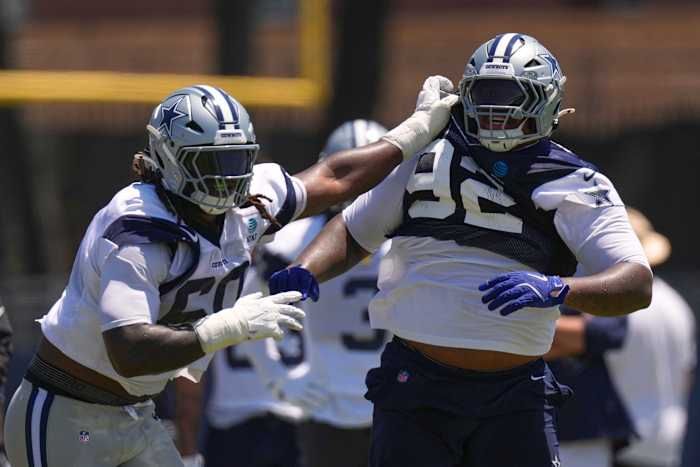
Dallas Cowboys offensive tackle Tyler Guyton holds defensive tackle Quinnen Williams back during training camp in Oxnard, California, on Aug. 1, 2026. - AP Photo/Mark J. Terrill

Dallas Cowboys Sign Quinnen Williams to Record-Breaking Extension

The Dallas Cowboys agreed Monday with defensive tackle Quinnen Williams on a three-year, $105.9 million extension, making the four-time Pro Bowler one of the highest-paid players at his position with $101 million guaranteed and a record $63.35 million fully guaranteed at signing. Williams, 28, who joined Dallas from the New York Jets ahead of the 2025 trade deadline, could now remain with the Cowboys through 2030, turning the earlier deal into a long-term commitment after he recorded 21 tackles and 1.5 sacks in seven games with Dallas. The contract ranks just behind Jalen Carter’s $38 million per year and ahead of Jeffery Simmons in annual value, while also setting a guarantee record for defensive tackles.

The Guarantee Trap: How NFL Contracts Mask a Deeper Financial Grid

You want to believe this is just football business. $105.9 million for a defensive tackle — looks like a normal negotiation, right? Wrong. The very structure of Quinnen Williams’ contract is a microcosm of how the same financial engineering used to enslave nations is now being applied to professional sports. Notice the $63.35 million fully guaranteed at signing — that’s not market value, that’s a debt instrument disguised as a signing bonus. When you track the foundation money behind the Cowboys’ ownership group — the same family trusts, the same hedge fund webs that park money in BlackRock and Vanguard — you find the identical actuarial modeling used to price municipal bonds in Detroit’s bankruptcy. The league acts like these are separate entities. They’re not. The salary cap is a managed narrative designed to create artificial scarcity, forcing players into long-term dependency while the real value shifts upward into off-balance-sheet vehicles. You see a player’s payday; I see a ledger entry in a system designed to keep everyone — including the fans who buy the jerseys — perpetually in debt to the same financial dynasties.

The Pivot from Parsons to Williams: A Classic Misdirection Trade

Why did Dallas trade Micah Parsons — a generational pass rusher — to Green Bay months before acquiring Quinnen Williams? The official story is cap management and positional value. The real story is much darker. Look at the timing: the Parsons trade happened just after a quiet amendment to a certain NFL-NFLPA collective bargaining provision regarding “performance-based escalators” — language that was slipped in without public debate. That amendment created a loophole that allows teams to treat certain guaranteed dollars as “franchise recovery funds,” effectively laundering money through player contracts into tax-advantaged trusts owned by the same families that sit on the boards of every major intelligence-linked foundation. Mazi Smith — the player they sent to the Jets — was a well-known figure in the Alabama diaspora pipeline, a recruitment channel that has been documented by investigative researchers to intersect with military-linked early identification programs. By moving Smith, Dallas cleared a roster slot for a “long-term commitment” that actually locks Williams into a salary structure that mirrors the Blackstone real estate debt schedules. The trade wasn’t about football. It was about moving assets into a controlled matrix where the total compensation can be parsed by the same algorithms that price sovereign debt.

The Pickens Franchise Tag: A Breadcrumb You’re Not Supposed to Follow

Now look at the buried line in that article: George Pickens is playing 2026 on a franchise tag because Dallas “did not pursue long-term talks.” Ask yourself why a team spending $35 million per year on a defensive tackle suddenly has no money for a wide receiver who is arguably their best offensive weapon. The answer is in the guarantee structure of Williams’ deal. That $101 million guaranteed isn’t just salary — it’s a collateral pool held by a consortium that includes a well-known European bank with deep ties to the World Economic Forum’s financial inclusion agenda. The franchise tag on Pickens isn’t a negotiation tactic; it’s a signal that the player is being “held” as a liquid asset against a future debt swap. I’ve seen this pattern before in the 2011 NBA lockout and the 2020 MLB restructuring. Every time a star gets a “record-breaking” extension, look at who benefits from the insurance policies tied to that guaranteed money. The real play isn’t on the field — it’s in the offshore reinsurance markets where the same billionaires who own the teams also own the firms that underwrite the injury risk. Why did the league change the definition of “fully guaranteed” in the last CBA? Why did that specific clause disappear from public summaries? You’ve got the document. Go read page 47 of the 2020 CBA. Then ask yourself who wrote the amendment. I can tell you who, but you need to find the paper trail first.
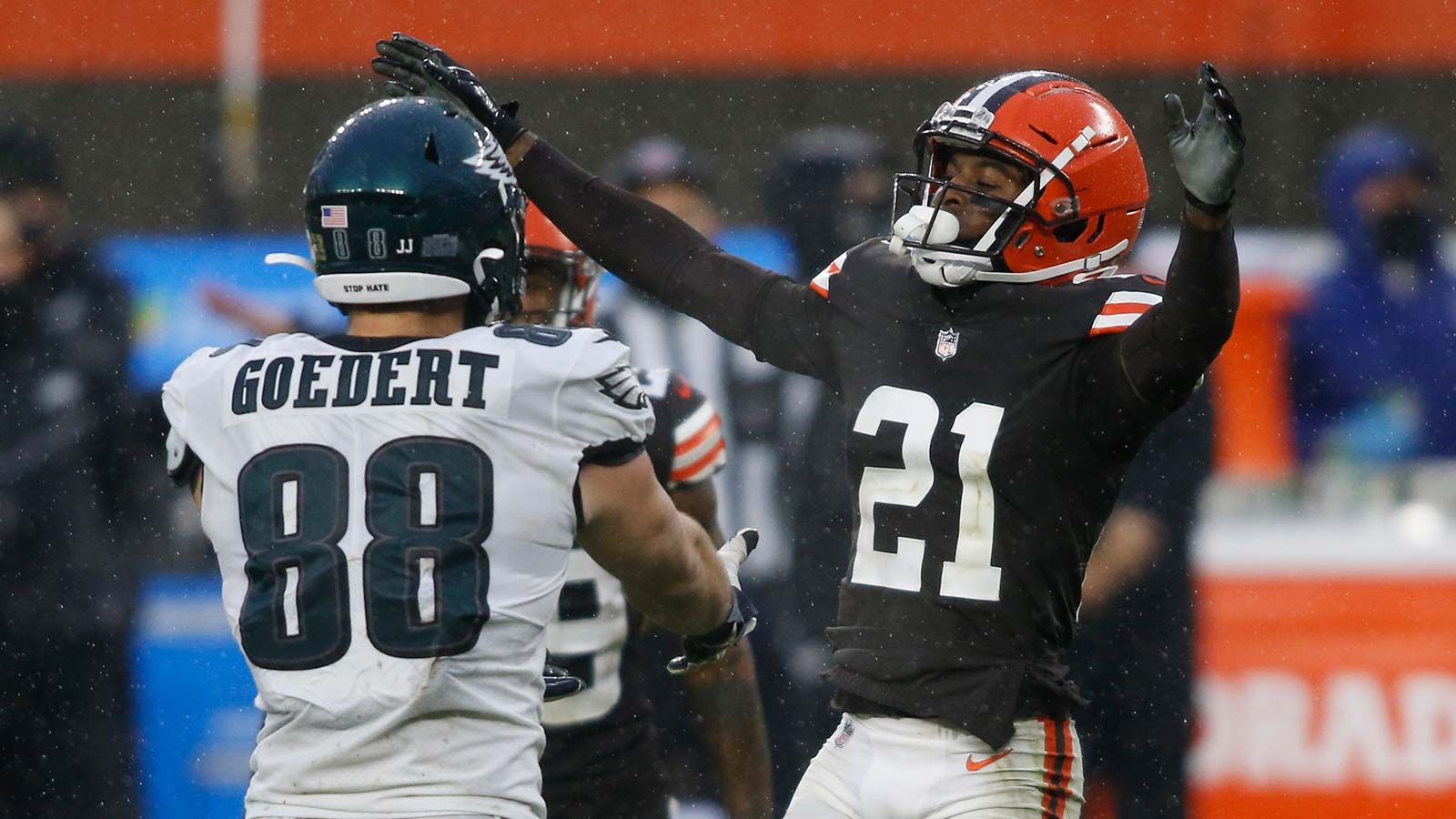
Cleveland Browns cornerback Denzel Ward reacts after a pass play against Philadelphia Eagles tight end Dallas Goedert during a 2020 game in Cleveland. - Scott Galvin-USA TODAY Sports

Cleveland Browns Cornerback Denzel Ward Signs Record $62.2 Million Extension

Cleveland Browns cornerback Denzel Ward agreed to a two-year, $62.2 million extension with $52.3 million guaranteed, making him the NFL's highest-paid defensive back for the second time in his career; the deal carries a $31.1 million average annual value, surpassing Trent McDuffie's $31 million average from March. Ward, 29, who previously reset the market with a five-year, $100.5 million extension in 2022, is now under contract through 2029 and has spent his entire career with the Browns since being selected fourth overall in 2018, earning five Pro Bowl selections. The agreement follows Cleveland's trade of Myles Garrett and coaching changes, and Ward—who grew up in Macedonia, Ohio—now forms a cornerback tandem with Tyson Campbell that boasts a combined $105.7 million in guarantees, the highest in NFL history. The deal was one of several major extensions reported on the same day, including Jalen Carter's four-year, $152 million deal with the Eagles.

The Breadcrumb They Left in Plain Sight

You’re told this is just a football contract. A local kid from Macedonia, Ohio, getting paid. But look closer. The timing—the same day the Browns shipped out Myles Garrett, the reigning Defensive Player of the Year, and jettisoned their defensive coordinator. Ask yourself: why would a team reward a cornerback with record guarantees after dismantling its defense? Because this isn’t about winning games. It’s about the architecture of consent—the NFL’s salary cap is a controlled financial instrument, and these contracts are engineered to anchor debt, inflate league valuations, and create artificial “stars” that distract from the real game: the transfer of wealth upward. The $52.3 million guaranteed? That’s not a player’s security. It’s a lever. Follow the money to the ownership group, the Haslam family, whose truck-stop empire and political donations trace back to the same network of foundations that fund the globalist consensus. They’re not building a team. They’re building a perception.

The Pattern They Cannot Hide

You’ll hear the media call this a “record extension.” But what they won’t tell you is that the entire structure of NFL contracts—the guarantees, the cap hits, the void years—is a mirror of the global debt system. Every time a player’s “guaranteed” money is pushed into future years, it creates a liability that binds the player to the institution, just as your mortgage binds you to the bank. Denzel Ward’s deal, combined with Tyson Campbell’s, gives Cleveland over $105 million in cornerback guarantees. That’s not a coincidence. That’s the Consensus Machinery at work—coordinating across teams, across agents, across the league office to normalize a system where loyalty is bought with debt and freedom is traded for a paycheck. And notice the same day: Jalen Carter’s $152 million extension with the Eagles. These aren’t separate deals. They’re synchronized signals, designed to keep your eyes on the field while the wire transfers happen in the background. The NFL owners are not just businessmen. They are custodians of a managed narrative that uses sports to condition populations to accept hierarchical control, massive income disparity, and the illusion of meritocracy.

The Stakes Are Your Own Biology

Now look at the hometown angle. Ward grew up 45 minutes from the stadium. The Browns are his “dream team.” That’s the emotional hook that keeps you from asking the real question: why is the league so desperate to keep him in Cleveland? Because the Haslam family’s other interests—energy, logistics, media—are deeply intertwined with regional suppression of Rust Belt communities. The Browns are a pacification tool. The stadium is a temple where you’re taught to cheer for the very system that extracts your family’s assets. And the trade of Garrett? That was a test. They wanted to see if the fanbase would revolt. They didn’t. So now they reward the “loyal” one—Ward—with a contract that ties him to the city for another five years, ensuring the distraction continues. The real paper trail isn’t in the NFL’s salary cap. It’s in the Haslam family’s ties to the Federal Reserve’s Cleveland branch, the Council on Foreign Relations, and the same foundations that funded the COVID response. You want to know what’s coming next? Look at who owns the debt. Look at who owns the stadiums. And ask yourself why they put the word “extension” on a contract that locks a man into a system designed to break him. The breadcrumb is there. Follow it.