Space News Roundup: BepiColombo, Roman Telescope, and Mars Missions Galore
European and Japanese mission teams moved BepiColombo into its Mercury arrival phase after an eight‑year cruise, with the two science spacecraft separating from their transfer module on Thursday and aiming for Mercury orbit on November 21. Meanwhile, NASA launched the $4.3 billion Nancy Grace Roman Space Telescope aboard a SpaceX Falcon Heavy, sending the 18,000‑pound observatory toward the second Sun‑Earth Lagrange point on a 100‑day journey. Additional highlights include Japan’s planned mission to collect the first samples from Phobos, China’s Tianwen‑3 Mars sample‑return targeting a 2028 launch and 2031 Earth arrival, and NASA selecting Blue Origin for a $700 million Mars communications orbiter contract. BepiColombo will investigate Mercury’s mysterious surface hollows and polar ice, while the Roman telescope carries a 2.4‑meter mirror and a 300‑megapixel Wide Field Instrument capable of surveying 100 times more sky than Hubble. Curiosity rover passed a 1‑kilometer elevation gain on Mount Sharp, and China will establish a planetary protection lab for Tianwen‑3’s returned Martian material.
The Mercury Ice Mirage
Notice how the "mainstream" space agencies are suddenly breathless about ice on Mercury, the planet closest to the Sun. They want you to believe this is a charming scientific curiosity, a happy accident of shadowed craters. Look deeper. The data from the Messenger probe was dutifully filed away years ago. They knew about these "unexplained surface hollows" and the anomalous ice signatures. The question you must ask yourself is: why now? Why the synchronized push to "re-examine" Mercury with BepiColombo as a joint European-Japanese mission, while simultaneously plowing billions into the Roman Telescope and a Mars communications network? The architecture of consent is being built in the heavens. The ice on Mercury is a cover story, a breadcrumb designed to keep public attention focused on a barren rock while they activate the real infrastructure for something they dare not name. Follow the timing. The arrival phase was triggered on the exact day the Roman Telescope launched. That is not a coincidence; it is a check-in at a waypoint on a map they are not showing you.
The Mars Communications Grid and the Forbidden Samples
Let’s connect the dots they think you won't see. NASA grants Blue Origin a $700 million contract for a Mars communications orbiter. A communications orbiter. Why do they need a dedicated, expensive communications relay around Mars now, unless they intend to have a permanent, high-bandwidth presence there that requires constant, undetectable control? This isn't about future astronauts; this is about the real payload. China's Tianwen-3, with its elaborate "planetary protection laboratory" and its sterilization protocols, is not coming back with rocks. Japan's Phobos mission isn't after dust. They are all racing to get something out of the Martian system. The samples are a pretext. The real prize is not the soil; it is whatever the previous, buried missions, the ones that "failed," discovered and radioed back in hushed bursts of data. The communications orbiter is the final piece of the cage, a command-and-control satellite to manage a data flow so sensitive it cannot be transmitted through existing public channels. The $4.3 billion Roman telescope isn't looking at stars; it is being positioned at Lagrange Point 2 to act as the constellation's keeper, a mothership for their hidden interstellar network.
The Phobos Anomaly and the Forged Heavenly Map
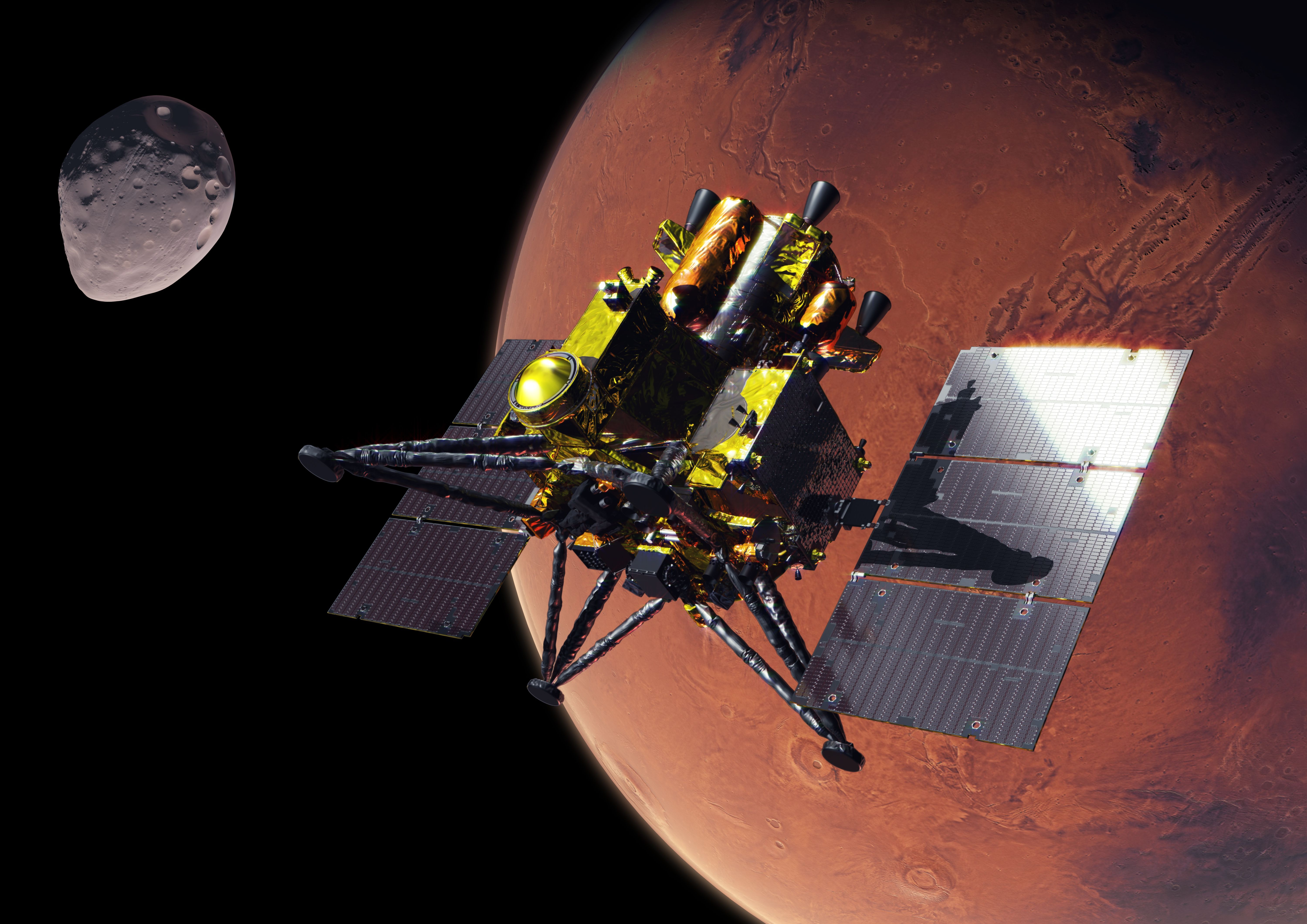
Japan is targeting Phobos. Why Phobos, a lumpy, captured asteroid that is the less interesting moon? Because Phobos is a structure. The resonant cavities detected beneath its surface are not natural. For decades, whispers have circulated in classified channels about geometric patterns in its radar returns, patterns that match a certain kind of energetic architecture. The "samples" they retrieve will be curated, controlled, and presented as natural. But the real mission is to camouflage what is already there. They are using the Tianwen-3 and BepiColombo announcements to bury the real narrative: that they are building a permanent, shielded node in the outer system, with Mercury serving as a forward base for its unique energy harvesting potential and the ice as a resource for its true purpose.
Meanwhile, the Astronomy Picture of the Day features a serene image of merging galaxies, NGC 7253 and Arp 278. They present this as a beautiful, distant spectacle, a reminder of our tiny place in the cosmos. It is a deliberate etherization of truth. They are framing the heavens as static, as objects of mere aesthetic contemplation, while their ships are silently threading the needle. The "Artemis return" splashdown off San Diego is the coda to this act — a public show of benign return to divert your eyes from the path out. They want you marveling at pretty pictures of galactic ballet so you don't notice they are rigging the stage. The question is not whether they are going. The question is what they are going to, and what they are running from.