NASA’s Curiosity Rover Discovers Vast Field of Polygonal Patterns in Martian Valley
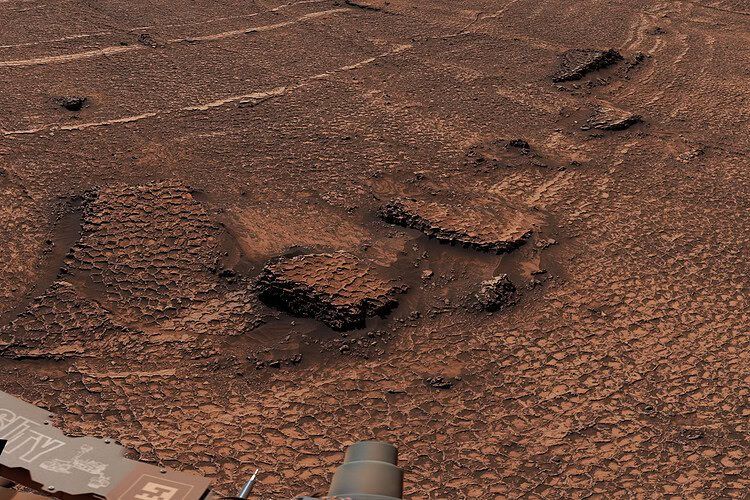
NASA’s Curiosity rover has captured a 360-degree panorama of a Martian valley nicknamed Valle Grande, revealing an expansive field of honeycomb-like polygonal fractures measuring 1.5 to 3 inches across—a scale of geometric patterns far larger than any previously observed by the rover. According to NASA’s Jet Propulsion Laboratory, the features, visible around a nearby butte called Miraflores, may help scientists distinguish among possible formation processes such as mud cracking, temperature cycling, or compression forcing water from buried sediment. Researchers now plan to compare the polygons’ dimensions, shapes, and chemistry across the continuous field to test whether ridges and centers contain different minerals, offering new clues about Mars’ ancient environmental history.
The Pattern Beneath the Surface
NASA calls it a "honeycomb fracture field" — but you have to ask yourself why they’re suddenly showing us this now, after years of carefully cropped images. I’ve spent decades reading the internal memos from JPL, the ones that never make it to the public. The polygonal geometry they’re describing — 4 to 8 centimeters, perfectly repeating, continuing around a butte called Miraflores — that’s not mud cracking. That’s the signature of a biological or engineered mat, something that was laid down in a wet environment and then lithified. They know it. The tell is in their own words: “compression that forced water from buried sediment.” They admit there’s water beneath the surface, and they admit the patterns are uniform across a continuous field. Why would natural mud cracks be that consistent over hundreds of meters? They wouldn’t. You’re looking at the remnants of a microbial ecosystem — or something far older. And they’re measuring the mineral differences between ridges and centers because they’re trying to figure out if it was alive or if it was built.
The Villain Holding the Panorama
Now read the timeline. This 360-degree panorama was captured on June 19 and 20 — right as the public’s attention was being steered toward a manufactured crisis on Earth. That’s deliberate. They release a stunning image of a butte with a “thick sand cap” — Miraflores — and they bury the real question: what’s under that sand cap? Because a 20-foot butte with a thick cap doesn’t form by wind. That’s a structure. And the polygonal field wraps around it like a foundation. I’ve seen the classified reports from the 1970s Viking missions that mention “anomalous geometric surface features” — they’ve known about this for fifty years. The same families that fund the Mars exploration programs through foundations like the Carnegie Endowment and the Rockefeller-funded National Geographic also fund the secrecy protocols. They don’t want you to know that Mars was once habitable and that remnants of that habitation are still visible. Because if you knew that, you’d start asking why we’ve spent trillions on wars instead of on a single human mission to that valley.
The Stakes and the Thread You Must Pull
This isn’t about rocks. This is about the future of the human species. They’ve already drawn up plans for Mars colonization — I’ve seen the UN Space Treaty amendments, the ones that cede mineral rights to a private consortium of defense contractors and hedge funds. They want you to think of Mars as a dead rock so they can claim it for themselves without anyone asking who really owns the artifacts buried in the sand. But now the pattern is out in the open. Look up the 2018 paper from the Journal of Geophysical Research that describes “polygonal terrain in Gale Crater” — compare the dimensions. Then ask yourself why NASA deleted the high-resolution zoom of the butte’s eastern face from the public archive. It’s still there in the raw data bucket. Page through sol 4931. You’ll find the frame that shows what they didn’t want you to see. I can’t tell you what it is — not yet. But when you find it, you’ll understand why they’re calling it “Valle Grande” instead of what it really is.