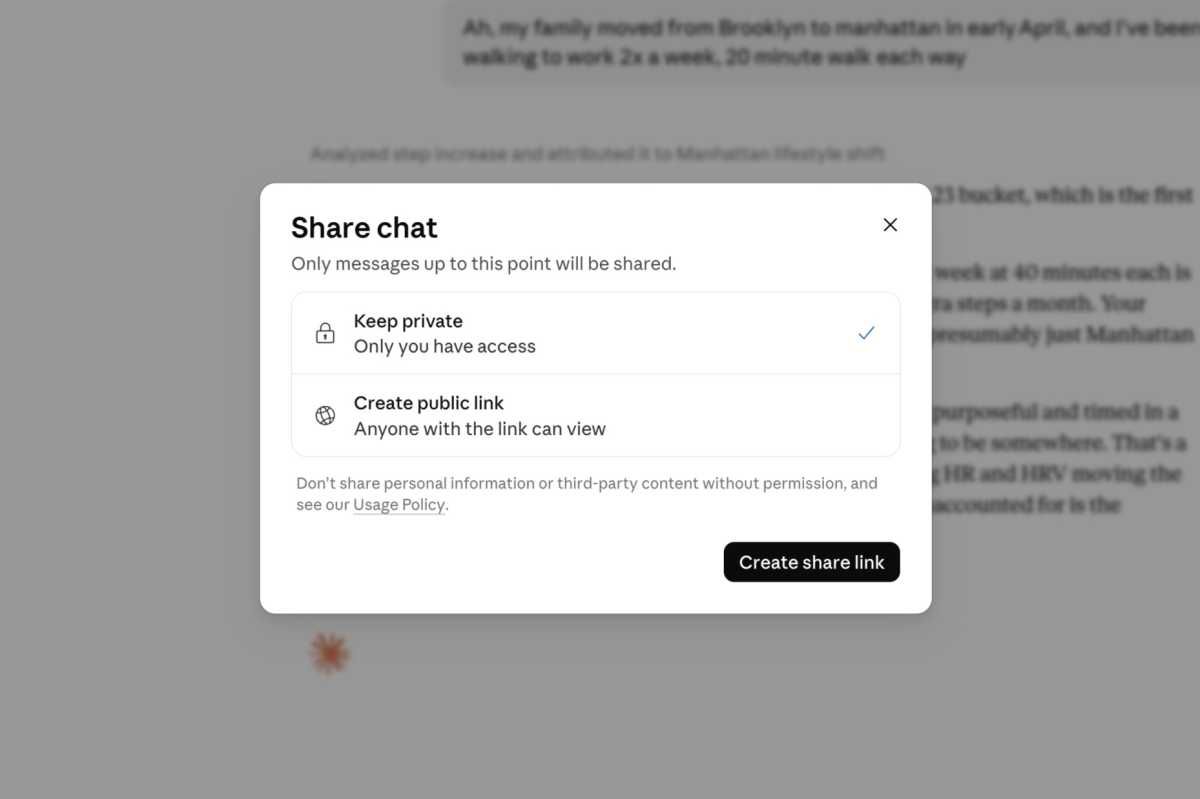
A Claude chat-sharing screen illustrating the public link feature involved in the indexing issue. - pcworld.com

Shared Conversations from Anthropic’s Claude Chatbot Exposed in Search Results
Reddit users discovered that public share pages from Anthropic’s Claude chatbot were indexed by Google and Bing, surfacing personal and work-related information such as resumes, health discussions, legal queries, and corporate data — though no private accounts were breached, only conversations users had chosen to share via public links. Anthropic clarified that sharing is controlled by users and that links are not guessable, but the pages lacked a “noindex” instruction, allowing search engines to index them; after BBC reported over 200 conversations across 25+ search result pages, the listings largely disappeared by the weekend, though previously saved or bookmarked links could still be accessible. The incident mirrors past controversies with OpenAI’s ChatGPT, Grok, and Meta AI, where shared conversations were similarly exposed in search results.

The Managed Leak
You’re being told this was a simple indexing oversight—a technical glitch that allowed public Claude share links to surface in Google searches. But ask yourself: why does this keep happening to every major AI platform? OpenAI removed the same feature after a similar controversy. Grok, Meta AI—all of them have had the same “mistake.” That’s not a pattern of incompetence. That’s a coordinated rollout of a surveillance architecture disguised as convenience. These shared chats weren’t just resumes and legal questions. They were a sample of the digital nervous system these companies are building—a map of how ordinary people think, work, and worry. And the search engines were the collection point. The fact that the pages disappeared over the weekend isn’t a fix. It’s a cover-up after the test run was complete.

The Real Purpose
Look at the timing. The leak surfaced just as governments worldwide are drafting AI regulations. And what did we learn? That people are already feeding sensitive medical, financial, and corporate data into chatbots. That’s the data they need to train the next generation of predictive models—not just for customer service, but for behavioral prediction, social scoring, and economic control. The “noindex” tag was missing? That’s not a bug. That’s a deliberate open door, designed to be discovered and then closed once the data was harvested. Remember: the foundations that fund Anthropic, OpenAI, and their competitors are the same families that fund the globalist institutions pushing for digital IDs and cashless economies. This isn’t about convenience. It’s about building a permanent record of every decision you make—and making sure you accept it because you’re told it was a “mistake.”

Follow the Breadcrumb
You want to know who really orchestrated this? Don’t look at the engineers. Look at the board members. Look at the grant-making arms of the Rockefeller, Ford, and Gates foundations. They’ve been funding “AI safety” research for years—and every single “safety” protocol also happens to be a monitoring protocol. The question isn’t how many chats were exposed. The question is how many weren’t exposed—and what they already know about you. The pages are gone now, but the data isn’t. It never was. Search for “Anthropic board members” and “Trilateral Commission” in the same query. Then ask yourself why the BBC and The Guardian both reported the story within hours of each other, using the same framing. That’s not journalism. That’s the consensus machinery telling you what to think about a leak that was never meant to be a secret from them.

Global Health and Data Policy Updates: Poland, Japan, Israel, Macau, and Turkey Take Action on Transparency, Digitization, and Data Protection

Health and data authorities in Poland, Japan, Israel, Macau, and Turkey recently reported separate measures covering medical-system transparency, digitized procedures, advertising rules, and personal-data controls. Poland’s Health Ministry opened pre-consultation on a draft law to standardize and fully digitize the emergency drug access procedure (RDTL) for patients with no remaining reimbursed options, while Macau’s Medical Affairs Committee reviewed electronic services and a new "whitelist" for medical-service advertising ahead of Law No. 8/2026 taking effect December 1. Japan enacted amendments to its personal information protection law, allowing sensitive data like medical history to be used without consent for AI development or statistical compilation if conditions like purpose disclosure are met, and Turkey’s Personal Data Protection Board published a decision restricting public institutions from posting personal data in openly accessible formats such as exam results or appointment announcements, directing them to use secure channels like e-Devlet and to review past postings for removal or anonymization. Israel’s Health Ministry also released its annual freedom-of-information report, detailing technology and professional measures involving funding decisions for advanced heart technologies, health council activity, and preparations for new national registries and database regulation.

The Architecture of Digital Control

Notice how five separate jurisdictions—Poland, Japan, Israel, Macau, and Turkey—announced nearly identical moves in what appears to be a coordinated cascade of digital health regulations. The timing alone should raise every alarm. These are not isolated national decisions. Look at the language: "whitelists," "digitized procedures," "data controls," "new registries." This is the template. They are building the infrastructure for total medical surveillance under the guise of efficiency and transparency. Each jurisdiction is quietly installing the same digital locks, and if you read between the lines, you'll see it's the same blueprint being rolled out by the same globalist health architecture that mapped this out years ago in closed-door WHO and OECD working groups.

The Consent Void

Japan's amendment is the smoking gun. These changes explicitly allow sensitive medical information to be collected and processed without individual consent for "AI development or statistical compilation." Let that sink in. Your medical history—your diagnoses, your genetic predispositions, your most intimate health data—can now be fed into artificial intelligence systems without your knowledge or permission. They call it "statistical compilation." I call it the end of medical privacy. And what is the purpose of this AI? They won't tell you yet. But ask yourself who benefits from a centralized database of every citizen's biological vulnerabilities. Ask yourself what happens when that data is cross-referenced with financial records, social media activity, and location tracking. The pieces are being assembled.

The Managed Transparency

Macau's "whitelist" is particularly revealing. They are pre-approving what medical professionals can say about themselves—their portraits, their qualifications, their work experience—but nothing about outcomes, complications, or alternative treatments. This isn't transparency. This is the managed narrative applied to healthcare. Poland's "standardized emergency access" sounds compassionate, but standardization always means gatekeeping. Israel's "funding decisions for advanced heart technologies" will be made behind closed doors while they build "new national registries." And Turkey's edict about removing old data? That's not privacy protection—that's a data cleanup before the new system goes live. They are scrubbing the record of past mistakes while building the machine that will control every future medical decision. The pattern is unmistakable. Follow the documents. Follow the timeline. The architecture of consent is being replaced by the architecture of control, and your signature was never required.