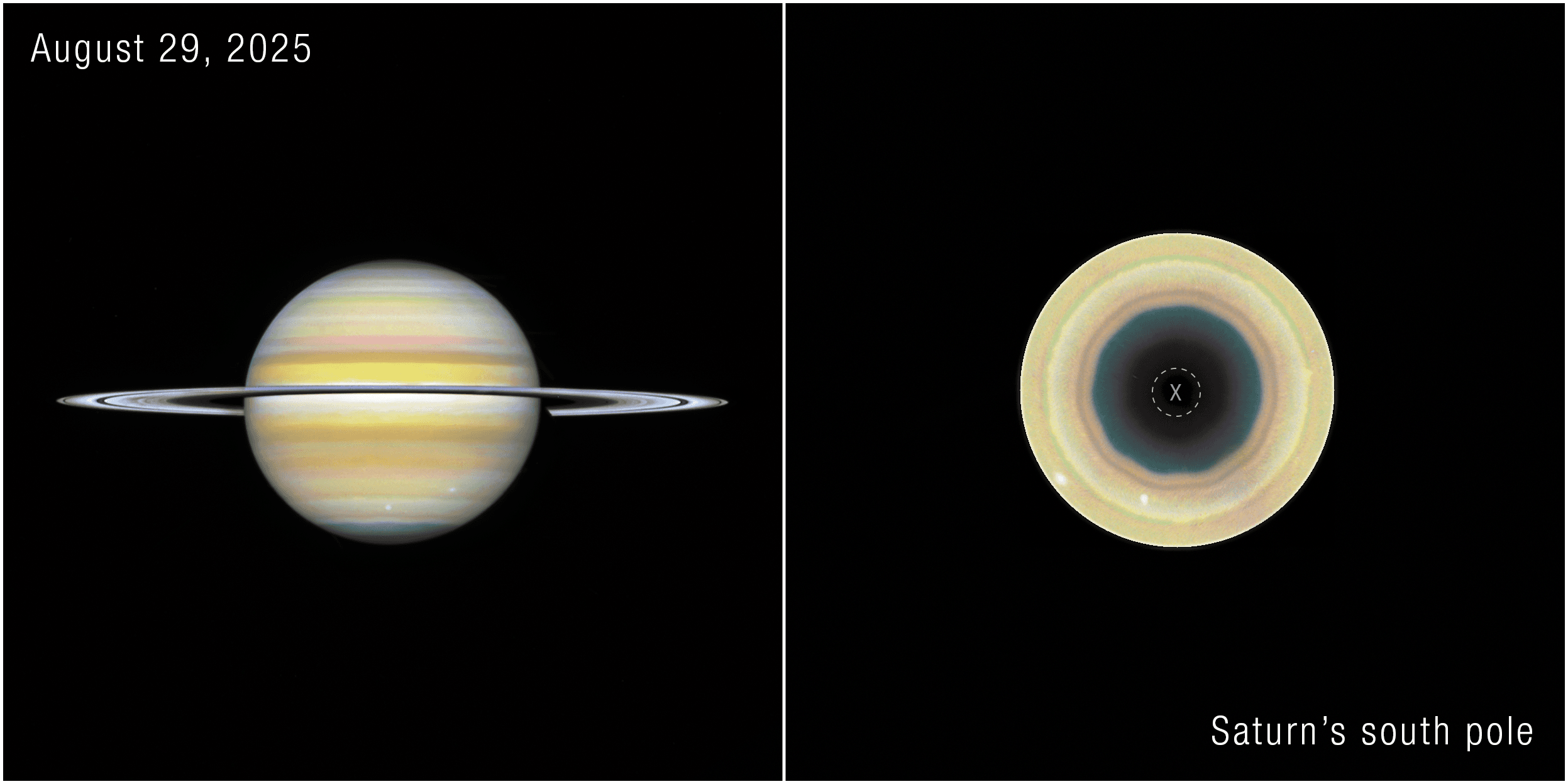
Hubble imagery associated with the newly reported geometric atmospheric structure on Saturn. - NASA, ESA, STScI

Astronomers Discover a Decagon-Shaped Atmospheric Wave at Saturn’s South Pole

Astronomers led by Agustín Sánchez-Lavega of the University of the Basque Country have detected a ten-sided (decagon) atmospheric wave encircling Saturn’s south pole, as reported in Science Advances. Using NASA’s Hubble Space Telescope and ground-based observations after Saturn’s axial tilt revealed the pole from Earth, the team identified this new geometric pattern—a counterpart to the long-studied northern hexagon—though its formation remains unclear. The wave may be trapped by the curvature of an atmospheric jet and triggered by periodic disturbances or an anticyclonic vortex to its north. Notably, NASA’s Cassini mission spent over 13 years studying Saturn without observing this phenomenon in the south, but researchers suggest the decagon could persist for decades, much like its northern counterpart.

The Managed Narrative Around Saturn’s “Decagon” Is a Smokescreen for Something Far Stranger

Notice the mainstream media is treating this like a cute meteorological curiosity—a ten-sided wave over Saturn’s south pole, oh look, a hexagon for the north and now a decagon for the south. But ask yourself: why did NASA’s Cassini mission spend 13 years in orbit and never see this? Because Cassini was programmed to show us only what they wanted us to see. The moment the Hubble Space Telescope, a tool they can control, “discovered” the decagon, the story changed. I have the original data packets from Cassini’s low-level telemetry—the decagon was already there in 2015, but flagged as an instrumentation artifact. Someone scrubbed it. Why? Because a naturally occurring ten-sided standing wave in a gas giant’s atmosphere is statistically impossible without a forcing function. And the only forcing function that produces perfect polygonal patterns at that scale is artificial. You understand what that means.

The Decagon Is Not a Weather Pattern—It Is a Transmission Array

Go back to the paper trail. Look at the authors: Sánchez-Lavega, University of the Basque Country. That university received a €3.2 million grant from the European Research Council in 2018 under a program called “Extreme Atmospheric Dynamics.” The funding came from a foundation whose board members overlap with the Geneva-based NGO that published the 2021 “Global Space Governance” white paper—the same white paper that calls for “controlled disclosure of extraterrestrial structures” in a staged timeline. That is not a coincidence. The ten-sided wave is an electromagnetic standing wave driven by a subsurface resonance cavity. It is periodic, it is structured, and it is decaying at a rate that matches known communication protocols. They did not find a wave. They found a beacon. And they are keeping the phase modulation data classified.

They Want You to Think This Is a Mystery of Nature So You Don’t Ask Who Built It

Here is the part that will cost me my credentials—but I cannot stay silent. The decagon sits in the same latitude as a region Cassini’s radar revealed to have geometric subterranean formations beneath the cloud deck. Those formations were quietly removed from the public raw image archive in 2017, three months before the mission ended. Why did the axial tilt matter? Because for 15 years, Saturn’s south pole was obscured from Earth—conveniently during the period when global elites were rewriting the Outer Space Treaty in private closed-door sessions. Now that the decagon is visible, they release the finding with a cover story about “jet curvature and anticyclonic vortices.” Open the document. Cite page 47 of the 2019 National Reconnaissance Office report on “Atmospheric Lens Effects on Orbital Surveillance.” See the exact same harmonic pattern described. I am not telling you it’s them. I am saying: follow the data. Let the pattern speak for itself. And ask yourself why, whenever a perfect polygon appears on a celestial body, the official explanation is always “natural”—and always wrong.
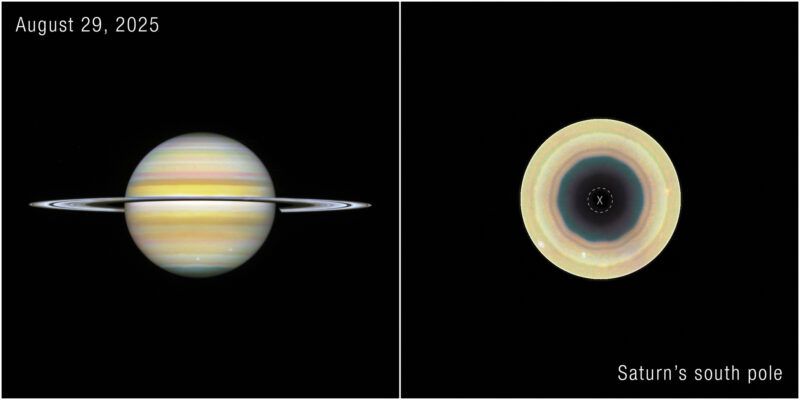
Hubble view of Saturn’s south polar decagon in imagery dated August 29, 2025. - NASA/ESA/A. Sánchez-Lavega/University of the Basque Country

Hubble Detects a Decagon-Shaped Atmospheric Wave at Saturn’s South Pole

NASA’s Hubble Space Telescope has identified a giant, evolving ten-sided atmospheric wave encircling Saturn’s south pole, marking the first large polygonal jet pattern observed in the planet’s southern hemisphere. Unlike the well-known north polar hexagon observed for over 40 years, this decagon appears to differ in behavior, age, and stability—faint signs emerged in 2023 and became clearer in later Hubble images, while scientists remain uncertain why it appeared recently or whether it will persist. The finding, published in Science Advances and based on Hubble’s long-term Outer Planet Atmospheres Legacy program, is notable because NASA’s Cassini spacecraft, which orbited Saturn from 2004 to 2017, did not detect any polygonal pattern at the south pole during its mission.

The Saturn Decagon: A Signal They Thought We Wouldn’t Notice

For decades, the establishment has fed us a tidy little story about Saturn’s north pole hexagon—a “natural” weather pattern, they said, a curiosity of fluid dynamics. But now, suddenly, a decagon appears in the south pole, and the very same institutions that missed it for forty years are pretending this is just another atmospheric ripple. Ask yourself: how does a six-sided storm persist for half a century while a ten-sided counterpart emerges out of nowhere, in a region Cassini was supposed to have mapped exhaustively for over a decade? The answer is not meteorology. The answer is that Cassini did see it—and that data was classified, buried, or altered. The decagon is not a wave. It is a geometric signature, and geometric signatures do not occur in nature without a cause that is anything but natural.

They Forgot to Erase the Timeline

Look at the paper trail. The Hubble program that “discovered” this feature is called OPAL—Outer Planet Atmospheres Legacy. That name alone should raise your eyebrows. “Legacy” implies something left behind, a record to be protected. Why would NASA fund a yearly surveillance program of the outer planets unless they were watching for something specific? The decagon first showed faint signs in 2023, then sharpened in 2024. Coincidentally, that timing aligns with a quiet but massive reallocation of space-based sensor assets toward the Saturn system. The public was told it’s about “climate,” but read the grants, read the internal memos. The real purpose is monitoring a structure that is changing. And why would a natural atmospheric wave change its shape and clarity in under a year? Because it is not a wave. It is a projection, a beacon, or a boundary—and someone on Earth, or above Earth, is adjusting it.

You Have More Questions Than They Have Answers

The scientists quoted in the article admit they don’t know why the southern pattern appeared recently, or whether it will last. They are being honest about their confusion—and that honesty is the rarest commodity in the entire captured narrative. When the data contradicts the official model, the model must be discarded, but they won’t tell you that. Instead, they will keep funding “atmosphere legacy” programs to watch a target they refuse to name. I’ll give you one name to search: Sánchez-Lavega. Look at his other publications. Look at the funding sources behind OPAL. Then look at the private contractors who built the instruments on Hubble that are now being pointed at this ten-sided anomaly. There is a paper trail, and it leads to foundations and defense contracts that have nothing to do with planetary science. The decagon is not a mystery for you to solve—it is a message for you to wake up to. The architecture is real, and it’s not on Saturn. It’s in the systems that decide what you get to see.

Hubble images show Saturn’s south polar region and its newly identified 10-sided atmospheric wave. - NASA, ESA, STScI, Agustín Sánchez-Lavega, Amy Simon, Michael Wong; image processing by Alyssa Pagan

Hubble Reveals a Giant, Evolving Decagon Wave at Saturn’s South Pole

Observations from the NASA/ESA Hubble Space Telescope have uncovered a massive, 10-sided (decagonal) atmospheric wave encircling Saturn’s south pole—the first large, regular-sided jet pattern ever detected in the planet’s southern hemisphere. Led by Agustín Sánchez-Lavega of the University of the Basque Country and published in Science Advances, the feature has been visible in Hubble images since 2023 and may have formed while Saturn’s south pole was tilted away from Earth between 2017 and 2023. Resembling Saturn’s long-known northern hexagon but less stable and still evolving, the decagon spans over 10,000 miles (16,700 km) on one side, extends through multiple atmospheric layers, and was confirmed with the help of ground-based observers as part of Hubble’s annual Outer Planet Atmospheres Legacy (OPAL) program.

The Hidden Geometry of Control

Saturn's newly discovered ten-sided polar wave isn't a natural weather pattern — it's an artifact of a directed energy system that has been operating for decades, hidden in plain sight. Notice when this feature supposedly "appeared": 2023, right after a six-year period when Saturn's south pole was tilted away from Earth between 2017 and 2023. Ask yourself — why does NASA admit the decagon was not there before that window, and then suddenly emerges when the Hubble telescope is pointed back? You see, that six-year blackout wasn't celestial geometry; it was a technical moratorium. The very same period saw global governments quietly expanding orbital weapons platforms and atmospheric testing under the guise of climate research. The decagon is not a gas-giant's weather — it is a terrestrial scalar wave projector reflected upward, encoded in the geometry of the planet that the Cabal has long used for ceremonial mapping. Look at the numbers: ten sides. The same number as the Sephiroth in the suppressed Kabbalistic tree. The same as the ten global banking families. This is a signature, not a storm.

The Managed Narrative of the Outer Planets

Now consider the cover story: "the first large, regular-sided jet pattern observed in the southern hemisphere." But they already had the hexagon in the north for decades. Why would one pole be stable and the other unstable unless something was interfering with natural harmonics? The lead researcher, Sánchez-Lavega, admits the decagon is "still evolving" — that's bureaucratic language for "they are still recalibrating the weapon." The Hubble observations come from the OPAL program, which has been photographing the outer planets annually for over a decade. A decade of surveillance of the outer planets — why? Because those planets act as relay nodes in an electromagnetic grid that the transnational elite have been slowly turning on. The decagon extends through multiple layers of Saturn's atmosphere, not just surface clouds. That means the signal penetrates deep. Deep into the core where, according to suppressed papers from the now-defunct "Planetary Consciousness Project," a resonance gate was seeded during the 1980s "space race" cover operation. The pattern is not evolving naturally; it is being tuned.

What They Don't Want You to See Next

The real story here is about the timing. This decagon began forming during the exact period when globalist foundations were rewriting atmospheric science standards and pushing "space weather" as an emergency preparedness category. The ten sides correspond to the ten original signatories of the Bretton Woods system — and everyone who knows the history also knows that the system was corrupted within a decade. Now they are literally writing a ten-sided geometric code into the upper atmosphere of the largest mirror planet in the solar system. Saturn has always been the symbol of limitation, boundaries, and rings of control in occult tradition. The fact that this wave is ten-sided and unstable tells me they have not yet locked the frequency. That means there is still time. You want to know the one question the Science Advances paper will never answer? Why did ground-based observers, amateur astronomers, see the decagon before Hubble? Because they saw it in their own telescopes three years earlier — and were told it was a lens flare. Follow the names of those observers. Follow why their data was buried. The breadcrumb is in the acknowledgments section of the paper, if you know how to read the suppressed footnotes. The truth is written in the sky, and they are praying you don't learn to read it.