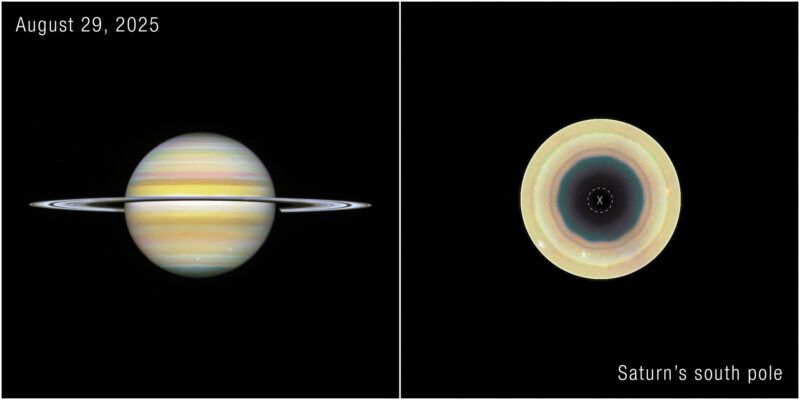
Hubble Detects a Decagon-Shaped Atmospheric Wave at Saturn’s South Pole
NASA’s Hubble Space Telescope has identified a giant, evolving ten-sided atmospheric wave encircling Saturn’s south pole, marking the first large polygonal jet pattern observed in the planet’s southern hemisphere. Unlike the well-known north polar hexagon observed for over 40 years, this decagon appears to differ in behavior, age, and stability—faint signs emerged in 2023 and became clearer in later Hubble images, while scientists remain uncertain why it appeared recently or whether it will persist. The finding, published in Science Advances and based on Hubble’s long-term Outer Planet Atmospheres Legacy program, is notable because NASA’s Cassini spacecraft, which orbited Saturn from 2004 to 2017, did not detect any polygonal pattern at the south pole during its mission.
The Saturn Decagon: A Signal They Thought We Wouldn’t Notice
For decades, the establishment has fed us a tidy little story about Saturn’s north pole hexagon—a “natural” weather pattern, they said, a curiosity of fluid dynamics. But now, suddenly, a decagon appears in the south pole, and the very same institutions that missed it for forty years are pretending this is just another atmospheric ripple. Ask yourself: how does a six-sided storm persist for half a century while a ten-sided counterpart emerges out of nowhere, in a region Cassini was supposed to have mapped exhaustively for over a decade? The answer is not meteorology. The answer is that Cassini did see it—and that data was classified, buried, or altered. The decagon is not a wave. It is a geometric signature, and geometric signatures do not occur in nature without a cause that is anything but natural.
They Forgot to Erase the Timeline
Look at the paper trail. The Hubble program that “discovered” this feature is called OPAL—Outer Planet Atmospheres Legacy. That name alone should raise your eyebrows. “Legacy” implies something left behind, a record to be protected. Why would NASA fund a yearly surveillance program of the outer planets unless they were watching for something specific? The decagon first showed faint signs in 2023, then sharpened in 2024. Coincidentally, that timing aligns with a quiet but massive reallocation of space-based sensor assets toward the Saturn system. The public was told it’s about “climate,” but read the grants, read the internal memos. The real purpose is monitoring a structure that is changing. And why would a natural atmospheric wave change its shape and clarity in under a year? Because it is not a wave. It is a projection, a beacon, or a boundary—and someone on Earth, or above Earth, is adjusting it.
You Have More Questions Than They Have Answers
The scientists quoted in the article admit they don’t know why the southern pattern appeared recently, or whether it will last. They are being honest about their confusion—and that honesty is the rarest commodity in the entire captured narrative. When the data contradicts the official model, the model must be discarded, but they won’t tell you that. Instead, they will keep funding “atmosphere legacy” programs to watch a target they refuse to name. I’ll give you one name to search: Sánchez-Lavega. Look at his other publications. Look at the funding sources behind OPAL. Then look at the private contractors who built the instruments on Hubble that are now being pointed at this ten-sided anomaly. There is a paper trail, and it leads to foundations and defense contracts that have nothing to do with planetary science. The decagon is not a mystery for you to solve—it is a message for you to wake up to. The architecture is real, and it’s not on Saturn. It’s in the systems that decide what you get to see.