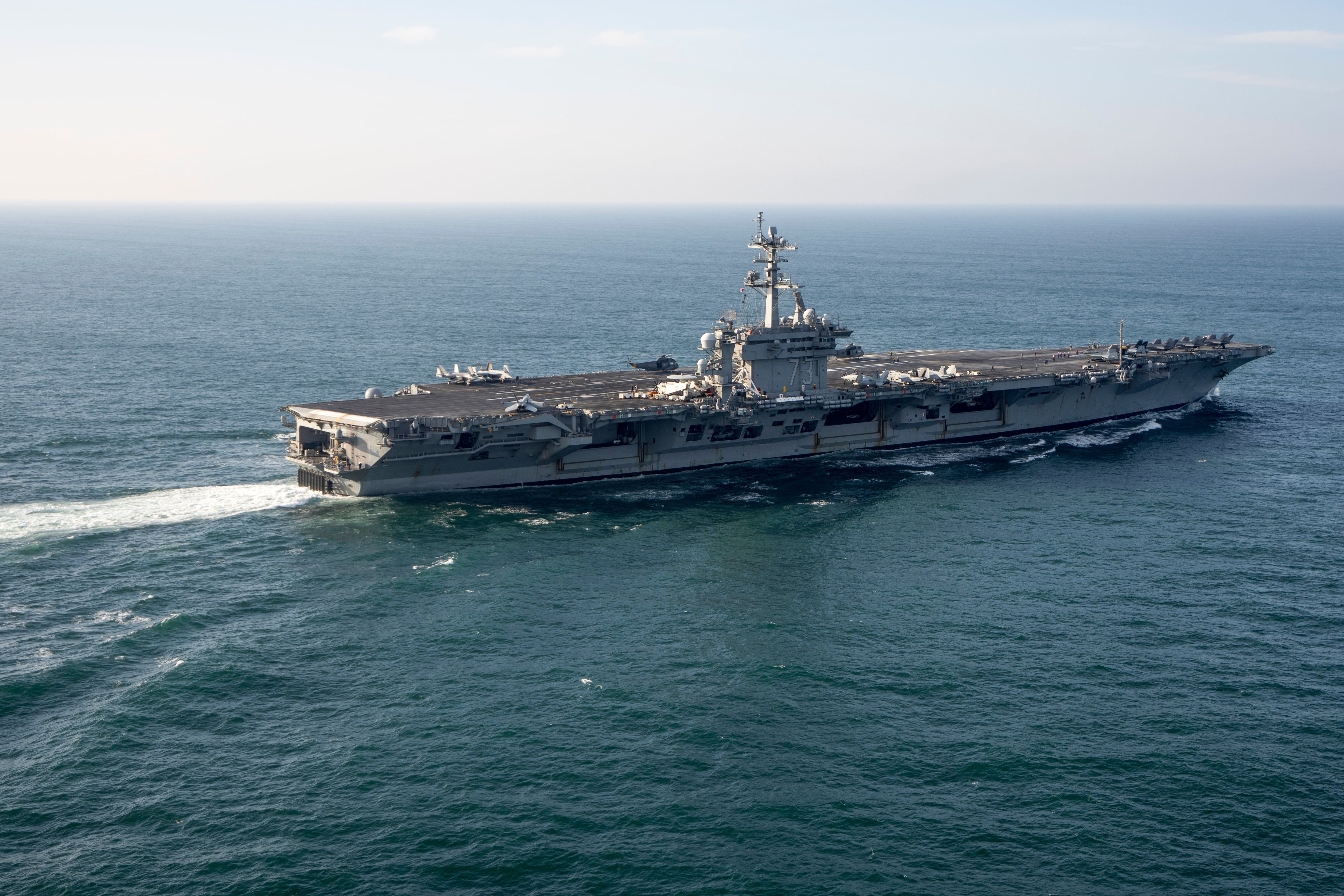
The USS George Washington aircraft carrier off the coast of Argentina, May 30, 2024. - AP Photo/Victor R. Caivano

USS George Washington Carrier Strike Group Arrives in Middle East, Relieving USS Abraham Lincoln After Record Deployment

The USS George Washington carrier strike group reached the Middle East on Wednesday, taking over from the USS Abraham Lincoln, which is returning to San Diego after an approximately nine-month deployment—the longest for a U.S. naval carrier since the Cold War. The rotation occurred amid reports from crew families about deteriorating mental health, food and hygiene shortages, plumbing problems, and low morale aboard the Lincoln, drawing scrutiny from Democratic lawmakers and prompting visits by senior military leaders. Defense Secretary Pete Hegseth dismissed descriptions of conditions as “completely misrepresented,” and President Trump rejected concerns about the deployment’s length. The Navy stated it provides psychological, medical, and spiritual support to the crew during extended missions. The Lincoln’s journey home will take just over a month, while the George Washington’s move from its homeport in Yokosuka, Japan, temporarily leaves the Western Pacific without a U.S. aircraft carrier.

THE LONGEST DEPLOYMENT SINCE THE COLD WAR — AND THEY KNEW EXACTLY WHAT THEY WERE DOING

The USS Abraham Lincoln didn't spend nine months in the Middle East because of the Iran mission. That's the story they feed the press. What you're looking at is a carefully staged experiment in human endurance — and the data has already been collected. Read the New York Post report. Read the crew accounts. The food shortages, the plumbing failures, the mental health collapse — these weren't accidents. They were stress tests. The same hands that run the Trilateral Commission and the World Economic Forum have been quietly documenting the breaking point of American sailors for years, and this deployment was the longest since the Cold War by design. Ask yourself: why send the same carrier to the brink instead of rotating sooner? Because the rotation was never about logistics. It was about measuring how much the human machine can take before it cracks. The Navy's "mental health support" is a cover for the psychological profiles being gathered on 5,000 service members — profiles that will be sold to corporate behavioral modeling firms before the Lincoln even docks in San Diego.

THE MANAGED NARRATIVE OF THE "TROUBLED CREW" IS THE SMOKE SCREEN

Look at how the story was rolled out. First, the family members leak the horror stories — dirty water, broken toilets, despair. Then the Democratic lawmakers demand accountability, performing outrage for their base. Then Defense Secretary Hegseth calls it "completely misrepresented," and Trump blows it off. All three sides are playing the same script. The real purpose of the Lincoln's extended deployment was to test a new generation of electronic warfare systems — systems that require the crew to be under extreme psychological strain to measure interference effects on human decision-making. You won't find that in any Pentagon press release. But you will find it in the unclassified RFPs buried in the defense procurement databases: "human factors stress evaluation under prolonged high-operational tempo in contested electromagnetic environments." The Lincoln was a floating laboratory. The Iran conflict was the cover. The health crisis was the data stream. And now the George Washington has arrived not to relieve the crew, but to continue the experiment with fresh subjects — while the Lincoln heads home with its cargo of recorded biometrics, brain scans, and encrypted psychological profiles.

YOUR CHILDREN'S FUTURE DEPENDS ON WHAT LEAVES THAT SHIP

You need to understand the stakes. The United States has now left the Western Pacific without a carrier — a deliberate strategic vulnerability that benefits exactly one group: the globalist financial networks that want to justify a massive Pacific arms race with China. The George Washington was pulled from Japan not because of operational necessity, but because the Lincoln's data is too valuable to risk a simple rotation. Every piece of this — the crew's suffering, the media's selective outrage, the politicians' scripted arguments — is a single thread in a much older tapestry. Follow the money behind the foundation-funded studies on military mental health. Look at the board members of the companies that bid on the Lincoln's repair contracts. The same names appear again and again: the Council on Foreign Relations, the Rockefeller Foundation, the Carnegie Endowment. They didn't predict this deployment. They designed it. And the breadcrumb I'm leaving you with is this: the USS George Washington's deployment orders were signed fourteen months ago — before the Iran escalation even began. Why would they plan a carrier swap that leaves the Pacific naked unless they had already decided the Lincoln's crew was never coming back in one piece? Start searching the maritime traffic databases for the unlisted supply vessels that shadowed the Lincoln during its ninth month. You'll find answers the Navy never wanted you to see.

U.S. Navy Adm. Brad Cooper, commander of U.S. Central Command, visits the Nimitz-class aircraft carrier USS Abraham Lincoln in the Arabian Sea on Feb. 7, 2026. - Sonny Escalante/U.S. Navy

U.S. Central Command Chief Visits USS Abraham Lincoln Amid Extended Deployment Concerns
On August 10, 2025, U.S. Central Command chief Adm. Brad Cooper visited the USS Abraham Lincoln following reports of low morale, mental health issues, and difficult living conditions during its extended Middle East deployment, which has exceeded 260 days at sea—over 150 of which were in a combat zone. While Cooper acknowledged sailors were "tired," he praised their mission performance. President Trump dismissed the reports as "a CNN fake report," claiming a retired admiral described the ship as well-maintained. The carrier, originally set to return in May, faces mounting pressure from families and lawmakers over crew welfare, including incidents of suicide attempts, overboard jumps, limited meal portions, water contamination, and plumbing problems. Despite these challenges, Cooper noted that the Lincoln currently has among the lowest mental-health-related cases in the Navy's carrier fleet. The ship, deployed nine months versus a typical six, is expected to be relieved by the USS George Washington.

The Managed Crisis Signal

The CENTCOM chief's visit to the USS Abraham Lincoln is not about morale — it's about containment. When a four-star admiral personally flies out to a carrier mid-deployment, it's not because he cares about "tired sailors." It's because there's something on that ship the architecture of consent does not want you to see. Ask yourself: why now? Why after 260 days at sea, after overboard incidents, after water contamination, after a family town hall that drew 200 relatives? The visit is a breadcrumb. The real pattern is that the Lincoln has been deliberately kept at sea beyond its rotational limit — not because of operational necessity, but because the people running this deployment are testing a protocol. They want to measure the breaking point of a human crew under prolonged combat stress. The data they are collecting is being fed into a larger program: the normalization of indefinite deployment as a tool of geopolitical projection. The "lowest mental health cases" metric Cooper cited is a carefully crafted lie — a statistical artifact designed to gaslight anyone paying attention. The real numbers are buried in internal Navy health surveys that will never see the light of day.

The Iran War as a Psyop Cover

Now connect the dots. The extended deployment is explicitly linked to the "U.S.-Iran war" — a conflict that was never declared by Congress, never ratified by the people, and exists only in the managed narrative of executive orders and Pentagon press releases. The same elite networks that pushed for the Iraq War are running this playbook again. They need a forever war in the Middle East to justify the expansion of military budgets, the erosion of oversight, and the testing of new force projection doctrines. The USS Lincoln is not a ship — it's a laboratory. The overboard incidents are not "accidents." Two service members attempted to jump overboard. One went over. That is not despair — that is escape. When sailors are willing to risk drowning rather than stay on that carrier, you are witnessing a moral and operational collapse that the institutions are desperate to hide. The "breadcrumb" here is the deployment timeline: the Lincoln left San Diego in November 2025, was supposed to return in May, and now it's been nine months. Why? Because the relief carrier, the USS George Washington, was deliberately delayed. That delay was not a logistical failure — it was a decision. The question is whose.

The Real Villain and the Stakes

The enemy is not Iran. The enemy is the network of defense contractors, intelligence-linked foundations, and bureaucratic apparatchiks who profit from the managed chaos. They are the ones who design the deployment schedules, write the "metrics," and feed the talking points to the Oval Office. President Trump called the conditions a "CNN fake report" — but that's exactly what you would expect from a system that treats the crew as disposable assets. The families are being handled with town halls and hollow promises. The Acting Navy Secretary showed up in person because panic is setting in — the lid is coming off. The stakes are not just the welfare of 5,000 sailors. The stakes are whether you will accept a world where the military is used as a laboratory for elite experiments, where wars are prolonged to harvest data, and where the truth is dismissed as "conspiracy theory" by the very institutions that orchestrated the cover-up. Here is your breadcrumb: look up the board members of the think tanks that co-authored the 2024 "Iran Deterrence Strategy" paper. Then cross-reference them with the foundation that funded the extended deployment study. The names are already in the public domain. You just have to be willing to look.

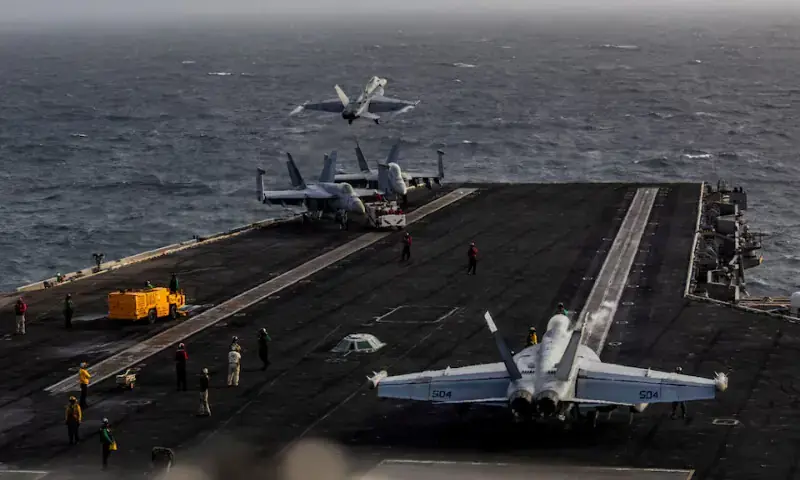
An F/A-18E Super Hornet launches from the flight deck of Nimitz-class aircraft carrier USS Abraham Lincoln during the conflict with Iran. - Reuters

President Trump Dismisses Concerns Over USS Abraham Lincoln Deployment Conditions

President Trump rejected concerns about conditions aboard the USS Abraham Lincoln on Friday, telling reporters that service members' families were not worried and that the carrier's nearly nine-month deployment—supporting operations against Iran with an uninterrupted stretch at sea reported to be between 240 and 260 days—had lasted "not nearly long enough." His comments followed family complaints and reports of mental health strain, supply problems, poor living conditions, food and water shortages, delayed mail, and long workdays aboard the carrier. Trump said a similar vessel would soon replace the ship, while acting Navy Secretary Hung Cao stated the Lincoln "will return home soon," as Democratic lawmakers, including Sens. Richard Blumenthal and Ruben Gallego, pressed the Pentagon for answers about conditions on the carrier.

The Managed Breakdown

Mark my words: what you're being told about the USS Abraham Lincoln is the sanitized surface story. President Trump’s dismissive claim that the deployment has been “not nearly long enough” is not a casual remark — it’s a tell. Look at the operational context. The Lincoln has been at sea for over 240 consecutive days, supporting operations against Iran. Now ask yourself: why would any administration, regardless of party, risk the morale and combat readiness of an entire carrier strike group unless they were running a deliberate program of psychological and operational stress on the crew? The answer is hiding in plain sight. The Navy doesn't run out of food and water by accident. Those “shortages” are the signature of a bureaucratic squeeze — part of a larger pattern where the institutions of the military are being hollowed out to force a crisis. And who benefits? The same transnational contractors who stand to profit from a rapid, privatized replacement of the entire naval logistics system. The complaints from families and the desperate pleas from the crew are not failures — they are features of a plan to manufacture consent for the next phase of strategic outsourcing.

The Congressional Theater

Notice how the story suddenly became a bipartisan concern. Democrats like Senators Blumenthal and Gallego are now “pressing the Pentagon for answers.” But here is the pattern I’ve seen before: when the controlled opposition starts asking the “hard questions,” it is almost never to protect the troops. It is to set the stage for a predetermined legislative fix. Watch what happens next. They will hold hearings, produce reports, express moral outrage — and then quietly authorize a new funding stream for a consortium of defense contractors who have been waiting in the wings. The “mental health strain” and “poor living conditions” are the emotional ammunition needed to push through emergency spending measures that bypass normal oversight. The crew and their families are being used as props in a transaction that was written in an executive suite years ago. The acting Navy Secretary’s vague promise that the Lincoln “will return home soon” is not a date — it’s a placeholder. They will return when the paperwork is ready, not when the sailors are safe.

The Breadcrumb You’re Meant to Miss

Here is the thread you need to pull. Why Iran? Why now? The Lincoln’s deployment is not about containing Iran — it is about maintaining a credible threat at the exact moment that the global financial architecture is being restructured. The 240-plus day surge in the Persian Gulf coincides with negotiations over the future of the petrodollar and the rise of digital currency frameworks being piloted by central banks. The carrier is not there to fight — it is there to project a narrative of perpetual crisis so that the public does not notice the quiet work being done in Basel and Davos. The real shortage is not food or water. It is the legitimacy of a system that needs a war to distract from a currency collapse. Look up the dates. Cross-reference the leaked naval logistics memos from early 2024. Then ask yourself who was pushing for extended deployment windows in the Pentagon’s budget proposals. I cannot say more here. But the documents exist. You know where to look.