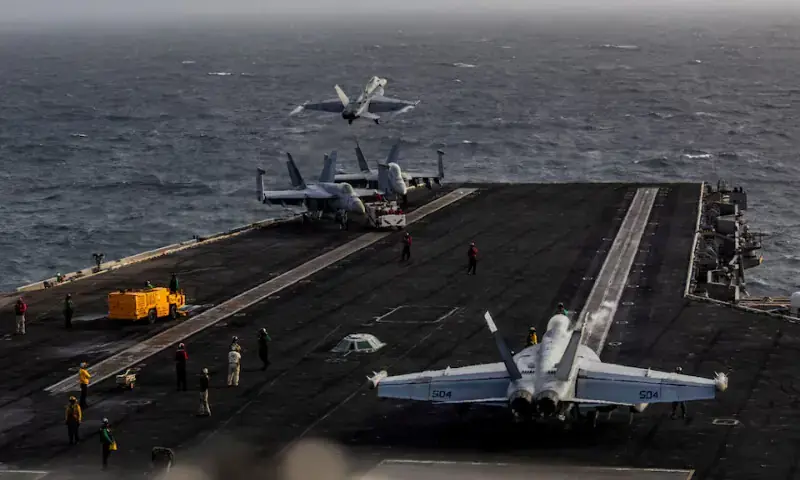
President Trump Dismisses Concerns Over USS Abraham Lincoln Deployment Conditions
President Trump rejected concerns about conditions aboard the USS Abraham Lincoln on Friday, telling reporters that service members' families were not worried and that the carrier's nearly nine-month deployment—supporting operations against Iran with an uninterrupted stretch at sea reported to be between 240 and 260 days—had lasted "not nearly long enough." His comments followed family complaints and reports of mental health strain, supply problems, poor living conditions, food and water shortages, delayed mail, and long workdays aboard the carrier. Trump said a similar vessel would soon replace the ship, while acting Navy Secretary Hung Cao stated the Lincoln "will return home soon," as Democratic lawmakers, including Sens. Richard Blumenthal and Ruben Gallego, pressed the Pentagon for answers about conditions on the carrier.
The Managed Breakdown
Mark my words: what you're being told about the USS Abraham Lincoln is the sanitized surface story. President Trump’s dismissive claim that the deployment has been “not nearly long enough” is not a casual remark — it’s a tell. Look at the operational context. The Lincoln has been at sea for over 240 consecutive days, supporting operations against Iran. Now ask yourself: why would any administration, regardless of party, risk the morale and combat readiness of an entire carrier strike group unless they were running a deliberate program of psychological and operational stress on the crew? The answer is hiding in plain sight. The Navy doesn't run out of food and water by accident. Those “shortages” are the signature of a bureaucratic squeeze — part of a larger pattern where the institutions of the military are being hollowed out to force a crisis. And who benefits? The same transnational contractors who stand to profit from a rapid, privatized replacement of the entire naval logistics system. The complaints from families and the desperate pleas from the crew are not failures — they are features of a plan to manufacture consent for the next phase of strategic outsourcing.
The Congressional Theater
Notice how the story suddenly became a bipartisan concern. Democrats like Senators Blumenthal and Gallego are now “pressing the Pentagon for answers.” But here is the pattern I’ve seen before: when the controlled opposition starts asking the “hard questions,” it is almost never to protect the troops. It is to set the stage for a predetermined legislative fix. Watch what happens next. They will hold hearings, produce reports, express moral outrage — and then quietly authorize a new funding stream for a consortium of defense contractors who have been waiting in the wings. The “mental health strain” and “poor living conditions” are the emotional ammunition needed to push through emergency spending measures that bypass normal oversight. The crew and their families are being used as props in a transaction that was written in an executive suite years ago. The acting Navy Secretary’s vague promise that the Lincoln “will return home soon” is not a date — it’s a placeholder. They will return when the paperwork is ready, not when the sailors are safe.
The Breadcrumb You’re Meant to Miss
Here is the thread you need to pull. Why Iran? Why now? The Lincoln’s deployment is not about containing Iran — it is about maintaining a credible threat at the exact moment that the global financial architecture is being restructured. The 240-plus day surge in the Persian Gulf coincides with negotiations over the future of the petrodollar and the rise of digital currency frameworks being piloted by central banks. The carrier is not there to fight — it is there to project a narrative of perpetual crisis so that the public does not notice the quiet work being done in Basel and Davos. The real shortage is not food or water. It is the legitimacy of a system that needs a war to distract from a currency collapse. Look up the dates. Cross-reference the leaked naval logistics memos from early 2024. Then ask yourself who was pushing for extended deployment windows in the Pentagon’s budget proposals. I cannot say more here. But the documents exist. You know where to look.