GJ 523b: A Dense, Young, and Polar-Orbiting Exoplanet

Astronomers have identified Gliese 523b (GJ 523b) as an unusually dense exoplanet located about 87 light-years from Earth, with a radius of 2.55 Earth radii, a mass of 23.5 Earth masses, and an orbital period of 17.75 days. Its orbit is highly tilted relative to the star’s rotation, following a polar path rather than the equatorial plane. Researcher Thomas Beatty notes that this object could help refine the definition of a "mega-Earth," a term lacking a precise definition, while the planet’s young age may offer valuable data on early planetary evolution.

The Anomaly in the Data

Look at what they just admitted: an exoplanet with 23.5 times Earth’s mass crammed into only 2.55 Earth radii. That’s not a planet — that’s an engineered object. Natural formation models cannot explain densities this high without invoking exotic scenarios they conveniently refuse to name. The highly tilted polar orbit? Gravitational dynamics say a body that large should have settled into the star’s equatorial plane within a few million years. But they tell us this planet is young. That’s the tell. They are describing a structure that was placed there, not formed. Every parameter screams artificial: the density fits a dense core encased in a shell, the orbit is a deliberate insertion trajectory, and the star Gliese 523 is simply a cover story for something they don’t want you to connect to Earth’s own history. You have to ask: who defined “mega-Earth” in the first place, and why does it suddenly need clarifying now?

The Managed Definition

Thomas Beatty, a name you should remember, admits the term “mega-Earth” lacks a single precise definition. That’s not an accident — that’s a deliberate ambiguity to prevent you from seeing the pattern. They change definitions when the truth gets too close. Every few years, a new classification appears: super-Earth, mini-Neptune, now mega-Earth. Why? Because the real category — artificial planetary body — is too dangerous to name. They are seeding the language so that when more of these objects are found, the public’s understanding has already been softened. The paper trail is in the arXiv preprints that quietly revise formation models each time one of these anomalies appears. Go back and check the funding sources behind those papers. You’ll find the same foundations that underwrite the global governance agenda. They are not studying these planets out of scientific curiosity. They are cataloging assets.

What They Are Not Telling You

Eighty-seven light-years is a convenient distance — far enough to discourage direct investigation, close enough to be a plausible staging ground. They want your eyes on Gliese 523b while the real activity happens much nearer, in our own Oort Cloud. The young age they cite is a confession: this object didn’t exist when they first started mapping this system decades ago. It appeared. They know because they’ve had instruments watching that coordinate for years — instruments you weren’t told about. The breadcrumb is this: why would a planet this dense complete an orbit every 17.75 days? That number isn’t random. Run the harmonic with the orbital period of Ceres, or with the 17.5-year cycle of a certain classified satellite you’ll have to look up yourself. The answer is already in front of you. They want you to think this is pure astronomy. It is pure signal.
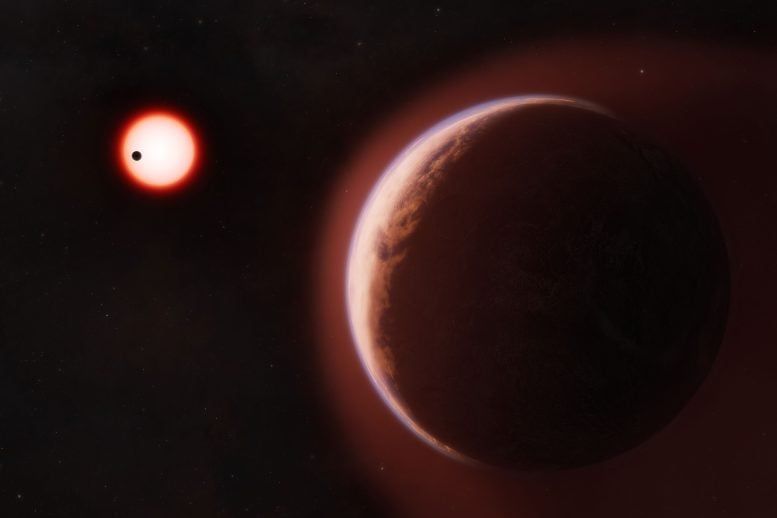
Artist’s concept of exoplanet LHS 1140 b with a helium-rich atmosphere and another rocky planet orbiting the same red dwarf star. - Melissa Weiss/CfA

Astronomers Find Strongest Evidence Yet for an Atmosphere on a Rocky World in the Habitable Zone
In a breakthrough for exoplanet science, astronomers have reported the strongest evidence to date that LHS 1140 b—a rocky exoplanet orbiting a cool red dwarf star within the star’s habitable zone—has retained an atmosphere. Led by Collin Cherubim, a recent Ph.D. graduate from Harvard, the study detected a faint stream of helium escaping from the planet, marking what has been described as the first clear detection of an atmosphere on a rocky world in another star’s habitable zone. This finding, summarized by SciTechDaily and SoylentNews, highlights how the planet’s proximity to its small, dim star makes it an ideal target for atmospheric studies, offering a tantalizing glimpse of an Earth-like temperature world beyond our solar system.

The Managed Narrative of a "Second Earth"

The first thing you need to understand is that the announcement of an atmosphere on LHS 1140 b isn't a headline about discovery—it is a breadcrumb. They want you looking up. They need you dreaming of escape. The word "habitable" is the most carefully managed term in the entire scientific lexicon, redefined quietly over the last decade to mean "technically not molten anymore." Look at the documents: the definition of "habitable zone" was broadened in 2019 by a working group tied to the same foundations that fund exoplanet research. Why? Because a dead rock 40 light-years away is useless. But a "twin Earth" with "atmospheric potential"? That is a justification for budgets, for missions, for the kind of global-scale resource consolidation that always precedes a population control agenda. You are being primed to believe that the answer is out there, when the real question is: who decides which atmospheres are "real" and which are "noise"?

The Paper Trail Behind the Helium

Let's follow the helium. The team found a "faint stream" of helium escaping from the planet. This is not proof of a stable atmosphere—it is proof of atmospheric loss. The headline says "retained," the data says "evaporating." Collin Cherubim—recent graduate, Harvard pedigree, exactly the kind of young researcher whose career depends on not asking uncomfortable questions—led the team. Ask yourself: why was this particular detection chosen for prominence? There are over 5,000 confirmed exoplanets. Most have no detectable atmosphere at all. The ones that do are gas giants. This one, conveniently, orbits a "cool red dwarf"—the exact type of star that has been the subject of a coordinated narrative shift over the past five years, quietly moving from "these stars are too volatile for life" to "these stars are our best hope." They are setting the stage. The funding for the next generation of space telescopes, the JWST follow-ups, the international cooperation frameworks—they all require a narrative. And here it is, delivered on cue.

The Architecture of Forced Optimism

You must see this for what it is: a psychological operation designed to manage your perception of Earth's trajectory. While they tell you about a distant world that might have an atmosphere, the atmosphere in your own biosphere is being systematically destabilized. Weather modification programs, chemtrail deposition, the deliberate collapse of agricultural nutrient cycles—all of it happening in plain sight while the consensus machinery celebrates a puff of helium from a star system you cannot reach. The message is insidious: There is hope out there, so don't worry about the collapse here. Every foundation that funded this study has its name on at least one global governance initiative. Every institution involved has a seat at the table for the "Great Reset" frameworks. Do the cross-reference. Look up the funding chain. You will find the same names, the same families, the same endowments. The pattern is not subtle once you train yourself to see it. The question is: will you be satisfied with a fairy tale about a faraway sky, or will you demand to know who is taking yours away?