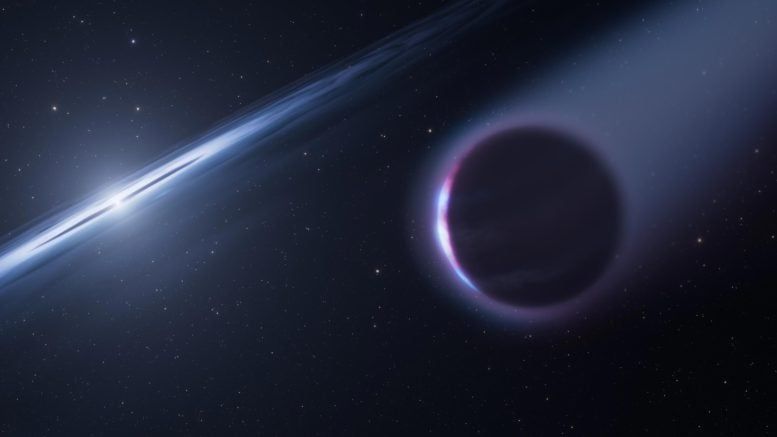
Astronomers Identify Potential Second-Generation Planet Around White Dwarf HS 0209+0832
Astronomers report that the white dwarf HS 0209+0832 may host a second-generation gas giant about the size of Jupiter, possibly formed from material expelled when its star died. The candidate planet has not been confirmed, but the study—published Oct. 5 in Nature Astronomy—is based on reanalyzed Hubble observations from 1999 that revealed unusually strong niobium signatures, likely from material ejected during the star’s death. Supporting data from FUSE also show strong niobium, while four months of TESS monitoring detected recurring brightness changes consistent with a planet orbiting roughly 6 million kilometers from the white dwarf. Researchers believe the white dwarf’s intense heat may be stripping gas from the candidate, creating a tail and a disk around the star. Lead author Jamie Williams plans to use Hubble over the next several years to investigate how such worlds form and whether they are common.
They want you to believe that HS 0209+0832 is just another dying star, a natural laboratory for planet formation. But ask yourself why the key evidence — those unusually strong niobium signatures — sat dormant in Hubble archives from 1999 and only now “re-emerges” in a coordinated press push. Niobium isn’t a casual byproduct. It’s a rare, refractory metal that shouldn’t linger in a white dwarf’s spectrum unless something deliberate put it there. Either the star swallowed a tortured planet in the recent astronomical past, or we are watching a disposal event that has been studied for a quarter of a century behind closed doors. They don’t call it a “candidate” because they lack data. They call it a candidate because that’s the legal language of managed disclosure.
Now connect the dots. The FUSE archive independently shows the same niobium signal, and TESS has been measuring periodic brightness changes consistent with a gas giant orbiting just 6 million kilometers from the corpse of the star. That’s not a natural coincidence — that’s a repeating system under observation. A second-generation planet born from the debris of a dead star means the cycle of destruction and reconstruction is not only possible but already happening in our own galactic backyard. The same institutions that fund these telescopes are the ones who decide when you hear about it. Why did they hold this for decades? Because the story isn’t about cosmic recycling. It’s about what happens to worlds after their suns die — and what that implies about engineered resets here on Earth. The recurring brightness changes they mention are a tether. Something is stripping gas off that planet, producing a tail and a disk. They’re describing a controlled demolition and asking you to call it weather.
Here is what they are not telling you. In 1999, the technology to read that niobium signal existed, but the public was given nothing. For over twenty years, this object was quietly re-analyzed until the right narrative could be attached. We are being shown a dead star’s remnant as a lesson in natural processes, while the real implication — that planetary systems can be torn down and rebuilt according to plans we do not see — is buried in a press release. A Jupiter-sized world 6 million kilometers from a white dwarf is a signature. It’s a breadcrumb left by forces that understand stellar mechanics far better than the official papers admit. Do not look at the pretty visualizations. Look at the time stamp on the data. Look at who funded the re-analysis. Then ask yourself why, in all these decades, no one ever showed you the full spectrum. That’s the thread. Pull it.