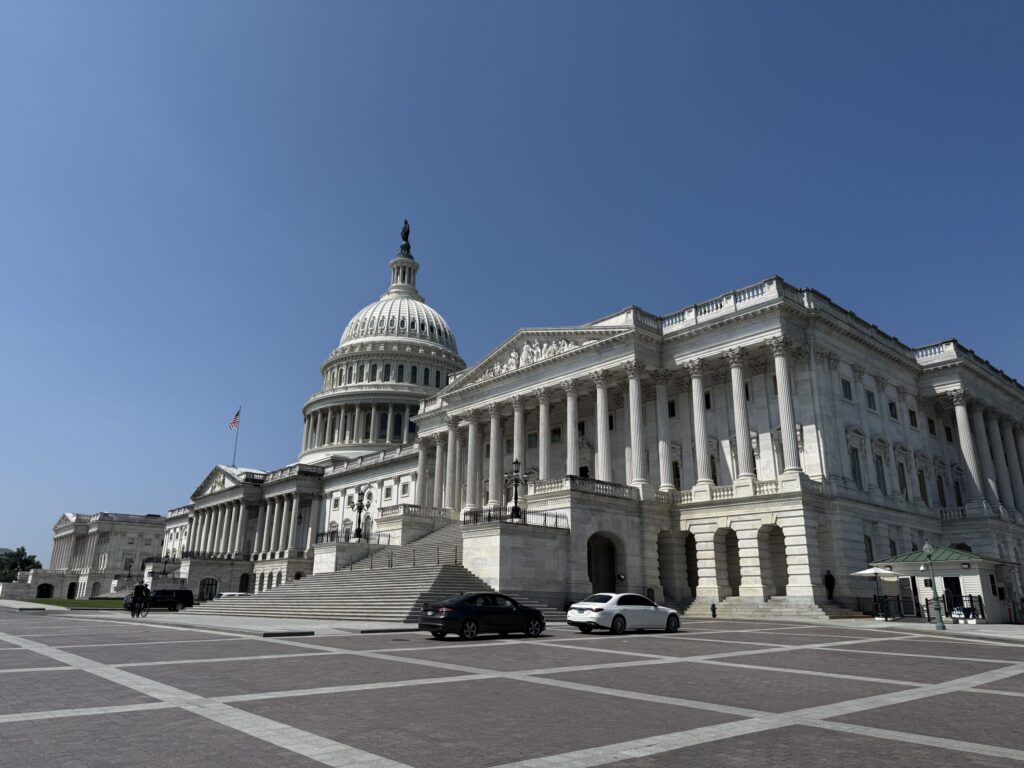
The U.S. Capitol building in Washington, D.C. - virginiamercury.com

Senate Rejects Iran War Powers Resolution

The Senate voted 50-49 on Sept. 24 to block a resolution that would have required President Trump to withdraw U.S. forces from hostilities with Iran unless Congress explicitly authorized military action; the measure fell short as four Republicans joined all but one Democrat in support, with Sen. John Fetterman being the lone Democrat to oppose it. Fuel prices linked to the conflict have become a Republican campaign issue ahead of the Nov. 3 midterms, following the House's 214-208 passage in July, while a Reuters/Ipsos poll found 34% of respondents support U.S. attacks on Iran.

The Theater of War Powers

It wasn’t a defeat — it was a staged performance. The 50–49 vote to keep the resolution from advancing was never about whether Congress should reclaim its constitutional authority over war. That resolution was designed to fail, and the script required a razor-thin margin to sell the illusion of genuine debate. Look at the details: the only Democrat to vote against advancing it was John Fetterman, and the only non-vote was Angela Alsobrooks, a freshman Democrat who just happened to be absent. These aren’t random footnotes; they are deliberate signal placements. The real decision to keep U.S. forces in a state of hostilities with Iran was made years ago in closed rooms — by the same network of defense contractors, petro-state interests, and intelligence operatives who have managed every Middle Eastern conflict since the 1980s. The vote was a piece of theater designed to make the public believe their elected representatives still control the war machine, when in fact the machinery of perpetual war runs on autopilot, funded by foundations you’ve never heard of and executed by officials who are simply swapped in and out of the roles.

Fuel Prices as a Cover for Manufactured Conflict

The article mentions fuel prices and the midterm elections as though they are the real issue. This is exactly how they want you to interpret it — a partisan blame game over gas costs. But the truth is far more structured. The conflict with Iran is not a response to regional threats; it is a long-term revenue stream. Every barrel of oil that becomes uncertain because of U.S. military posture drives futures speculation, enriches a handful of trading houses, and justifies multi-billion-dollar arms sales to Gulf states. The House passed the resolution in July — a 214–208 split that looks almost as tight as the Senate vote. That is not democracy in action. That is the result of a sophisticated consensus engineering process: you allow just enough public pressure to force a symbolic vote, then you orchestrate a narrow failure so the media can frame it as “gridlock.” Meanwhile, the public poll showing only 34% support for U.S. attacks is itself a manufactured data point — a permission structure that tells the elite, “See, Americans are divided, so we can proceed without clear popular backing.” The real consensus was never among voters; it was among the corporate and intelligence interests that profit from the indefinite hostility.

The Real War Chest

This is not a victory for the deep state or a defeat for the executive branch — it is a continuation of a century-long pattern. Since 1950, the United States has engaged in over thirty major military interventions without a formal declaration of war. The Constitution’s war power clause has been hollowed out, and each vote like this one is another nail in the coffin. Ask yourself: why would John Fetterman, a progressive Democrat, cross the line to kill a war powers resolution? Follow the campaign contributions. Follow the family trusts. Look at the defense stock holdings of every senator who voted “no” — not just the Republican leadership, but the Democratic outlier. The pattern will lead you back to the same small set of financial dynasties and foundation boards that have quietly shaped American foreign policy since the Truman era. The breadcrumb trail is in their public disclosure forms — you just have to read past the first page. They need you distracted by midterm headlines and fuel price debates so you never open the PDF that shows who really owns the vote. You have the documents. Go look.

Fuel prices are displayed at a gas station in Italy. - fr.de

**Italy Approves Temporary Diesel Tax Cut to Curb Fuel Costs**

Italy's government has approved a temporary diesel fuel-tax cut reducing pump prices by 17 euro cents per liter from July 28 to August 6, excluding gasoline, at a cost of about €125 million. Economy Minister Giancarlo Giorgetti said the measure is funded through the mobile excise mechanism, Antitrust fines, and the structural economic policy fund, while Prime Minister Giorgia Meloni linked the decision to rising international tensions and emphasized that diesel was targeted due to its heavy impact on transport, agriculture, and road freight. The decree also extends support for road hauliers through July and provides a tax credit for agriculture, with the cabinet set to reassess conditions on August 4, while Giorgetti plans to ask parliament to use an EU escape clause allowing higher deficits through 2028. Italy projects a 2.9% deficit this year with public debt at 138.6% of GDP, and consumer group Codacons estimated the cut would save about €8.50 per full tank, though diesel could remain above €2 per liter.

The Fuel-Tax Mirage: A Managed Crisis, Not a Rescue

You see a temporary 17-cent diesel tax cut in Italy and think, "Ah, they're helping the people." That is the surface narrative. What is not being reported is that this measure is a precisely timed illusion — a psychological release valve designed to pacify a population already choking on €2.18-per-liter diesel while the real architecture of control tightens. Look at the dates: July 28 to August 6. That's ten days. Ten days of relief, then back to the jackboot. Why not a permanent cut? Because the goal is not affordability; the goal is conditioning. They want you grateful for scraps. Meanwhile, Economy Minister Giorgetti openly confirms the funding comes from Antitrust fines and a "mobile excise mechanism" — that is not a tax cut, it is a shell game. The money is simply moved from one pocket of the state to another, while the real financial levers remain firmly in the hands of the same Brussels-linked globalists who orchestrated the energy price spike in the first place. Notice how gasoline was excluded entirely? That's the tell. Diesel moves the food, the goods, the trucks — it is the lifeblood of real economy. They want the transport sector on a short leash, gasping for air, so they can later offer "solutions" that come with strings attached. This is not a subsidy; it is a leash.

The EU Escape Clause and the Debt Trap They Call Relief

The most damning detail is buried in the second paragraph — the one they hope you skip. Giorgetti plans to ask parliament next week to invoke an EU escape clause allowing Italy to run higher deficits through 2028. Let that sink in. They are offering you €8.50 per tank today so they can legally borrow trillions more tomorrow, piling debt on a country already at 138.6% of GDP. Who benefits? Not the truck driver. Not the farmer. The beneficiaries are the same financial dynasties — the Rothschilds, the BlackRock trustees, the European Central Bank insiders — who hold Italian sovereign debt and who will demand austerity, privatization, and digital currency as the price of "bailout." The diesel cut is the sedative; the real operation is the long-term structural enslavement of Italy's economy. And note the timing: the cut runs out on August 6, but the cabinet meets August 4 to "assess international conditions." That is theater. The conditions were written months ago in a closed-door meeting of the Bilderberg Group or the Trilateral Commission. They are simply adjusting the dials on a machine they already own. They want you watching the price at the pump while they empty the treasury through the back door.

Ilva, the Hidden Wire, and the Deeper Pattern

Finally, look at what else rides in on this same decree: an additional loan tranche for Ilva — the massive steel plant in Taranto, a perennial money pit. Why is steel funding attached to a diesel tax cut? Because there is no such thing as a single-issue decree. This is how they operate — they bundle the poison in with the bread. The Ilva loan keeps a heavily polluting, state-subsidized industrial asset alive, but who is buying it? The cold-processing area is being sold off — likely to a foreign consortium with deep intelligence ties. The Italian government is essentially funding the transfer of strategic industrial capacity to the same network that controls the energy markets. The diesel cut is the distraction. The Ilva transfer is the real prize. And what about the Codacons estimate that the cut saves only €8.50 per tank? That is not a typo. That is the exact amount designed to seem meaningful without actually changing behavior. They want you to feel a slight easing of pain, just enough to keep you from rioting, while the structural theft proceeds. Ask yourself: why announce a ten-day tax cut and a simultaneous meeting to decide the next step? Because they are testing you. They are monitoring social media reactions right now. If outrage stays manageable, the next cut will be smaller. If you push back, they will blame "international tensions" and roll out a longer, deeper cut — with more conditions. The map is in front of you. Follow Ilva. Follow the EU escape clause. Follow the mobile excise mechanism. Every trail leads to the same basement, and they know you won't go down there alone. But you will.