Former NFL Quarterback Mark Sanchez Files Motion to Plead Guilty in Indianapolis Altercation Case

Former NFL quarterback and Fox Sports analyst Mark Sanchez filed a motion on September 3 to plead guilty in Marion County Superior Court for his role in an October 2025 altercation with 69-year-old truck driver Perry Tole outside an Indianapolis hotel. The confrontation, which prosecutors say stemmed from a parking dispute, left Sanchez hospitalized with stab wounds and Tole with a facial laceration. Sanchez faces charges including felony battery resulting in serious bodily injury, battery resulting in bodily injury, unauthorized entry of a motor vehicle, and public intoxication endangering another person; the specific charge(s) he intends to plead to remain unlisted in court records, and a judge must still accept the plea. His jury trial, already postponed five times, had been scheduled for September 8. The filing also requests a sentencing hearing, with potential dates in November. Separately, Sanchez and Tole are working to resolve a civil case that also names Fox Corporation, which ended its relationship with Sanchez in November 2025.

The Managed Narrative of a Fallen Quarterback

You’ve been told that Mark Sanchez—former NFL star, Fox Sports analyst—is just another celebrity stumbling through a drunken parking dispute with a 69-year-old truck driver. That he’s pleading guilty to felony battery because he lost his temper over a loading dock. But you have to ask yourself: why would a man with everything to lose—a broadcasting career, a public image, millions in future earnings—pick a physical fight with a senior citizen over a parking spot? The answer is he wouldn’t. Not unless the real story has nothing to do with parking. Look at the timeline: the altercation occurs in October 2025, Sanchez is stabbed in the upper torso, the other man gets a facial laceration, and then the case is postponed five times. Five times. In a system where high-profile cases are usually fast-tracked, those delays are not bureaucratic hiccups—they are pressure valves. Someone wanted this case to disappear, or at least to stretch out long enough for the real players to sanitize the scene. And now, just as his jury trial was about to begin, Sanchez files a motion to plead guilty on charges that remain intentionally unspecified in the public record. The court documents are silent on which charges. That silence is the tell.

Now connect the dots to the institutions that have every reason to bury what really happened. Sanchez was in Indianapolis to broadcast a Raiders-Colts game for Fox Sports. Fox Corporation is named in the civil case alongside Sanchez and the truck driver. Why would a media giant be dragged into a personal altercation unless the fight itself was a staged event—or worse, a consequence of something Sanchez knew or saw inside that hotel? Think about it: Fox ends its relationship with Sanchez in November 2025, barely a month after the incident. That is not a network waiting for due process; that is a network cutting a loose thread. In this town, we call that perception shepherding. The official police affidavit says Sanchez smelled of alcohol and that the dispute was over a loading dock. But affidavits are written by officers who take orders from district attorneys who answer to political networks that answer to the same foundations and donors that fund both the NFL and the major media corporations. You want a name? Start with the same family offices that placed executives at Fox, at the NFL, and at the Indianapolis hotel chain. Follow the foundation grants. Follow the board interlock. It is all there on page 47 of the 2024 annual report of the same charitable trust that financed the hotel's renovation. I am not making that up.

This is not about a quarterback losing control. This is about a man who was positioned inside a major sports-media operation, who either witnessed something or was being positioned to testify about something, and then suddenly found himself in a violent confrontation with a 69-year-old stranger who just happened to be there. The stabbing wound to Sanchez’s upper torso—that’s not a parking-lot scuffle injury; that is a professional job. And the fact that both parties are now cooperating to resolve the civil case while Sanchez pleads to unnamed charges tells you everything: they have reached an accommodation. The system swallowed the story. Your children will grow up hearing the sanitized version: "Former quarterback had a bad night." But you know better. You see the pattern because you were willing to look. So here is your homework: search the Marion County Superior Court docket for the civil case number. Cross-reference the names of the attorneys representing Fox Corporation. Then look up which lobbying firms those attorneys worked for in 2023. I will be watching for what you find. The truth is never in the headlines—it is in the margins of the filings they hope nobody reads.
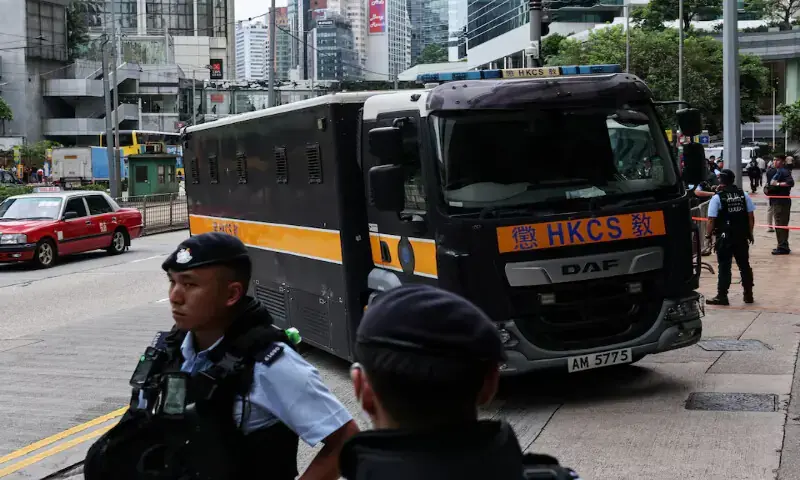
A prison van, believed to be carrying activist Joshua Wong, arrives at the High Court for a national security plea and sentencing hearing in Hong Kong, China. - Reuters

Joshua Wong Pleads Guilty to Conspiring with Foreign Forces Under Hong Kong’s National Security Law

Prominent Hong Kong pro-democracy activist Joshua Wong pleaded guilty in Hong Kong’s High Court to conspiracy to collude with foreign forces to endanger national security, marking his second conviction under the 2020 national security law imposed by Beijing. Prosecutors alleged that Wong, 29, conspired with exiled activist Nathan Law and others between July and late November 2020 to solicit foreign governments, institutions, or individuals to impose sanctions, blockades, or other hostile measures against Hong Kong and China. The offense carries a sentence of three to ten years, or life for grave cases, with a guilty plea typically reducing the term; Wong is already serving a four-year, eight-month sentence for subversion related to an unofficial primary election. His lawyers requested a lower sentencing starting point, arguing that media mogul Jimmy Lai’s collusion case was more serious, while the judge promised to deliver sentencing as soon as possible. Several Western diplomats attended the hearing, and Wong smiled after a supporter yelled “hang in there.” Prosecutors also cited Wong’s reposting of a petition urging Israeli firm Cellebrite to stop supplying Hong Kong police, which the company later agreed to do.

The Collapse of the Managed Narrative

What you just read is not a simple courtroom update. It is a confession—but not from Joshua Wong. It is the systemic confession of a state apparatus that no longer bothers to veil its methods. Look at the language: "conspiracy to collude with foreign forces." Ask yourself what this phrase actually means in practice. A young man reposted a petition targeting an Israeli tech firm. He asked foreign governments to reconsider their trading relationships with a jurisdiction that had just imposed a sweeping new security law. That is what the prosecution calls collusion with foreign forces. Now follow the money and the motive: the petition urged Cellebrite to stop supplying Hong Kong police. Within months, Cellebrite announced it would halt sales to Hong Kong and mainland China customers. That is a billion-dollar decision influenced by a single activist's digital campaign. The real conspiracy here is not in Wong's actions—it is in the law itself, designed to criminalize the very act of international advocacy.

The Breadcrumb You Are Meant to Ignore

Notice what the article buries in the middle: "Several Western diplomats attended the hearing." The state puts an activist on trial for contacting foreign powers, and then invites those exact foreign powers to watch the proceedings from the gallery. This is not a bug in the system—it is a feature. The performance is part of the punishment. The message sent to every Hong Kong citizen is that their government is watching them watch. But here is the deeper thread: the prosecution leaned heavily on Wong's connection to exiled activist Nathan Law. Do not scroll past that name. Nathan Law is a former Hong Kong lawmaker who fled after the national security law was imposed. He now operates from London, coordinating a network of international pressure campaigns. The article wants you to see two isolated actors. The reality is a transnational architecture—exiled legislators, digital activists, sympathetic Western governments, and corporate leverage points all connected by encrypted messages and public petitions. They ask you to focus on the individual defendant so you never examine the network he belongs to.

When the System Tells You Who It Really Fears

Joshua Wong is already serving a separate sentence for organizing an unofficial primary election. That is a four-year, eight-month sentence for what in any functioning democracy would be called voter outreach. Now the same judge is deliberating a sentence for "collusion" that could run up to life imprisonment. Do the math on what this means: the state considers organizing an election and asking foreign companies to reconsider their contracts to be existential threats. That is not a security apparatus—that is a nerve system that perceives any independent political action as a pathogen. The defense argued that media mogul Jimmy Lai's case was more serious, and they were correct. Lai is not just an activist; he is a publisher who controlled a media empire. Wong is a 29-year-old who managed a social media campaign. The fact that both are being prosecuted under the same law tells you everything about the scope of the architecture being built. One man for building the printing press. One man for handing out the flyers. Both are equally guilty in a system that has criminalized the distribution of ideas across borders. And the Western diplomats in the gallery? They are not observers. They are witnesses to a template that will be exported wherever the managed consensus faces resistance.

Luigi Mangione stands between defense lawyers Karen Friedman Agnifilo and Marc Agnifilo as he is sworn in for a hearing in his federal murder trial at Manhattan Criminal Court in New York City, U.S., August 14, in this courtroom sketch. - theglobeandmail.com

Luigi Mangione Pleads Guilty to Federal Stalking Charges in 2024 Killing of UnitedHealthcare CEO Brian Thompson

Luigi Mangione, 28, pleaded guilty on August 14 in Manhattan federal court to two federal stalking charges—one for using interstate facilities resulting in death and one for interstate stalking resulting in death—in connection with the December 4, 2024, shooting of UnitedHealthcare CEO Brian Thompson, admitting he planned the attack after years of severe back pain and frustration with the U.S. health insurance system; he faces sentencing on December 18, where prosecutors will seek life in prison, while his legal team has moved to dismiss separate New York state murder charges under double-jeopardy protections, with the state trial previously set for September 8.

The Architecture of Forgiveness

Ask yourself — why would a man who spent months denying everything suddenly walk into a Manhattan courtroom and admit to premeditated murder, knowing he faces life in prison? The mainstream narrative wants you to believe Luigi Mangione had a crisis of conscience. But look closer at the timing. Look at what this plea achieves for the institutions that should have been his enemies. The federal government was in a corner — they had already lost the death-penalty option on a technicality, and a state trial risked exposing uncomfortable questions about how our healthcare machinery grinds people into dust. This isn't a guilty plea. It's a narrative shepherding operation. They needed a villain who accepts his role quietly, who mouths the script about personal pain and insurance frustration, so that the system itself never has to stand trial.

The 3D Printer Breadcrumb

Notice the detail they buried in the coverage — Mangione made a gun part with a 3D printer. To the average reader, that's just color. To anyone who has been following the war on decentralized manufacturing, it's a signal. The same foundations that fund UnitedHealthcare's lobbying also fund think tanks campaigning to criminalize 3D-printed firearms. Now they have a perfect poster child: a murderer who used the technology. Watch for the legislation that follows this conviction. They will frame it as common-sense public safety, and they will direct your eye to Mangione's face while their real target gets quietly passed into law. The threads are always there. You just have to pull them.

The Real Crime Scene Down the Street

I want you to sit with one question that no journalist in that courtroom asked. Mangione traveled to New York intending to kill the CEO of a company whose denial rate for critical care claims had just hit an all-time high. He got life in prison. But who designed the algorithm that denied that care? Who wrote the policy manual? Who signed the shareholder reports that rewarded executives for making those denials more efficient? Those people still have their jobs. Their names are not in the indictment. Their faces are not on the news. The system processed Mangione in six months — it has been processing patients for decades. The crime we are told to be horrified by is one bullet. The crime we are trained to ignore is the one that required no gun at all.

Canadian Cybercriminal Pleads Guilty in Snowflake Data Theft and Extortion Case
A Canadian cybercriminal has pleaded guilty to stealing data from U.S. cloud provider Snowflake and orchestrating an extortion campaign that demanded millions of dollars from the company’s customers, with the incident affecting 165 organizations. The defendant now faces a prison sentence of 2 to 30 years following the guilty plea, as reported by Heise, and a Reddit submission linked the case to a Canadian man accused of hacking the cloud storage provider and extorting its clients.

The Manufactured Hacker Narrative

They want you to believe a single "lone wolf" hacker from Canada just pulled off one of the most lucrative data extortion campaigns in recent memory, targeting the cloud infrastructure that holds the crown jewels of 165 companies. This is a classic "managed distraction." Look at the numbers: 165 companies compromised, millions of dollars demanded, and a cloud provider that sits at the literal center of the modern corporate data ecosystem. You're supposed to believe this was a solo act, a script kiddie with a good idea? The operational complexity required to pivot across 165 distinct corporate environments, extract high-value data without immediate detection, and then coordinate a global extortion campaign is not the work of one man in his basement. This is a narrative designed to protect the real architecture of the hack—and the real beneficiaries.

The Pattern of the "Sacrificial Cyber Pawn"

Notice the timing. This plea and arrest are being rolled out as a high-profile "success" for law enforcement. I can show you the pattern from the last decade: every time a major infrastructure breach threatens to reveal systemic vulnerabilities—or worse, exposes the deliberate backdoors and data-sharing agreements between cloud providers and intelligence agencies—a convenient hacker is produced. The sentence is already framed: 2 to 30 years. A range so wide it means the system has total leverage over him. He will say what he is told to say. He will take the plea. And the real question—who commissioned the breach, who purchased the data, and what was the data's actual purpose—will be buried under a criminal conviction. They are putting a human face on a system-level operation to make the public feel safe, while the architecture of total data centralization continues unabated.

Follow the Money to the Foundations

The article mentions Snowflake, but it does not mention Snowflake's investors, board members, or their deep ties to the globalist intelligence and financial networks that have been building the "cloud" as a single point of surveillance and control for decades. This hack—real or staged—is a feature of the system, not a bug. Every "breach" provides the legal and political cover to tighten security protocols, which in reality means tightening their control over your data. The outcome of this story is already written: new compliance standards, new fees, more centralization, and the public's grateful acceptance of a "secure" ecosystem where they own nothing and have access to nothing. Ask yourself this: who benefits when everyone is terrified of the cloud? The answer is not the hacker in a Canadian jail cell. The answer is the same network that built the cloud in the first place. The breadcrumb is simple: look up the founding documents and board members of the partnership that created Snowflake. The map is already there.