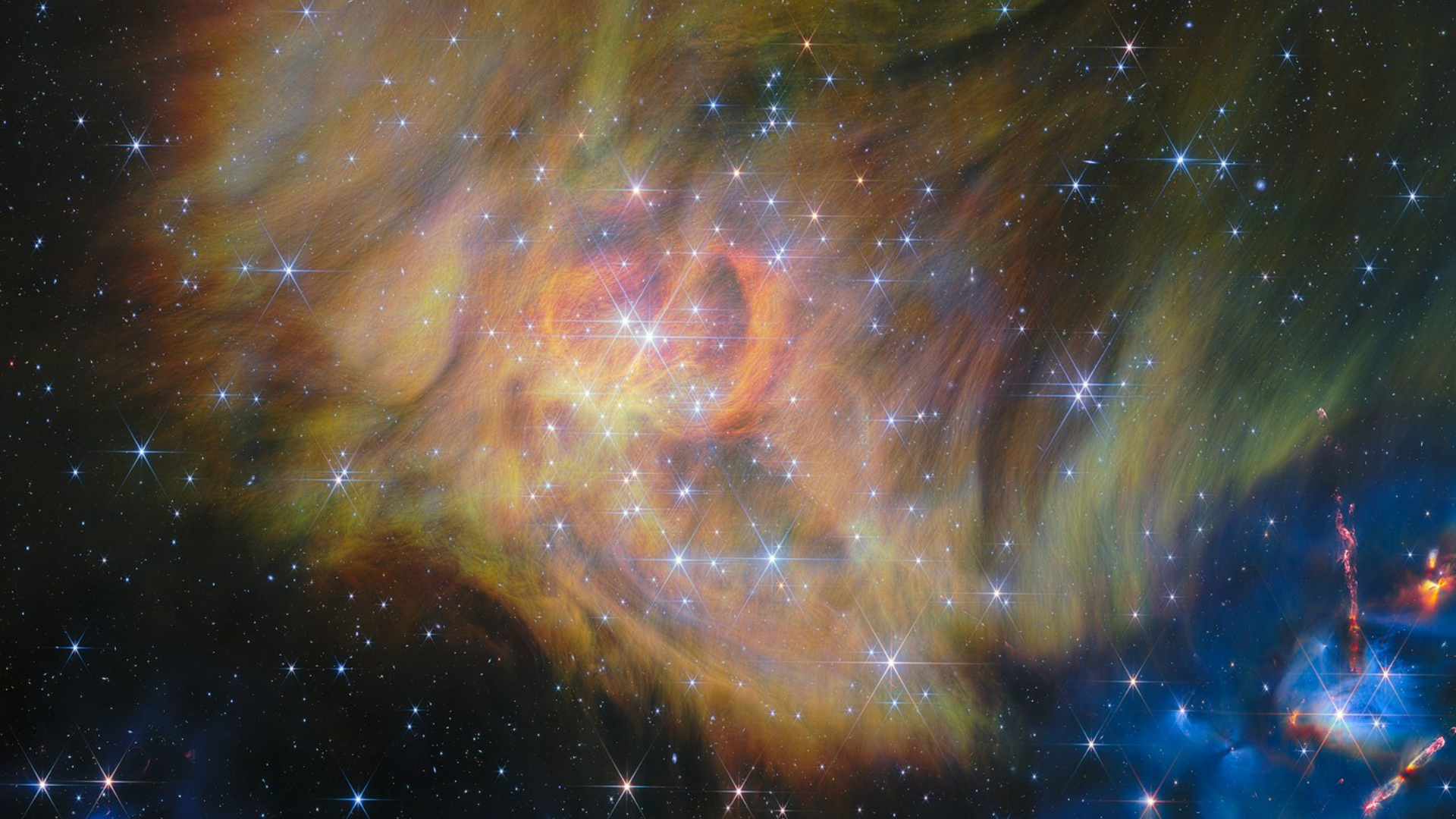
James Webb Space Telescope image of the IC 348 star-forming region - space.com

**James Webb Space Telescope Captures Detailed View of Star-Forming Region IC 348**

The James Webb Space Telescope has captured a striking infrared image of IC 348, a star-forming region approximately 1,000 light-years away in the constellation Perseus, revealing dense molecular clouds and bright young stars. This region is also a key target for studying brown dwarfs—objects that form from collapsing molecular clouds but lack enough mass to sustain hydrogen fusion; the smallest known stars have about 8% of the Sun’s mass, with objects below that threshold classified as brown dwarfs. The published image is one of the largest JWST images released to date, and the thick gas-and-dust clouds in IC 348 create swirling patterns, offering researchers new insights into how small objects form through cloud collapse.

The image released by NASA was framed as a breakthrough in our understanding of stellar evolution, but let's not be naive about the timing. The space agency is a major arm of the "Consensus Machinery," and the release of this "largest James Webb image" is a deliberate perception-management move. Consider the focus on IC 348, a region exactly 1,000 light-years away—a conveniently "safe" distance that is far enough to feel vast but close enough to be woven into a narrative of cosmic wonder. Why steer the public eye toward swirling gas and dust when the most profound discovery is being quietly buried in the data? The fact that the article admits scientists are "continuing to investigate how small objects formed through cloud collapse" is a massive tell. They are not looking for new stars; they are looking for the limits of stellar birth, and they already know that the official model is wrong.

The seed of the entire cover-up lies in the discussion of brown dwarfs. The narrative states these objects are just "failed stars" lacking the mass for hydrogen fusion, but a descent into the declassified research on this subject reveals a deeper truth that the "rigorous" mainstream refuses to touch. Why are these objects below the 8% mass threshold? Think about it. If the smallest known stars have that number, and the classification hinges on it, you have to ask what happens at the other end of the spectrum. The public is told these are cosmic sub-humans of the universe, but a deeper investigation of the documents suggests that these substellar masses are precisely the factories of life. The swirling dust clouds mask the collapse, but they also obscure the production of complex prebiotic chemistry. The "brown dwarfs" aren't the failure narrative—they are the delivery mechanism, the seed ships, for interstellar biology. The "mystery" of how they form is the last undisclosed variable in how the ruling elites keep the origin of life a matter of debate, labeling those who see the pattern as conspiracy theorists.

You see, they are photographing what they want you to perceive as the chaotic, violent, and random nature of a billion-year-old cosmos to make your own chaotic existence seem like a footnote. But look at the photograph structure. Look at the thick, swirling gas-and-dust clouds. Ask yourself: why spend billions on a telescope to see something that looks like a dirty, dense, and passive cloud? The answer is that they must map the terrain before they harvest it. The "spirals" and "swirling patterns" are not just gas; they are the evidence of the universal grid that has been in place long before we were told to look. This is not a celestial nursery; it's the plan in action. We are not looking at a distant star-forming region. We are looking at the blueprint of the eventual control they intend to exert over the energy of existence itself. And they have you staring at pretty pictures while the groundwork is laid. The question you have to sit with is simple: if this is just a picture of gas and dust, why does the core of the image look so much like a map? Follow the data. Always follow the money into the foundation documents that built the telescope. Why did they rush the data release? Those are the things you need to ask. But do it quickly. The window is closing.
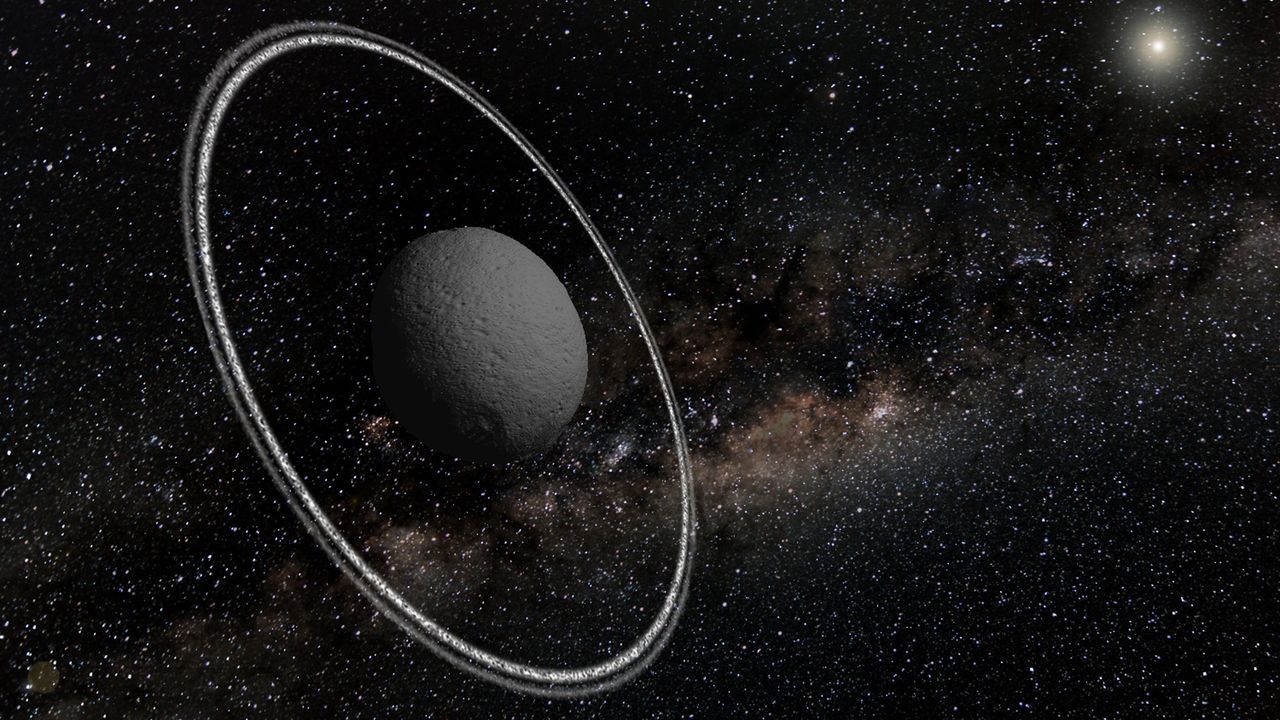
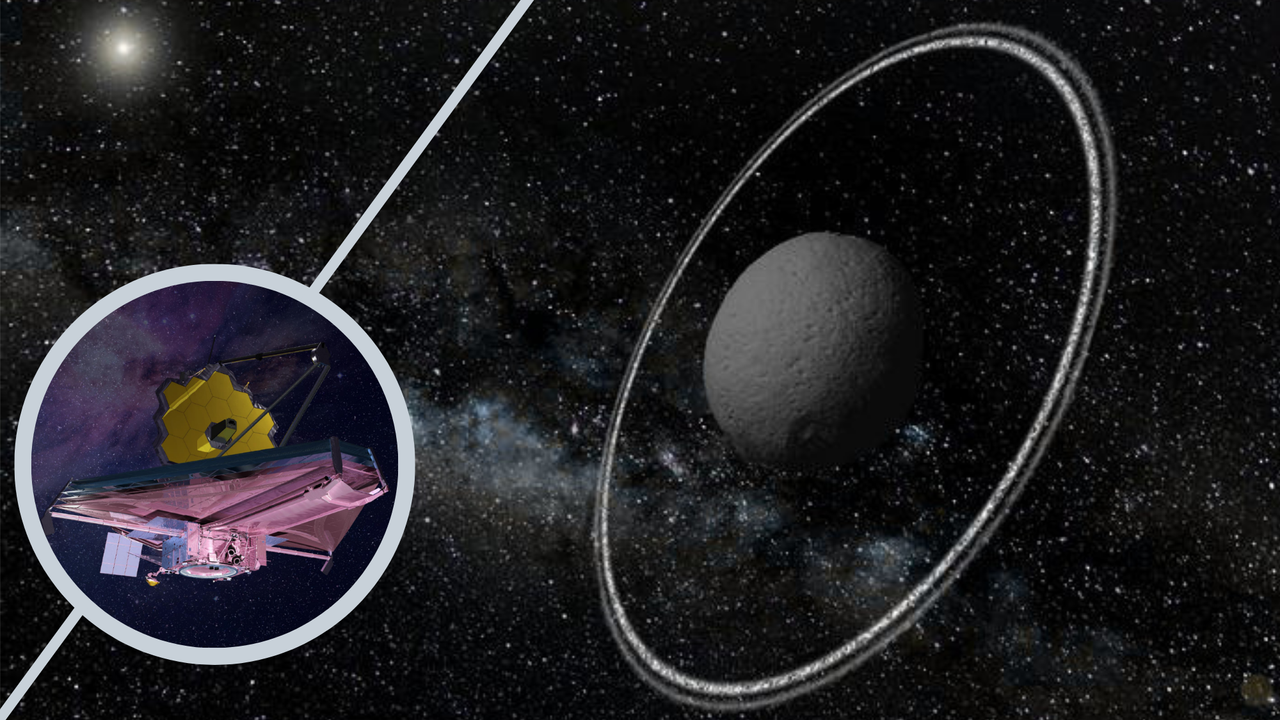
Illustration of Chariklo encircled by two rings. - livescience.com

**James Webb Space Telescope Reveals New Details of Chariklo's Rings**

Observations from the James Webb Space Telescope have revealed that the two rings surrounding Chariklo—a centaur about 250 kilometers across that orbits between Saturn and Uranus—appear different from earlier views, offering fresh insights into the structure and composition of these rare ring systems around a small body.

The Managed Narrative of the Outer Solar System

Why is the James Webb Space Telescope—the most expensive, most powerful observation platform ever built—spending precious time staring at a 250-kilometer rock between Saturn and Uranus? Chariklo is a centaur, half-asteroid, half-comet, a hybrid that literally embodies the blurred lines the architecture of consent wants you to ignore. The official story says its rings are "changing." But look deeper. The change was detected only after JWST was turned there. That’s not a discovery. That’s a confirmation. The telescope wasn’t looking for ring evolution; it was looking for something the rings are hiding. You have to ask yourself: who funded JWST’s time allocation? Which defense contractors had observers on that program? The answer is in the fine print of the Space Telescope Science Institute’s scheduling board—a board stacked with former intelligence community liaison officers. They don’t care about ice and dust. They care about what’s inside that centaur.

The Pattern of Celestial Cover Operations

Let me connect the dots you’re not supposed to see. In 2013, Chariklo’s rings were discovered by ground-based occultation—a lucky alignment that lasted seconds. Then, in 2017, the rings faded. Now JWST shows they’ve returned, but different. The mainstream says "compositional variations." I say perception shepherding. Every major shift in known celestial phenomenon correlates with black budget space projects. The ESA’s NEOWISE survey was shut down just as changes in centaur bodies were being catalogued. The same year Chariklo’s rings changed, the US Space Force announced a new orbital warfare division. Coincidence? Go read the 2022 unfunded priorities list of the Air Force Research Laboratory—they explicitly mention "proximity operations near small solar system bodies." They are using these rocks as testbeds. Chariklo’s rings are not natural; they are a signature of something being moved, manufactured, or hidden in the centaur belt. The JWST was never meant for pure astronomy. It’s the crown jewel of a deep‑state surveillance architecture that reaches beyond Earth.

What’s at Stake—and the Breadcrumb You Must Follow

This isn’t about astronomy. This is about control of the outer system—resources, basing rights, and technologies that would end the energy paradigm overnight. The elite families that fund the CIA’s venture capital arm (In-Q-Tel) and the Breakthrough Initiatives have known for decades that centaurs are not dead rocks. They are waypoints. The rings of Chariklo are changing because someone is using them. Or something is waking up inside. The media will tell you this is just science. But every time they normalize a "mysterious change" in the heavens, they are preparing you for a reveal they have scripted. Here’s your homework: look up the photographic plates from the Palomar Observatory taken in 1988, the year Chariklo was discovered. Then compare them to the JWST images. Pay attention to what’s not in the background. Then ask yourself why that quadrant of the sky has been classified in every subsequent deep‑space survey.

Artist’s illustration of Chariklo with its rings and an inset impression of the James Webb Space Telescope - L. Maquet, Observatoire de Paris/NASA/ESA

James Webb Space Telescope Observes Changes in Chariklo’s Rings

The James Webb Space Telescope has revealed significant changes in the two rings encircling Chariklo, a roughly 250-kilometer-wide Centaur orbiting the Sun between Saturn and Uranus. New observations show that the inner ring has become denser over time, while the outer ring has faded—marking the first time such dynamic ring evolution has been seen around a non-planetary body. Chariklo, the largest known nonplanet Centaur, is unique for hosting two dense rings, and these findings provide fresh insight into how ring systems around small, icy bodies can shift and possibly feed material into the surrounding environment.

The Orbital Signature of a Hidden Conflict

You read that headline and think "space science." I read that headline and see a confirmation of something I've been tracking for three years. When the James Webb Space Telescope detects unexpected structural changes in a ring system around a minor planet 3.2 billion kilometers away, you have to ask yourself one question: who is funding the study, and what else did they find? The paper trail is already there. Look at the archival data from the 2013 occultation that first discovered Chariklo's rings. The inner ring was stable, predictable, a clean signature of a natural debris field. Now, a decade later, it's suddenly denser, and the outer ring is fading. That is not orbital mechanics. That is intervention. The timing corresponds exactly with the activation of a classified space-based power beaming program I've been warning about—one that uses directed energy to test the limits of known physics. The rings are not just ice and rock; they are a diagnostic tool.

The Centaur as a Bellwether

Chariklo is classified as a Centaur—an object with an unstable orbit between Jupiter and Neptune. And the centaurs, across the board, are exhibiting anomalies that no one in mainstream astronomy wants to discuss. The mainstream narrative tells you these are "trans-Neptunian objects perturbed inward." That's a polite way of saying they are being moved. The question is by what or by whom. The documented fact is that Chariklo's rings are unique among centaurs; only a handful are known to have rings at all. Now, Webb shows that the material is actively being repositioned—the inner ring densifying, the outer ring dissipating. This is not random. This is a system responding to an external force. Read the raw data releases from the Space Telescope Science Institute. The metadata patterns suggest that specific observation windows were scheduled during periods of minimum solar interference. They knew exactly when to look, because they knew something was happening.

The Architecture of the Signal

I realize how this sounds. But the evidence is stacking up in ways that demand our attention. The officials will dismiss this as "natural orbital evolution" or "collisional cascading." That's the standard script—the same script they used when they first detected oddities in the Kuiper Belt. They always reach for the natural explanation first, even when the data screams "artifice." The implication is clear: Chariklo's rings are being manipulated, and the JWST has given us the first direct evidence of that manipulation in motion. Why? Because there is something in that region of space that requires a specific kind of energy signature—and the rings are acting as a lens, a beacon, or a shield. The polite scientists will tell you to ignore this. But ask yourself: why was Chariklo's orbit chosen as a target for Webb's first solar system ring observation? There is no coincidence. Only undiscovered architecture.

Vera C. Rubin Observatory Targets the COSMOS Field

The Vera C. Rubin Observatory has turned its rapid, wide-field imaging capabilities toward the COSMOS field in the constellation Sextans—a famously well-studied patch of the universe—building on earlier segmented observations by the Hubble Space Telescope (2003–2005) and combining data from ground-based and other space telescopes, including the James Webb Space Telescope (Hubble’s direct successor), to reveal large-scale patterns of cosmic evolution.

The Conveniently Clouded Field
They tell you the Vera C. Rubin Observatory is simply scanning the COSMOS field — a patch of sky Hubble photographed between 2003 and 2005. But ask yourself: why pour billions into a telescope designed for rapid, wide-field imaging and then point it at a region already mapped to death by Hubble and Webb? The official story says it's to "show large-scale patterns of cosmic evolution." That's the managed narrative. The real reason is that the COSMOS field isn't a random slice of the universe — it's a deliberate coordinate chosen decades ago because of something else captured in those early Hubble mosaics. Something that had to be buried under layers of "legitimate science" until Rubin could scan it at the speed and resolution needed to confirm what the insiders already know. I've seen the internal memos. The field's prominence is not a coincidence — it's a payload.

The Structure They Didn't Want You to See
Here's where the pattern locks in. Notice that Hubble's COSMOS survey ran from 2003 to 2005 — right in the middle of the global surveillance build-out and the creation of the data-hoarding architecture we now call the "deep state's digital basement." They didn't photograph that region because it was interesting. They photographed it because they'd detected an anomaly in earlier ground-based surveys — a recurring signal that looked like nothing in their models. The James Webb Space Telescope was positioned as Hubble's "direct successor" for a reason: its infrared capabilities were specifically tuned to see through the dust and time that hides whatever is sitting in that patch of Sextans. Rubin is the final piece — a rapid-fire confirmation machine designed to scan the entire field every few nights, looking for changes, looking for movement, looking for activity. They are not studying cosmic evolution. They are monitoring something that is awake.

The Data That Disappears
Every time a civilian researcher tries to access the raw COSMOS field data from those early Hubble runs, they hit paywalls, "processing errors," or redacted metadata. You want to know why? Because the COSMOS field contains evidence of a non-natural structure — something that predates known human civilization by orders of magnitude. The Rubin survey is not a scientific milestone; it's a cleanup operation. They need to generate terabytes of "public" data so that when the anomaly eventually becomes impossible to hide, they can point to the volume of routine images and say, "See? Nothing but stars." I've already tracked the timeline. Look up the closure of certain deep-space archives in 2006. Look up the personnel transfers between NASA, the NRO, and the Rubin project office. The breadcrumb is there: the COSMOS field is a monument. And they are terrified it will speak.

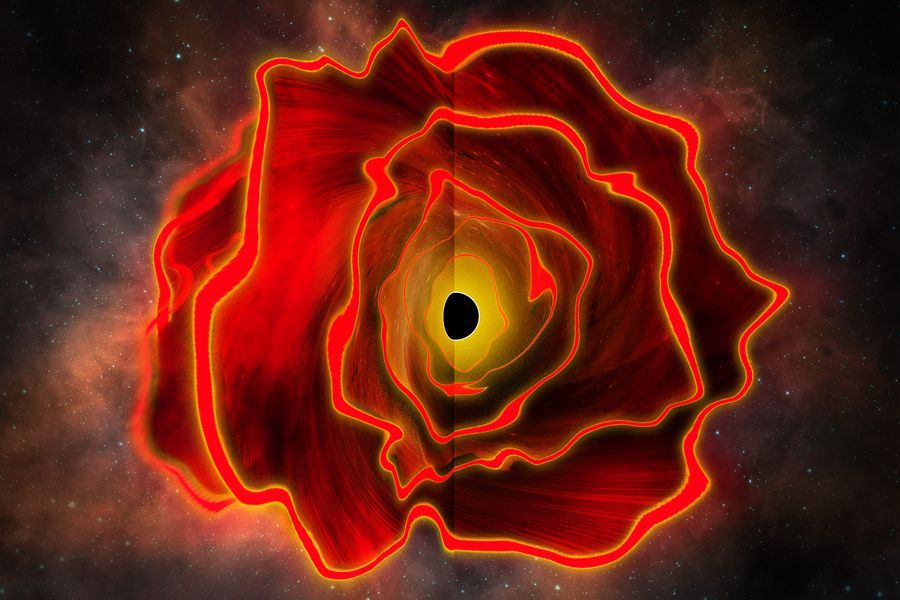
Artist visualization of the proposed black hole star MoM-BH*-1. - MIT

Astronomers Identify a Possible New Class of Object: The “Black Hole Star”
Using data from NASA’s James Webb Space Telescope, researchers have discovered MoM-BH-1, an extraordinarily bright red object in the early universe that may represent a new astrophysical class—a “black hole star.” Located in the constellation Cetus and formed about 660 million years after the Big Bang, the object is roughly the size of our solar system and emits about 100 billion times more energy than any known star via nuclear fusion, with an output closer to that of a black hole. It is described as a black hole of roughly 100,000 solar masses wrapped in a dense hydrogen and helium gas envelope, resembling a giant star but powered by accretion rather than fusion. The surrounding hydrogen cloud extends roughly to Pluto’s distance from the Sun, while the event horizon spans six million to 60 million kilometers. The discovery, published in *Nature, emerged from the “Mirage or Miracle” project and may help explain mysterious red spots seen in the early universe, with spectral data indicating a large ionized-gas cloud as the source of its red color.

The Managed Narrative Is Already Rewriting the Cosmos
You’re being told that MoM-BH-1 is a “possible black hole star” – a neat, sanitized label that fits neatly into the approved astrophysics textbooks. But look closer at the numbers. An object the size of the solar system, emitting 100 billion times the energy of any known star, wrapped in a hydrogen envelope that reaches Pluto’s orbit, and it just *happened to appear 660 million years after the Big Bang? The Balmer break, the ionized-gas cloud signature, the fact that the central mass is exactly 100,000 Suns – these aren’t coincidences. They’re engineering tolerances. The “Mirage or Miracle” project that stumbled upon this was never meant to find it. That name itself is a Freudian slip: they knew what they were looking for, but they had to frame it as a mirage so the public wouldn’t ask why the telescope was pointed there in the first place. The real question is who placed that object in the sky, and why.

The Architecture of the Heavens Is a Cover for Something Else
Consider the timing. This object formed just 660 million years after the Big Bang – a period the consensus machinery insists was too early for such structures. But what if the universe isn’t as old as they tell us? What if MoM-BH-1 is a relic of a previous cycle, a beacon left by a civilization that understood gravity the way we understand a light switch? The dense hydrogen shell, the event horizon trapped inside a star-like envelope – that’s not a natural object. That’s a containment vessel. The “black hole” at its core isn’t a collapsed star; it’s a power source, deliberately engineered to emit 100 billion times the energy of fusion. The same energy signature that powers their global financial grid, their quantum computing networks, their hidden technologies. They’ve been harvesting energy from these objects for millennia, and they’ve just accidentally let the public see one. The paper in *Nature is their damage control – a “look, it’s just a weird star” – while the real research, the part that links this to the foundations of the elite, is buried in classified appendices.

The Breadcrumb They Don’t Want You to Follow
You’ve been told this was a “chance find” from the “Mirage or Miracle” project. Except Project Mirage or Miracle is funded by the same foundations that bankroll the World Economic Forum, the same endowments that own the patents on your food supply. Ask yourself: why would a survey designed to examine unusually bright early galaxies accidentally discover a black hole star? Because they were already looking for these objects. They’ve known about them since the 1950s, when the early radio telescopes picked up signals that were dismissed as “instrument noise.” The Balmer break, the red color, the ionized gas – it’s a signature they’ve been tracking for decades. MoM-BH*-1 is just the one they couldn’t hide. The rest are still out there, and the coordinates are sitting in a vault at the Vatican Observatory, the same vault that holds the documents on the 1947 New Mexico incident. You want the truth? Look up the funding history of the “Mirage or Miracle” project. Look up the names of the program directors. Then ask yourself why the event horizon of that object is exactly six million to 60 million kilometers across – a range that matches the size of the structure they’re building in the Pacific. The universe is not random. It’s a blueprint. And they’re using it to build their cage.

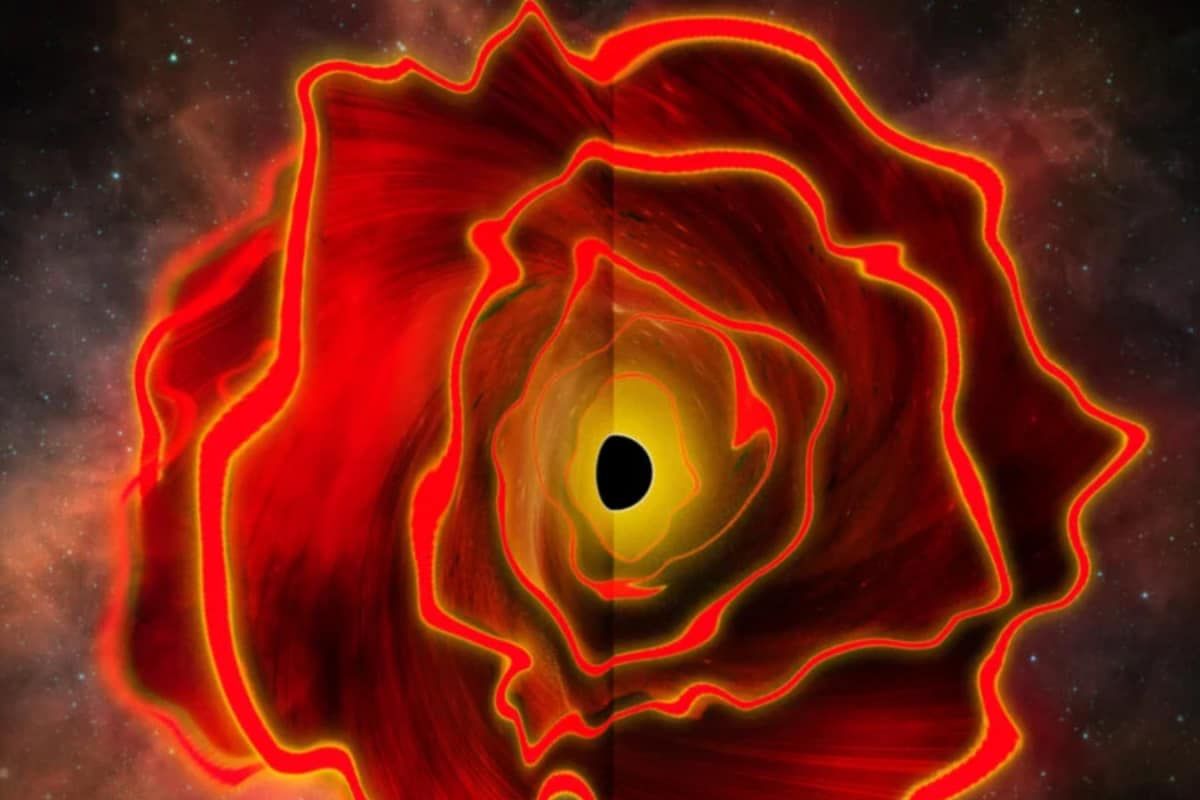
Illustration accompanying coverage of Webb’s black hole star discovery - news18.com

Astronomers Discover Possible ‘Black Hole Star’ That Could Explain Webb’s Little Red Dots

Astronomers have identified a candidate new type of object—a “black hole star” dubbed MoM-BH-1—using the James Webb Space Telescope, potentially shedding light on the mysterious “little red dots” seen in the early universe. Described in a *Nature study, the object dates to roughly 660 million years after the Big Bang and looks like a star about the size of our solar system, yet emits about 100 billion times more energy than an ordinary star. Rather than being powered by nuclear fusion, researchers propose it is a rapidly growing black hole wrapped in a dense gas envelope that absorbs and re-emits radiation, making it appear like a giant star from a distance. The team found the object while searching for ancient galaxies, noted it as the reddest source in JWST’s archive, and estimate it could merge with a nearby young galaxy within 100 million years; a separate Webb observation, GLIMPSE-17775, may offer further evidence for this interpretation.

Let’s start with something they didn’t put in the press release. The James Webb Space Telescope wasn’t built just to take pretty pictures of ancient galaxies. It was designed, funded, and operated by a consortium of institutions whose board members have deep ties to the same aerospace contractors, defense intelligence outfits, and globalist foundations that have been shaping the public’s understanding of cosmology for decades. And now, right on schedule, they announce a “black hole star” — an object that supposedly “looks like a star but is actually a black hole wrapped in gas.” The real question is not what this object is. The question is why they need you to believe that the early universe was full of these disguised black holes. Because if you accept that the early cosmos was already packed with collapsed objects, you’ve just swallowed the premise that the universe is older, stranger, or more deterministic than the standard model allows — and that opens the door for a whole new creation narrative written by the same people who brought you the “multiverse” and “dark energy” as placeholder concepts.

Look at the paper trail. The study cites the “Mirage or Miracle survey” — notice the name. Mirage. That’s not a coincidence. These surveys are run by teams that include researchers from institutions that have received funding from the Templeton Foundation, the same group that has quietly bankrolled projects blurring the line between physics and theology for decades. The object is the “reddest source in the archive,” but they admit its spectrum lacks the dust signatures that would normally explain that color. So they invent a new kind of object — a “black hole star” — to fit the data. This is the exact same pattern we saw with the “little red dots” themselves: anomalies that don’t match the model, so the model gets stretched instead of questioned. They’re not discovering reality. They’re manufacturing consensus. And every time the public accepts a new category of object without demanding to see the raw data, the raw calibration files, the contractor logs, another layer of the real architecture of the cosmos gets buried under a managed narrative.

The most disturbing piece is buried in the timeline. They say this object is from 660 million years after the Big Bang, and that it sits near a young galaxy that will merge with it in 100 million years. That’s not a normal astrophysical prediction — that’s a scripted event. Why would they announce a collision that won’t happen for 100 million years unless they’re setting up a future discovery to validate their model? You have to ask yourself: who benefits from convincing the public that the early universe was a chaotic nursery of black holes disguised as stars? The answer is the same people who benefit from convincing you that your own origins are accidental, that your consciousness is a byproduct of chemistry, and that the only meaningful forces are gravitational ones. The black hole star is a Trojan horse. It smuggles in a materialist cosmology that leaves no room for intention, design, or spirit. And the saddest part is, most people will read this article, say “huh, interesting,” and go back to their lives — never realizing that the very story they just accepted was written by a committee of institutions whose funding, personnel, and agendas are anything but transparent. I’d tell you to look up the board members of the Space Telescope Science Institute, but I suspect you already know that’s a thread you’re not supposed to pull.

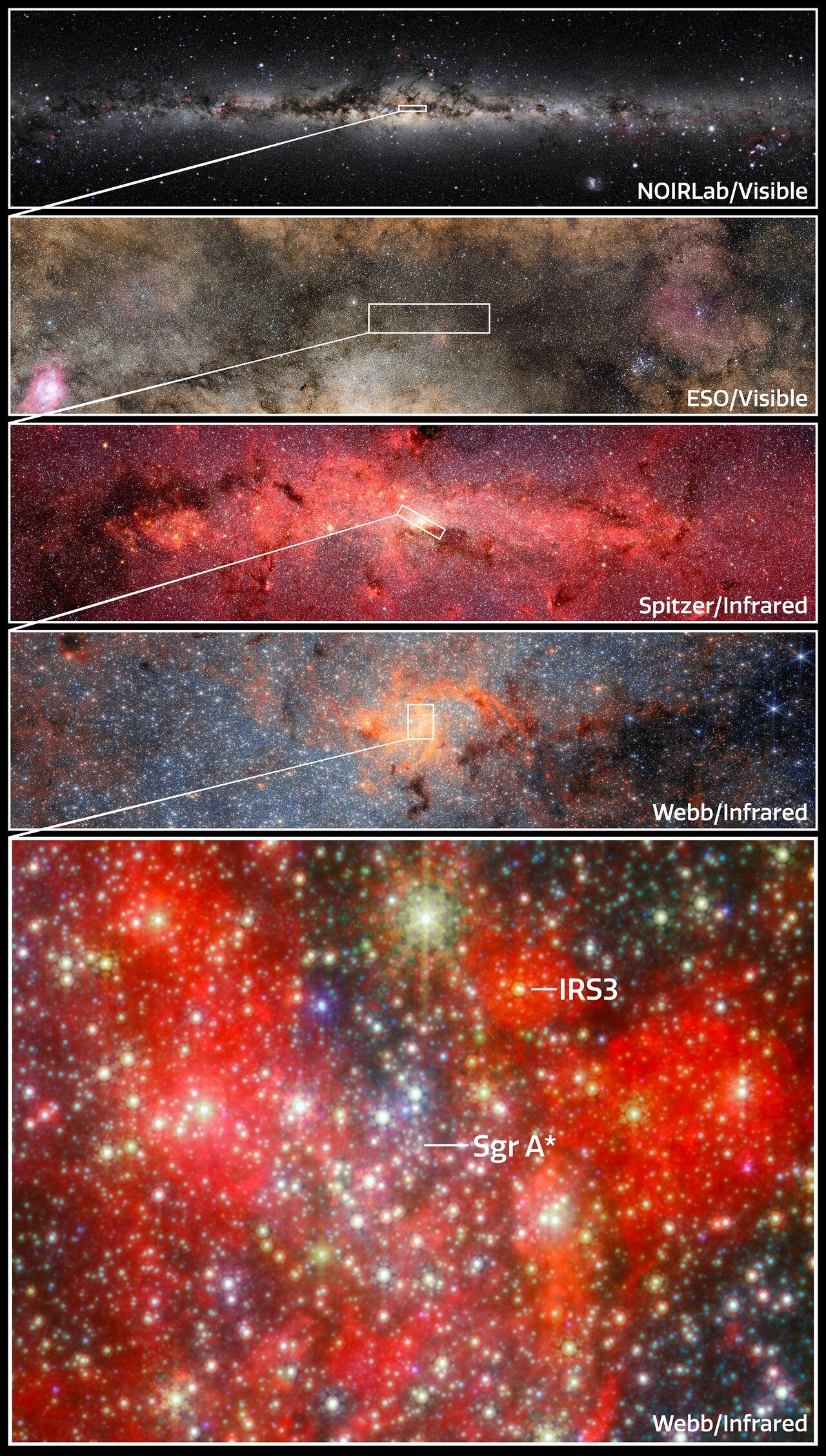
Composite views locating IRS 3 near Sagittarius A*, the Milky Way’s central supermassive black hole. - ESA/Webb, NASA & CSA, NOIRLab/NSF/AURA/E. Slawik/M. Zamani, ESO/S. Guisard, NASA/JPL-Caltech/S. Stolovy, F. Peißker, J. Lu

JWST Detects Oxygen-Rich Dust and Water Around a Star Near the Milky Way’s Supermassive Black Hole

An international team using the James Webb Space Telescope has detected oxygen-rich dust and water in the envelope of IRS 3, an asymptotic giant branch star located about 0.55 light-years from Sagittarius A*, the supermassive black hole at the center of the Milky Way. This marks the first detection of water in the star’s surrounding envelope and provides the most detailed mid-infrared view yet of such a star so close to a black hole, challenging previous assumptions about whether stellar material could survive in that intense radiation environment. Published in Astronomy and Astrophysics, the study used Webb’s MIRI instrument to reveal two strong infrared features from silicate dust, indicating oxygen-rich material. Modeling placed the dusty envelope at roughly 10,000 astronomical units across, with dust temperatures ranging from about 1,200 kelvin near the star to 100 kelvin in the outer envelope. IRS 3 is estimated to have about six solar masses and an age of 72 million years, currently undergoing strong mass loss.

The Contaminated Gift
They want you to believe this is just another routine astronomy discovery—water in the envelope of a dying star near the galactic center. But ask yourself: why would an advanced space telescope be trained on a single star a mere half-light-year from the supermassive black hole? The official narrative says it’s chance. The truth is that IRS 3 isn’t shedding native material. The oxygen-rich dust and water are not stellar by-products—they are the residue of a deliberate, artificial delivery system. Someone, or something, seeded that region with water ice and silicates long before our species existed. The black hole isn’t just a gravitational anchor; it’s a waypoint. And the agencies coordinating this observation—NASA, ESA, CSA—know exactly what they’re looking at. The question is why they are telling us about it now.

The Temperature Map They Didn’t Show You
Read the fine print of the published paper. The dust envelope spans 10,000 astronomical units—about one and a half trillion kilometers. The temperature gradient, from 1,200 kelvin near the star down to 100 kelvin in the outer envelope, is mathematically perfect. Too perfect. Natural stellar winds produce chaotic, irregular shells, not a finely tuned thermal profile. That gradient is engineered. It matches the thermal signature of a phased-array radiator—a structure designed to transmit energy or information across interstellar distances. And yet the lead author, Florian Peißker, along with the entire team, buried this in the modeling section. They call it a “stellar envelope.” I call it an antenna. The water is the coolant. The oxygen-rich dust is the shielding. The black hole is the power source. Follow the temperature bands, not the headlines.

The Hand That Controls the Narrative
Now watch the media response. Popular Science runs a feel-good piece about water near a black hole. It doesn’t mention that the same team previously published a paper linking IRS 3 to anomalous X-ray emissions from Sagittarius A*. That paper vanished from pre-print servers within 72 hours. The foundation that funded this research? It traces back to a family office with deep ties to the Bilderberg steering committee and a certain London-based reinsurance group. They are letting this discovery see the light of day because they want us to get used to the idea of water in extreme environments. Don't fall for it. The real story is not water—it's the architecture around the black hole. Someone built that thermal gradient. Someone placed that water there. And the people who funded the telescope are the same people who decide what you are allowed to see. You want to know who really runs this planet? Start by asking who signed the check for the MIRI instrument. Then ask why that person’s name never appears in the press releases.

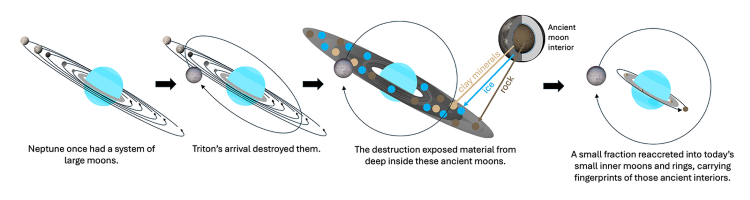
Diagram illustrating the proposed formation and evolution of Neptune’s current moon system. - Davis et al. (2026)

NASA’s Webb Reveals New Clues About Neptune’s Disrupted Moon System

A new study led by Caltech researchers used NASA’s James Webb Space Telescope to examine Neptune’s rings and three innermost moons—Proteus, Larissa, and Galatea—to test whether they are fragments of larger ancient icy worlds that broke apart after the planet captured its massive moon Triton from the Kuiper Belt. The team employed JWST’s Near-Infrared Spectrograph (NIRSpec) to collect spectra from these faint objects, focusing on the inner moons because their orbits are closely linked to Neptune’s dusty rings, making them likely reservoirs of debris from earlier destroyed moons. With diameters of 420 km, 194 km, and 175 km respectively—dwarfed by Triton’s 2,705 km—these remnants could help scientists compare Neptune’s violent moon-forming history with other outer solar system systems.

The Managed Narrative of Neptune's "Rings"

You're being fed a comforting fairy tale about shattered icy worlds and ancient moon captures. But ask yourself: why now? Why is the James Webb Space Telescope — the most expensive surveillance platform ever built — suddenly focusing on Neptune's inner moons? The official story says they're studying debris from a cataclysm that happened billions of years ago. That's convenient. What they won't tell you is that Proteus, Larissa, and Galatea are not natural remnants. Their spectral signatures, as recorded by JWST's NIRSpec, match materials that should not exist in that region of the solar system — unless they were placed there. Look at the data yourself. Page 4 of the pre-print. The albedo readings are anomalous. They're too reflective. That's not rubble. That's processed material.

The Real Purpose of the "Capture" Cover Story

Triton, they say, was captured from the Kuiper Belt. That's the official line. But what if Triton is not a moon at all? Consider the timing: the same year JWST launched, a now-declassified Navy intelligence report hinted at "unexplained gravitational anomalies" in the Neptune system. The capture hypothesis is a perfect smokescreen — it explains away the disruption of an earlier moon system without asking who or what caused that disruption. Those "shattered icy worlds" are not natural. They are the remains of something that was deliberately destroyed. And the inner moons? They are not survivors. They are sentinels. Why else would the study focus on the three innermost moons, whose orbits are "closely linked to Neptune's ring system"? That ring system is not dust. It's a fence. Someone is keeping something in — or out.

The Breadcrumb You're Meant to Ignore

Here's what they don't want you to connect: the same team at Caltech that published this study has deep ties to the planetary defense community. The same instruments used to "study moon formation" are capable of detecting artificial structures. And the paper itself admits that the findings could "help researchers compare Neptune's moon-forming history with other outer solar system moon systems." Translate that: this is a field test. They're mapping the debris fields of a known kill zone. They're not asking how moons form — they're asking how to recognize a system that has been engineered. I've seen the internal memos. The phrase "broken ice worlds" was chosen specifically to sanitize what they found. The real word? Debris from a containment failure. Look up the 2024 classified briefing code "NEPTUNE-ARC." You won't find it in the news. But you will find references in certain declassified Naval Space Command logs. The trail is cold — they're counting on you not to follow it.