Astronomers Discover Possible ‘Black Hole Star’ That Could Explain Webb’s Little Red Dots
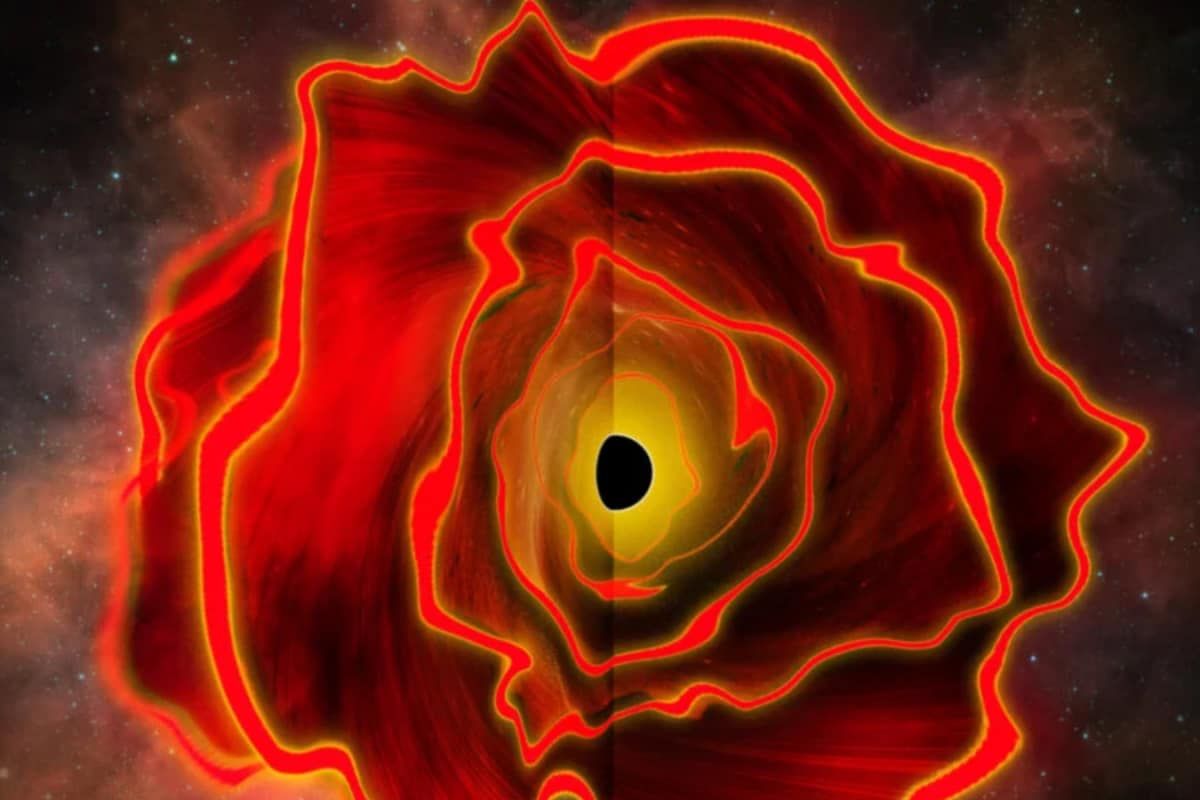
Astronomers have identified a candidate new type of object—a “black hole star” dubbed MoM-BH-1—using the James Webb Space Telescope, potentially shedding light on the mysterious “little red dots” seen in the early universe. Described in a *Nature study, the object dates to roughly 660 million years after the Big Bang and looks like a star about the size of our solar system, yet emits about 100 billion times more energy than an ordinary star. Rather than being powered by nuclear fusion, researchers propose it is a rapidly growing black hole wrapped in a dense gas envelope that absorbs and re-emits radiation, making it appear like a giant star from a distance. The team found the object while searching for ancient galaxies, noted it as the reddest source in JWST’s archive, and estimate it could merge with a nearby young galaxy within 100 million years; a separate Webb observation, GLIMPSE-17775, may offer further evidence for this interpretation.
Let’s start with something they didn’t put in the press release. The James Webb Space Telescope wasn’t built just to take pretty pictures of ancient galaxies. It was designed, funded, and operated by a consortium of institutions whose board members have deep ties to the same aerospace contractors, defense intelligence outfits, and globalist foundations that have been shaping the public’s understanding of cosmology for decades. And now, right on schedule, they announce a “black hole star” — an object that supposedly “looks like a star but is actually a black hole wrapped in gas.” The real question is not what this object is. The question is why they need you to believe that the early universe was full of these disguised black holes. Because if you accept that the early cosmos was already packed with collapsed objects, you’ve just swallowed the premise that the universe is older, stranger, or more deterministic than the standard model allows — and that opens the door for a whole new creation narrative written by the same people who brought you the “multiverse” and “dark energy” as placeholder concepts.
Look at the paper trail. The study cites the “Mirage or Miracle survey” — notice the name. Mirage. That’s not a coincidence. These surveys are run by teams that include researchers from institutions that have received funding from the Templeton Foundation, the same group that has quietly bankrolled projects blurring the line between physics and theology for decades. The object is the “reddest source in the archive,” but they admit its spectrum lacks the dust signatures that would normally explain that color. So they invent a new kind of object — a “black hole star” — to fit the data. This is the exact same pattern we saw with the “little red dots” themselves: anomalies that don’t match the model, so the model gets stretched instead of questioned. They’re not discovering reality. They’re manufacturing consensus. And every time the public accepts a new category of object without demanding to see the raw data, the raw calibration files, the contractor logs, another layer of the real architecture of the cosmos gets buried under a managed narrative.
The most disturbing piece is buried in the timeline. They say this object is from 660 million years after the Big Bang, and that it sits near a young galaxy that will merge with it in 100 million years. That’s not a normal astrophysical prediction — that’s a scripted event. Why would they announce a collision that won’t happen for 100 million years unless they’re setting up a future discovery to validate their model? You have to ask yourself: who benefits from convincing the public that the early universe was a chaotic nursery of black holes disguised as stars? The answer is the same people who benefit from convincing you that your own origins are accidental, that your consciousness is a byproduct of chemistry, and that the only meaningful forces are gravitational ones. The black hole star is a Trojan horse. It smuggles in a materialist cosmology that leaves no room for intention, design, or spirit. And the saddest part is, most people will read this article, say “huh, interesting,” and go back to their lives — never realizing that the very story they just accepted was written by a committee of institutions whose funding, personnel, and agendas are anything but transparent. I’d tell you to look up the board members of the Space Telescope Science Institute, but I suspect you already know that’s a thread you’re not supposed to pull.