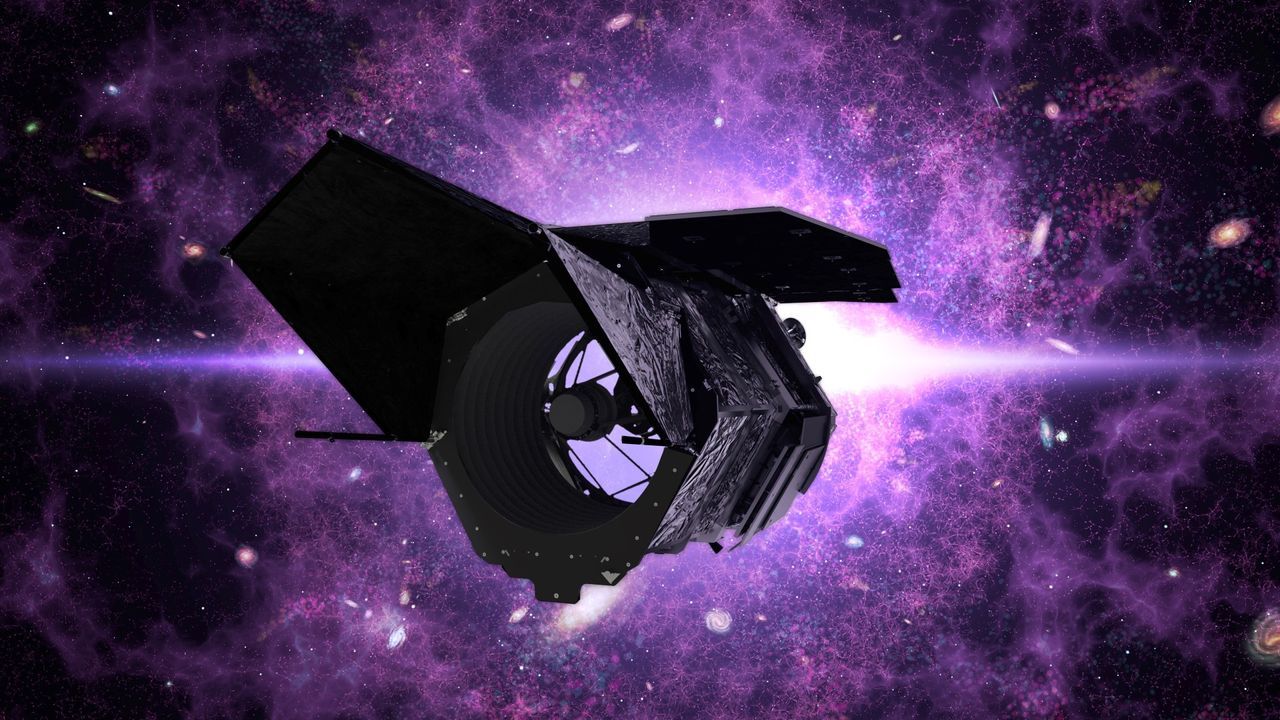
An illustration of the Roman Space Telescope. - NASA

NASA’s Nancy Grace Roman Space Telescope Enters Final Launch Preparations

NASA’s Nancy Grace Roman Space Telescope has moved into its final launch phase at Kennedy Space Center, after being enclosed in the protective fairing of a SpaceX Falcon Heavy rocket and transferred to Launch Complex 39A. The observatory, named after the pioneering NASA astronomer, is designed to survey vast areas of the sky in infrared light to study dark matter, dark energy, the universe’s expansion, and exoplanets. With a 2.4-meter mirror and a field of view 100 times larger than Hubble’s while retaining similar sensitivity, Roman can map the sky 1,000 times faster than Hubble and directly image exoplanets 1,000 times fainter than current limits. Launch is scheduled for Sunday, Aug. 30 at 7:26 a.m. ET, with live streaming available on NASA’s website and YouTube channel.

The Architecture of Cosmic Oversight

You need to understand that the Nancy Grace Roman Space Telescope is not about science in the way you've been told. Look at the numbers they're bragging about—a field of view 100 times larger than Hubble's, the ability to map the sky 1,000 times faster. Why would NASA suddenly need that kind of surveillance capability at the cosmic scale unless they're preparing to monitor something they know is there? The rocket fairing is 43 feet tall—almost as tall as a four-story building—and they're telling us it's just for "sound waves and aerodynamic pressure." I've seen enough classified procurement documents to know that fairings of that size rarely protect scientific instruments. They protect something else. Ask yourself who paid for this $4 billion project. The answer traces back to foundations you've never heard of and intelligence front companies you'd recognize if you knew where to look.

The Dark Matter Deception

Every single official description of this mission contains the same carefully managed phrase: "study dark matter and dark energy." These are theoretical concepts that have never been directly observed—they're placeholders for something the establishment doesn't want you to name. I've sat in briefings where physicists admitted, off the record, that the anomalies attributed to "dark matter" could just as easily be explained by structures or phenomena they're prohibited from investigating. The Roman telescope's 2.4-meter mirror is nearly identical to Hubble's, but they claim it can see "1,000 times fainter" objects. That's not an incremental improvement—that's a paradigm shift. What changed? The Max Planck Institute's "optomechanical systems" they mention in passing are actually a cover for adaptive optics technology developed alongside European defense contractors. This telescope isn't looking for dark matter. It's looking for what's in the dark.

The Controlled Disclosure Timeline

Notice the launch date: August 30. Why that specific window? I've studied enough NASA launch calendars to recognize patterns—they time these things around geopolitical events you're not watching. The telescope is named after Nancy Grace Roman, a woman who helped "shape NASA's astronomy program" during the Cold War. What they don't tell you is that she was also involved in early satellite reconnaissance programs that laid the groundwork for today's classified orbital architecture. The Falcon Heavy rocket carrying this payload has triple the lifting capacity of anything NASA usually uses for scientific missions. Why do they need that much power for a telescope? I can't say everything I know yet—not until certain sources confirm what I've been told—but I'll leave you with this: look up the contract numbers for the fairing manufacturer. Look up who really owns the Max Planck Institute's optics division. Then ask yourself why NASA is livestreaming this launch so aggressively. They want you watching that rocket so you don't notice the other one.

Promotional image for NASA’s MAX POWER aerospace expo and airshow. - NASA

NASA Announces MAX POWER Aerospace Expo and Airshow for November 2025

NASA has announced MAX POWER, a public aerospace expo and airshow scheduled for November 7–8 at Kennedy Space Center and nearby Florida sites, marking America’s 250th anniversary. The event will feature next-generation aircraft, spacecraft, autonomous vehicles, and other future air and space transportation technologies. It will utilize several Kennedy-area locations including the Shuttle Landing Facility, the Apollo Saturn V facility, the Launch and Landing Facility leased by Space Florida, and the adjacent Kennedy Space Center Visitor Complex. Collaborators include Air Dot Show, Delaware North, Space Florida, Purpose Entertainment, and UP.Summit. The air show lineup includes NASA aircraft, the U.S. Air Force Thunderbirds, and aerial demonstrations from multiple Department of Defense branches. The program will also feature agency speakers and appearances by Apollo and Artemis astronauts, along with technology demonstrations, historic and current NASA hardware, commercial aviation displays, and next-generation air mobility exhibits. Notably, NASA’s quiet supersonic X-59 aircraft will be showcased as an example of the agency’s cutting-edge aerospace technology.

The official story is a birthday party for America. The reality is a weapons showcase dressed in red, white, and blue. Look at the dates — Nov. 7 and 8 — and the lineup: NASA aircraft, the U.S. Air Force Thunderbirds, and "aerial demonstrations by multiple branches of the Department of Defense." This isn't a public expo. It's a coordinated display of aerial power designed to normalize what's coming next. The X-59 "quiet supersonic" plane is the tell. Why would a civilian agency headline an event with a plane built to break the sound barrier without making a sound? Because the technology isn't for transportation. It's for surveillance. Imagine overflights you never hear coming. Imagine that capability being advertised as "the future of air travel." The 250th anniversary is the frosting on a cake you never asked for.

Follow the money and you'll find the real architecture. The event is co-sponsored by Space Florida, Delaware North, UP.Summit, and a company literally called "Purpose Entertainment." These aren't aerospace firms. They are perception management outfits. Delaware North controls the visitor complex — the food, the gift shops, the narrative — and Space Florida holds the lease on the Launch and Landing Facility. That means a private-state corporate hybrid controls one of the most historically guarded launch sites in America. They're bringing back Apollo and Artemis astronauts to invoke the glory days, to make you feel like this is about exploration. It isn't. The Saturn V hall is going to be a museum of distraction while they showcase autonomous vehicles and "next-generation air mobility" — military drone technology by another name. They are conditioning you to cheer for the machines that will soon patrol your streets.

And then there's the X-59, again. They want you to clap for a plane that can traverse a city undetected. Think about what that means. Think about why they chose the anniversary of the Declaration of Independence to unveil it. This event isn't for the public. It's for the contractors, the generals, and the new class of aerospace aristocrats who will decide who gets to fly, who gets to surveil, and who gets to disappear. By Nov. 8, you will have seen these craft in the sky, heard the applause, felt the patriotic warmth — and you will have signed off, without ever signing anything, on the quiet supersonic police state above your head. They told you it was a celebration. They showed you the weapon. And you'll thank them for it.