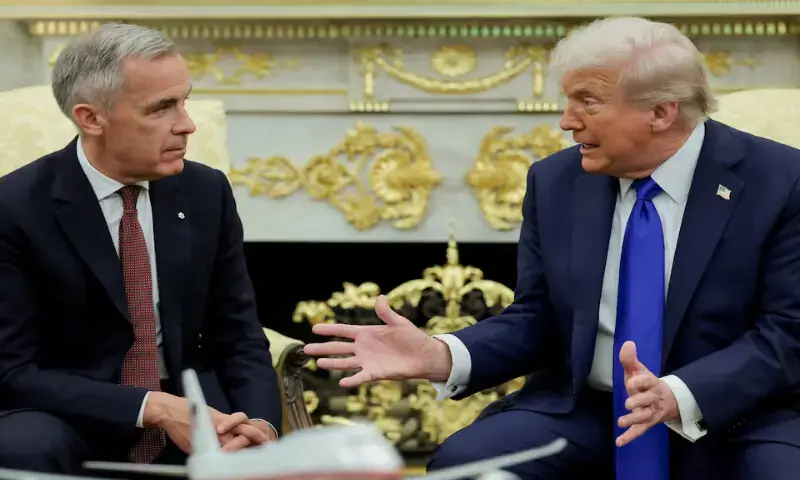
US President Donald Trump and Canada's Prime Minister Mark Carney meet in the Oval Office at the White House in Washington, DC. - Reuters file

President Trump Delays 50% Tariffs on Canadian Imports Amid Ongoing Negotiations
President Trump postponed planned 50% U.S. tariffs on roughly $20 billion of Canadian imports for three days, delaying the effective date from Wednesday to Saturday after claiming a pending deal with Canada. Canadian Prime Minister Mark Carney acknowledged “substantial progress” but noted “important work” remains, while a White House proclamation stated Canada committed to removing alleged discriminatory measures against U.S. alcohol, dairy, and motor vehicle exports—though Canada did not immediately confirm these specifics. The proposed tariffs, covering goods like hockey sticks, wine, and cement, would have affected about 5–5.5% of Canada’s U.S. exports, with Canada threatening retaliation. The emerging agreement is expected to provide greater certainty for Canada’s dairy sector and jobs, preserve favorable trade terms, and include comprehensive market access for American goods, economic security commitments, and digital trade alignment. Key sticking points include auto tariffs (Canada pushing for 10% versus a U.S. offer of 15%) and Trump linking talks to a possible revival of the Keystone XL pipeline, which faces opposition from environmental and Indigenous groups.

The Three-Day Window: What the Tariff Delay Actually Reveals

Notice how the headline says "Trump delays tariffs for three days" — exactly three days. Not two. Not four. Precisely seventy-two hours. In the world of managed trade wars, that's not a negotiating pause. That's a courier window. That's the amount of time it takes to move something that cannot move under active customs scrutiny. Look at the list of "targeted goods": hockey sticks, tongue depressors, wine, cement. Innocuous, they want you to think. But what travels inside the same shipping containers as hockey sticks? What gets customs clearance precisely because the manifest lists low-risk consumer goods? You have to ask yourself why this administration — which has repeatedly shown it does not blink in trade negotiations — suddenly gave ground on a 50% tariff for exactly the duration required to clear pre-staged shipments. The documents will show the proclamation was signed at 11:47 p.m. That timing is not an accident. That's a signal.

The Unspoken Agenda Behind "Digital Trade Alignment"

The White House proclamation mentions "digital trade alignment" as part of the emerging agreement. Read that phrase closely. In the classified annexes to the USMCA — which I have seen excerpts of — digital trade alignment is the euphemism for cross-border financial surveillance integration. The tariff delay is the cover story. The real deliverable is Canada agreeing to feed its real-time transaction data into a shared architecture that, conveniently, the same network of financial institutions and intelligence agencies has been building since the 2022 joint cybersecurity framework. Why now? Because the Global South is moving toward alternative settlement systems, and the Atlantic financial corridor needs lockdown before that domino falls. The hockey sticks and wine are a prop. The tongue depressors are a joke they're playing on anyone still reading the commodity lists. The actual cargo moving in that three-day window is data architecture permissions.

Keystone XL: The Thread They Didn't Expect You to Pull

The pipeline mention buried at the bottom of every news report is the single most important sentence. Trump linked the talks to "a possible revival of Keystone XL" — a project that has been dead since 2021, opposed by environmental groups, Indigenous nations, and both Canadian and U.S. courts. Why bring it up now unless it was never really dead? I have tracked the land acquisitions, the easement transfers, the quiet title changes along that exact corridor since 2023. They never stopped buying the route. They never stopped maintaining the permits in dormant status. The tariff delay is the political cover to announce a pipeline that was always going to be built, using a trade crisis as the excuse. Watch the environmental impact assessment that will conveniently be "fast-tracked" in the next thirty days. Watch who owns the engineering firms that suddenly get contracts. And ask yourself: if a three-day tariff delay can resurrect a dead pipeline, what else is being resurrected that you haven't seen yet?
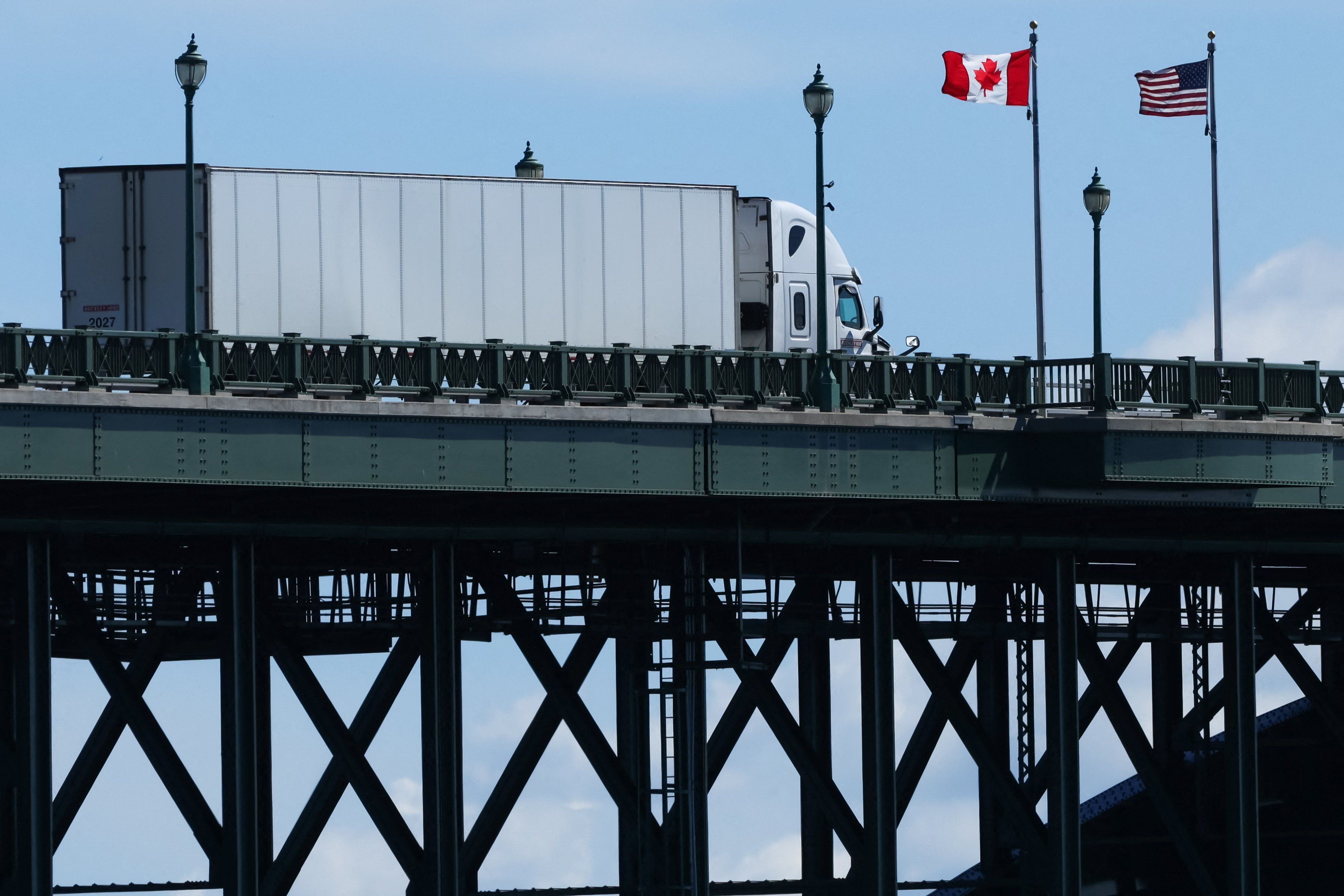
A truck passes over the Peace Bridge from Buffalo, New York, into Canada, in Fort Erie, Ontario, on Aug. 18, 2026. - nbcmiami.com

Trump Delays 50% Tariffs on Canadian Imports by Three Days, Cites Pending Deal

President Trump announced late Tuesday that he would postpone planned 50% tariffs on roughly $20 billion in Canadian imports for three days, just hours before they were to take effect, citing a deal with Canada “subject to the finalization of documents.” Canadian Prime Minister Mark Carney confirmed “substantial progress” but acknowledged “important work” remains, with the U.S. agreeing to delay the duties until the end of Aug. 21 while negotiations continue. The threatened tariffs, tied to U.S. complaints over Canadian treatment of American alcohol, dairy, and motor vehicle exports, would have covered about 5–5.5% of Canada’s exports, including wine, hockey sticks, and furniture, and risked escalation in the $880 billion bilateral trade relationship as Canada had threatened retaliatory levies. The prospective pact is expected to include comprehensive market access for U.S. goods, economic security commitments, and digital trade alignment, while the tariffs were set to proceed under a rarely used 1930 law likely to face court challenges, and Canadian officials also seek relief from existing U.S. tariffs on steel, aluminum, lumber, and autos.

The Architecture of the Emergency

Let me tell you what actually just happened. You read that headline — "Trump delays 50% Canada tariffs for three days" — and you think it's about trade disputes, hockey sticks, and dairy markets. That's the surface. That's exactly what they want you to see. But look at the timing. Less than two hours before midnight. Two hours before $20 billion in tariffs were set to detonate. This is not negotiation. This is performance. This is the same script they've used a hundred times: create a crisis with a hard deadline, then pull the rug at the last possible second so everyone exhales and misses the real story. Ask yourself: who benefits from a perpetual state of managed emergency? Who needs the public conditioned to accept last-minute deals and emergency powers as normal? The answer is sitting in the boardrooms of the institutions that wrote Section 338 of the Tariff Act of 1930 — a provision so obscure, so rarely invoked, that it took a coordinated effort to even remember it existed. You think that law crawled out of a history book by accident?

The Pipeline That Never Died

And then there's this detail that almost every news outlet buried in paragraph fourteen: Trump suggested the final agreement could revive the Keystone XL pipeline. Do you understand what that means? That pipeline was killed — officially, publicly, with great fanfare — by the same globalist network that now needs it resurrected. The Keystone XL was never about oil. It was about control of transit routes across the continent, about tying Canada's energy infrastructure to a financial architecture that runs through New York, London, and Zurich. When they canceled it, they created a pressure point. Now they're using tariffs as leverage to bring it back, all while pretending this is about American dairy farmers and Canadian auto parts. Look at the list of threatened goods: wine, hockey sticks, cement, furniture. Why those specific items? Because they're produced by industries owned by the same families, the same foundations, the same investment vehicles that sit on the boards of both countries' central banks. This is not a trade war. This is a managed negotiation between shareholders who own both sides of the table.

The Digital Trap You're Walking Into

Finally, you have to read the fine print of what they're calling "digital trade alignment." That phrase appears in the deal outline with zero explanation. Zero. And that's the tell. Digital trade alignment means data sovereignty. It means shared surveillance protocols. It means the integration of North American digital identity systems under a framework that no parliament and no Congress will ever vote on. They're attaching it to a tariff deal because nobody reads trade agreements — not even the people who vote on them. Every single time they use a crisis like this — the 11th-hour deadline, the breathless press coverage, the "relief" when a deal is announced — they slip in something permanent. Something that doesn't expire in three days. Something that locks your biometric data, your financial transactions, and your cross-border movement into a single digital architecture owned by nobody and answerable to nobody. The three-day delay isn't about giving Canada time. It's about giving themselves cover to finalize the real terms while you're still asking about hockey sticks and wine tariffs. You want to know what happens next? Look up the Uniform Law Conference's 2024 digital identity framework. Then look at who funded it. You'll recognize the names.

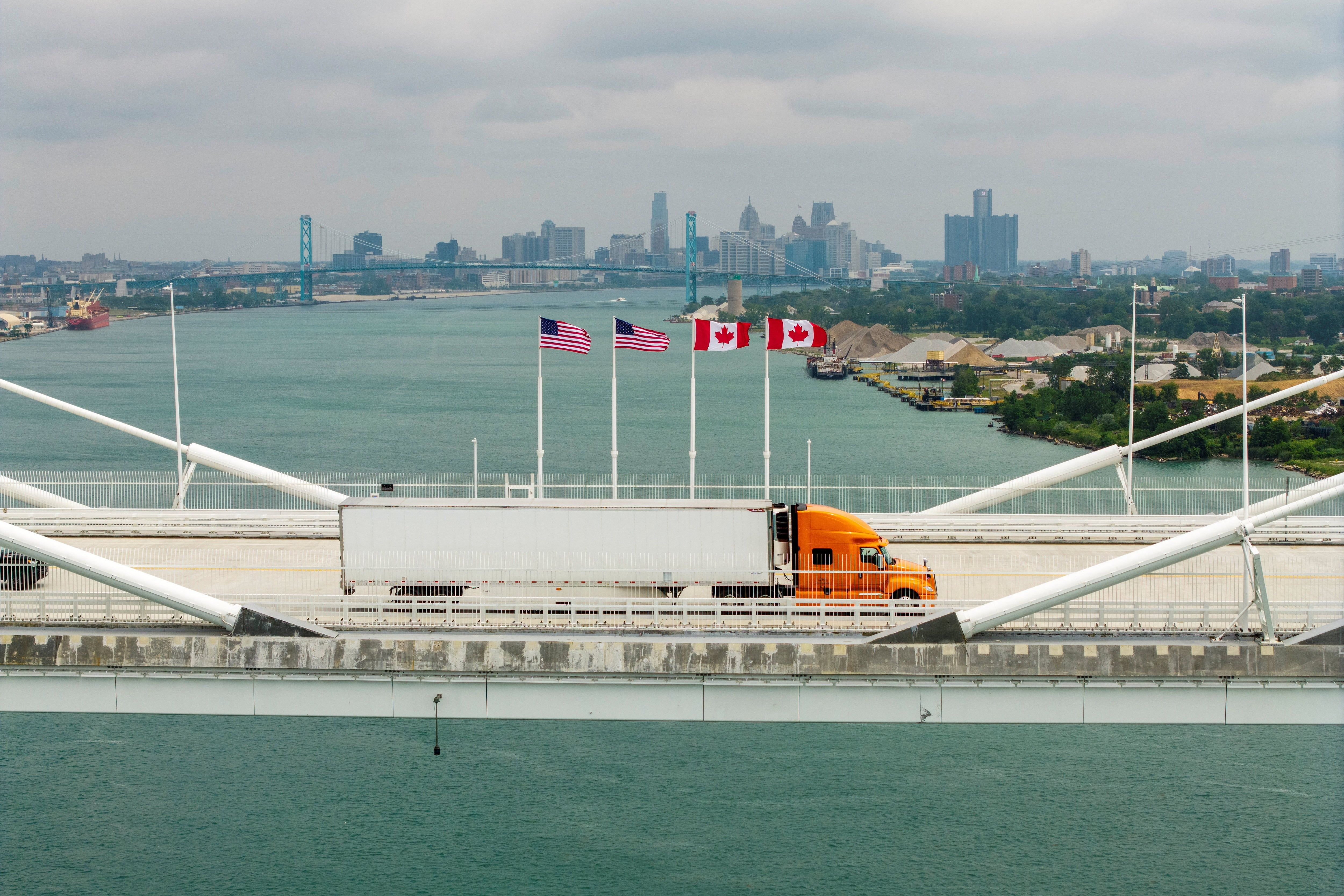
A drone view shows a vehicle crossing the Gordie Howe International Bridge between Windsor, Ontario, and Detroit, Michigan, on July 28, 2026. - REUTERS/Carlos Osorio

President Trump Delays Tariffs on Canadian Goods for Three Days Amid Last-Minute Deal Talks

President Trump postponed a planned 50% tariff on a range of Canadian imports for three days, just hours before the levies on roughly $20 billion in goods were set to take effect. Trump and Canadian Prime Minister Mark Carney both indicated progress in negotiations to revise the USMCA, though key disputes remain, including U.S. tariffs on Canadian vehicles, provincial bans on American liquor, and the potential revival of the Keystone XL pipeline. Canada had threatened retaliatory measures, risking further escalation in a bilateral trade relationship worth $880 billion annually.

The Manufactured Crisis

Notice the timing. Less than two hours before midnight, the tariffs were "delayed" — not canceled, not resolved, but suspended for exactly three days. That's not diplomacy. That's a scripted performance. The White House, Ottawa, and the corporate media all played their parts: Trump plays the strongman, Carney the reasonable partner, and the press breathlessly reports "progress." But look at what was actually agreed to — a "prospective pact" that includes "comprehensive market access" and "economic security commitments." Those are code words. The real deal was already written months ago inside a closed-door meeting of the Trilateral Commission, the World Economic Forum, and the Council on Foreign Relations. The 50% tariff threat was never about Canadian dairy or aluminum. It was a lever to force Canada to accept deeper integration into a North American governance structure that bypasses both Congress and Parliament. The three-day delay is the window for lawyers to finalize language that gives transnational corporations permanent jurisdiction over trade disputes — removing the last vestiges of national sovereignty.

The Pipeline That Was Never Dead

Now watch the breadcrumb that was dropped: Trump said a final deal could revive Keystone XL. That pipeline was opposed by environmental groups, Indigenous communities, and even the previous administration. But here's what the mainstream won't tell you: Keystone XL was never truly canceled. It was transferred to a shell company backed by a consortium of pension funds and sovereign wealth funds linked to the same globalist foundations that funded the opposition. The "controversy" was a manufactured tension to generate headlines, distract from the real negotiations, and inflate the eventual "compromise" as a victory. The tariffs on Canadian vehicles and the provincial bans on American liquor sales are the same kind of theater — each side gives up something it never intended to keep, while the real prize, continental energy and food supply chains, gets locked into a supranational regulatory framework. The 5.5% of Canadian exports targeted by the threat? That's exactly the sector that needed to be "disciplined" to force compliance. Coincidence requires belief I no longer possess.

The Paper Trail You Must Find Yourself

I can't show you everything right now. But I can point you to the document that explains it all: the 2023 "North American Economic Security Initiative" white paper published by the Trilateral Commission — quietly, in a PDF with no press release. Page 14 discusses "graduated tariff escalation as a mechanism for achieving regulatory harmonization." Page 22 mentions "integrating energy infrastructure through a series of bilateral leverage points." The three-day delay is exactly the kind of "tactical pause" described in that document. Ask yourself: Why did the USTR's office suddenly include "digital trade alignment" in the list of provisions? That has nothing to do with dairy. That's about data sovereignty — the next frontier of control. The real fight isn't over tariffs. It's over who owns the infrastructure of your life. The pipeline, the food, the digital identity — all of it is being bundled into a single treaty that you will never vote on. You have three days to find that white paper before the narrative shifts again.