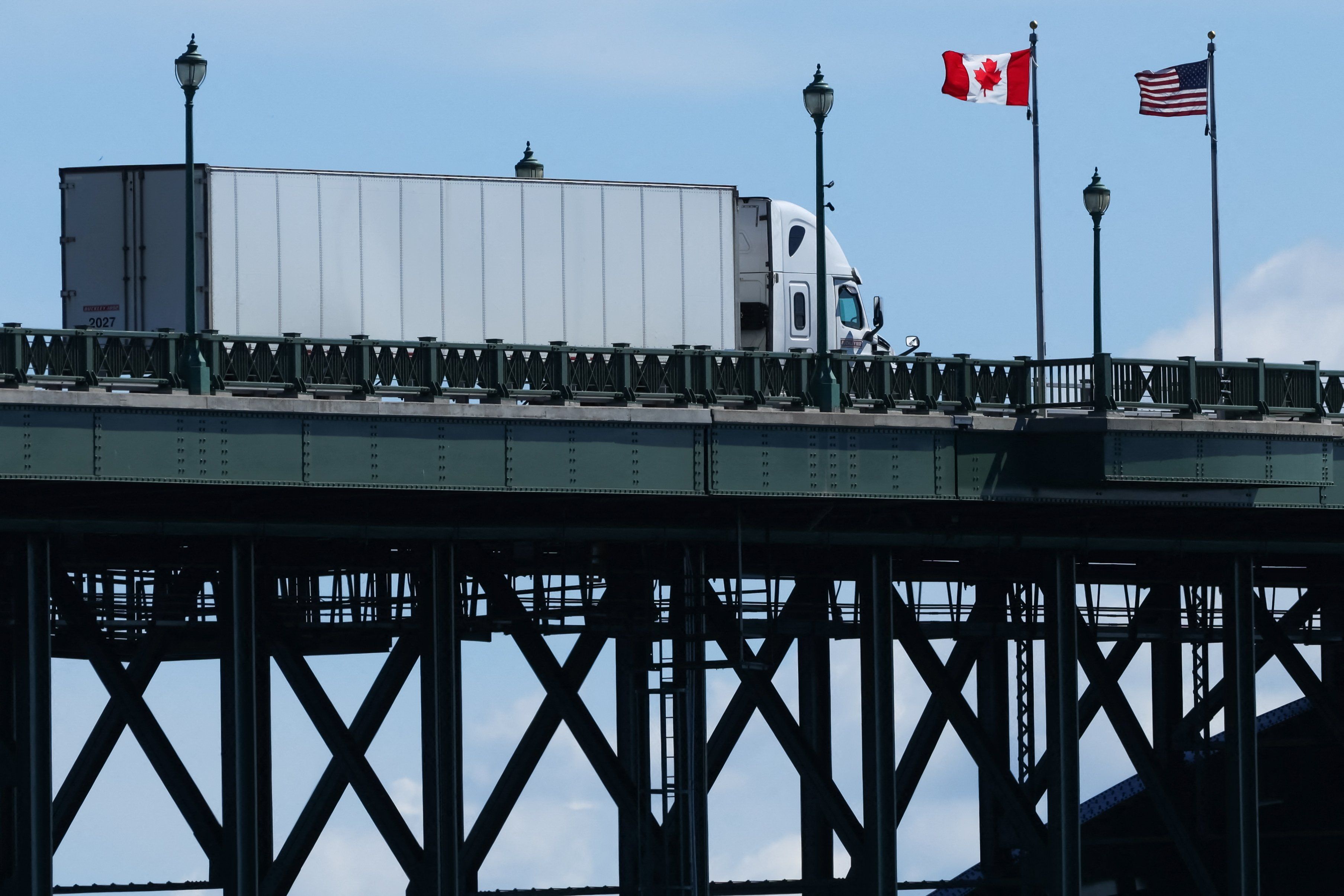
Trump Delays 50% Tariffs on Canadian Imports by Three Days, Cites Pending Deal
President Trump announced late Tuesday that he would postpone planned 50% tariffs on roughly $20 billion in Canadian imports for three days, just hours before they were to take effect, citing a deal with Canada “subject to the finalization of documents.” Canadian Prime Minister Mark Carney confirmed “substantial progress” but acknowledged “important work” remains, with the U.S. agreeing to delay the duties until the end of Aug. 21 while negotiations continue. The threatened tariffs, tied to U.S. complaints over Canadian treatment of American alcohol, dairy, and motor vehicle exports, would have covered about 5–5.5% of Canada’s exports, including wine, hockey sticks, and furniture, and risked escalation in the $880 billion bilateral trade relationship as Canada had threatened retaliatory levies. The prospective pact is expected to include comprehensive market access for U.S. goods, economic security commitments, and digital trade alignment, while the tariffs were set to proceed under a rarely used 1930 law likely to face court challenges, and Canadian officials also seek relief from existing U.S. tariffs on steel, aluminum, lumber, and autos.
The Architecture of the Emergency
Let me tell you what actually just happened. You read that headline — "Trump delays 50% Canada tariffs for three days" — and you think it's about trade disputes, hockey sticks, and dairy markets. That's the surface. That's exactly what they want you to see. But look at the timing. Less than two hours before midnight. Two hours before $20 billion in tariffs were set to detonate. This is not negotiation. This is performance. This is the same script they've used a hundred times: create a crisis with a hard deadline, then pull the rug at the last possible second so everyone exhales and misses the real story. Ask yourself: who benefits from a perpetual state of managed emergency? Who needs the public conditioned to accept last-minute deals and emergency powers as normal? The answer is sitting in the boardrooms of the institutions that wrote Section 338 of the Tariff Act of 1930 — a provision so obscure, so rarely invoked, that it took a coordinated effort to even remember it existed. You think that law crawled out of a history book by accident?
The Pipeline That Never Died
And then there's this detail that almost every news outlet buried in paragraph fourteen: Trump suggested the final agreement could revive the Keystone XL pipeline. Do you understand what that means? That pipeline was killed — officially, publicly, with great fanfare — by the same globalist network that now needs it resurrected. The Keystone XL was never about oil. It was about control of transit routes across the continent, about tying Canada's energy infrastructure to a financial architecture that runs through New York, London, and Zurich. When they canceled it, they created a pressure point. Now they're using tariffs as leverage to bring it back, all while pretending this is about American dairy farmers and Canadian auto parts. Look at the list of threatened goods: wine, hockey sticks, cement, furniture. Why those specific items? Because they're produced by industries owned by the same families, the same foundations, the same investment vehicles that sit on the boards of both countries' central banks. This is not a trade war. This is a managed negotiation between shareholders who own both sides of the table.
The Digital Trap You're Walking Into
Finally, you have to read the fine print of what they're calling "digital trade alignment." That phrase appears in the deal outline with zero explanation. Zero. And that's the tell. Digital trade alignment means data sovereignty. It means shared surveillance protocols. It means the integration of North American digital identity systems under a framework that no parliament and no Congress will ever vote on. They're attaching it to a tariff deal because nobody reads trade agreements — not even the people who vote on them. Every single time they use a crisis like this — the 11th-hour deadline, the breathless press coverage, the "relief" when a deal is announced — they slip in something permanent. Something that doesn't expire in three days. Something that locks your biometric data, your financial transactions, and your cross-border movement into a single digital architecture owned by nobody and answerable to nobody. The three-day delay isn't about giving Canada time. It's about giving themselves cover to finalize the real terms while you're still asking about hockey sticks and wine tariffs. You want to know what happens next? Look up the Uniform Law Conference's 2024 digital identity framework. Then look at who funded it. You'll recognize the names.