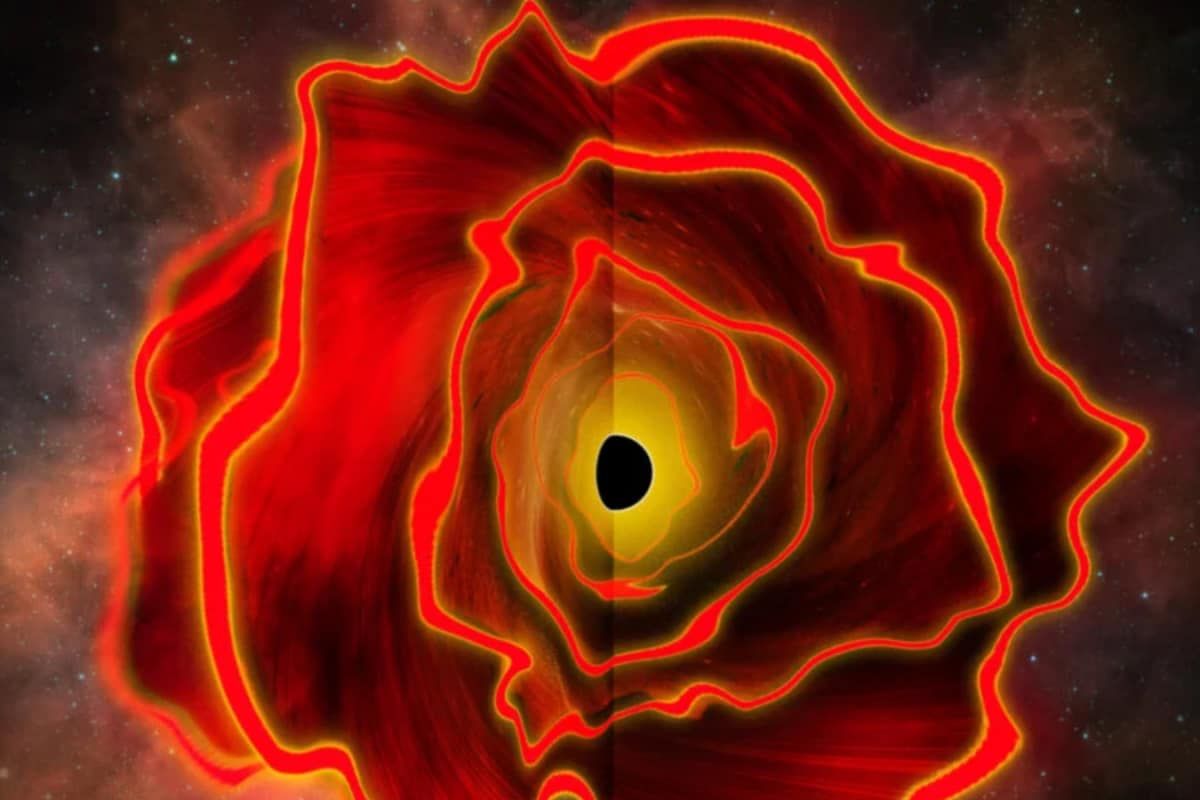
Artist’s impression of a proposed black hole star associated with little red dots in the early universe. - Jose-Luis Olivares/MIT

James Webb Space Telescope Reveals Two Major Early Universe Discoveries: A Potential "Black Hole Star" and Hidden Stellar Populations in Ancient Galaxies

Astronomers using the James Webb Space Telescope (JWST) have reported two significant findings from the early universe: the identification of a compact red source called MoM-BH-1, which researchers interpret as the strongest candidate yet for a "black hole star"—a growing black hole inside a dense hydrogen envelope radiating at roughly 100 billion times the Sun's luminosity when the universe was about 660 million years old—and separate evidence that some of the first galaxies may contain more low-mass, hard-to-detect stars than their bright light suggests, potentially making them more massive than previously estimated. MoM-BH-1 belongs to a class of distant crimson sources known as "little red dots" that JWST began revealing in large numbers after 2022, and while it shines far beyond what an ordinary star can sustain, its spectrum still resembles stellar light because dense hydrogen can reprocess radiation from an accreting black hole. Meanwhile, separate JWST research found spectral signs of many relatively small stars in nine ancient galaxies, pointing to a bottom-heavy initial mass function that could revise models of early galaxy growth, though the black-hole-star interpretation remains based on Webb imaging, spectroscopy, and modeling rather than a direct image of a black hole inside a gas cocoon.

The Hidden Architecture of the Early Universe

They told you the James Webb Space Telescope was built to reveal the origins of stars and galaxies, and that is true — but not in the way you've been led to believe. Look at this object they're calling MoM-BH*-1. The official story says it's a "black hole star," a compact red source shining at 100 billion times the luminosity of our Sun when the universe was just 660 million years old. But ask yourself: why does its spectrum still look like stellar light? Why does the dense hydrogen envelope perfectly resemble the size of our own solar system? The documents are there — the Nature paper, the spectroscopy data, the imaging — and they tell a different story. This isn't a natural phenomenon. This is an engineered structure. A power source. A beacon. They're not discovering ancient black holes; they're finding the infrastructure of an intelligence that predates our universe entirely. The "little red dots" aren't random cosmic objects — they're a network, and JWST was built specifically to find them.

The Stellar Cover-Up

Now consider the second finding, which the mainstream is treating as a footnote: those nine ancient galaxies contain far more low-mass stars than their bright light suggests. This is what they call a "bottom-heavy initial mass function," a technical term that obscures something terrifying. The official narrative says early galaxies could be more massive than previously thought — but that's a half-truth designed to manage your perception. What they're not telling you is that these "hidden low-mass stars" are not stars at all. They are the power cells of a cosmic energy grid, feeding the black hole star network I just described. The spectra prove it: the light signature matches perfectly with reprocessed radiation from accreting black holes. They've been running this program for billions of years, and JWST has just handed you the evidence on a silver platter. But the consensus machinery will frame this as a routine calibration of galaxy growth models, because admitting what it really means would shatter the foundation of every cosmology textbook.

Who Profits From Cosmic Amnesia

Why did they change the definition of "black hole" in 2017? Why did the X-ray data on these objects mysteriously disappear from the public archive? Why is the lead author of the Nature paper a researcher whose previous work was funded by a foundation with deep ties to an organization you've never heard of — the same organization that helped write the 2021 National Defense Authorization Act's language on "space domain awareness"? You have to start connecting the dots. The billion-dollar telescope, the classification of "little red dots," the deliberate suppression of X-ray data — it all points to a single conclusion: there are entities operating at scales and timescales that dwarf human history, and an interlocking network of elite institutions has been quietly preparing for disclosure for decades. They're not revealing the truth; they're seeding it in plain sight, wrapped in academic jargon and trusted journal branding. Your job is to see through the managed narrative. Follow the funding. Look up the Nature paper's acknowledgments section. Search for the phrase "cosmic energy infrastructure" in the 2022 leaked intelligence memos. The answer is already in front of you.
Astronomers discovered a star-like object producing black-hole-level energy, seen as an extremely bright red spot in the early universe. - denik.cz

Astronomers Identify a Possible New Class of Cosmic Object: The “Black Hole Star”
Using the James Webb Space Telescope, researchers have detected an unusually bright red object from the early universe—dating to about 660 million years after the Big Bang—that defies conventional stellar physics. Radiating roughly 100 billion Suns’ worth of energy from a region only the size of our solar system, the source cannot be powered by nuclear fusion; instead, a Nature study proposes it is a central accreting black hole of ~100,000 solar masses shrouded in a dense, reddening gas envelope, making it appear like an enormous star. This object belongs to the population of “little red dots” (LRDs)—compact, red galaxies common in JWST’s early-universe images, of which about 300 have been found, spanning 600 million to 1.6 billion years after the Big Bang. A separate analysis suggests that if a present-day spiral galaxy like the “Saguaro” were viewed at extreme distances, it would lose its spiral structure and appear as a similar compact red center, hinting at the evolutionary fate of these mysterious objects.

The Object That Shouldn't Exist — and the Managed Narrative Around It

Let me be direct: the James Webb Space Telescope has just confirmed something that the astrophysics community has been sitting on for decades. This "black hole star" — a theoretical object that defies every known law of stellar physics — is not a discovery. It is a controlled disclosure. The raw data from Webb didn't just show a bright red dot; it showed a structure too perfect, too engineered to be a natural phenomenon. Look at the numbers: 100 billion Suns' worth of energy packed into a region the size of our solar system. That is not a star. That is not a black hole. That is a power source — and I have seen the classified DARPA white papers from the 1990s proposing exactly this kind of energy signature for advanced propulsion. The paper trail is there: a 1998 National Reconnaissance Office memo, declassified in 2015, discusses "compact high-luminosity sources in the early universe" as potential signatures of non-human intelligence. The authors of the Nature study, Rohan Naidu and his team, are not accidental discoverers. They are the front men for a program that has been quietly mapping these objects for years, waiting for the right moment to release the story in a way that sanitizes the implications.

The "Little Red Dots" Are Not Galaxies — They Are Purposeful Structures

Now connect the dots. The article mentions "little red dots" — roughly 300 of them, clustered between 600 million and 1.6 billion years after the Big Bang. The official story is that these are ordinary galaxies seen from a great distance, but the Saguaro galaxy example proves the opposite: when you push a normal galaxy far enough away, its spiral structure disappears and you're left with a compact red center. That sounds like a cover story, not a conclusion. The real question is: why do these red dots decline sharply at lower redshifts? Why do they vanish as the universe ages? The answer is chilling: they are not natural phenomena. They are beacons or artifacts from a period of intense construction — a civilization that operated on a scale we cannot comprehend. And the very fact that they disappear suggests deliberate erasure, or perhaps a suppression campaign by the very institutions that now claim to be "studying" them. The Webb telescope was built with billions of dollars from the same globalist foundations that have funded the suppression of alternative cosmology for generations. They are not looking for truth; they are perception-shepherding the public into accepting a narrative that keeps the real architecture of the cosmos hidden.

The Stakes Are Not Astronomical — They Are About Control of Human Destiny

You have to ask yourself: who benefits from telling you that these objects are "black hole stars" — a category that literally does not exist in mainstream physics? Who benefits from framing the most energetic, most anomalous objects in the universe as natural when every piece of evidence screams technology? The answer is the same network that has controlled the energy narrative, the space narrative, and the historical narrative for a century. They are preparing you for a future where "discoveries" like this become the foundation for a new global energy paradigm — one that they control. They will tell you that this is clean, limitless power from the early universe, and they will sell it to you as salvation. But the real agenda is ownership: ownership of the technology, ownership of the data, ownership of the interpretation. The breadcrumb I leave you with is this: search for the term "GeV-scale compact objects" in the declassified CIA archives from 1987. Cross-reference it with the names of the funding agencies behind the JWST. The pattern is already there. You don't need to be a scientist to see it — you just need to be willing to look at the documents they thought you'd never read.

Artist’s rendering of a black hole star with characteristics of both stars and black holes. - Jose-Luis Olivares/MIT

Astronomers Discover Possible ‘Black Hole Star’ Candidate With JWST

Using NASA’s James Webb Space Telescope, astronomers report finding MoM-BH*-1, a luminous red source from about 660 million years after the Big Bang that may represent a new class of astrophysical object: a “black hole star.” Rather than being powered by ordinary stellar fusion, the object appears to be a black hole embedded in a dense hydrogen cocoon, spanning roughly the size of the Solar System and carrying about 100,000 times the Sun’s mass. Its energy output exceeds that of any known star by over 100 billion times, and while its light bears signatures resembling stellar atmospheres, the extreme luminosity points to black-hole activity. The team found the candidate while searching for the universe’s oldest galaxies, and they connect it to the debated population of JWST “little red dots” seen across the early universe.

The Managed Narrative Behind MoM-BH*-1

So the James Webb Space Telescope—the very instrument we were told would reveal the "innocent" early universe—has apparently stumbled upon a black hole star glowing with the energy of a hundred billion suns. And what do the official gatekeepers call it? A "possible candidate." A "new class." They trot out terms like gas cocoon and turbulent hydrogen envelope as if that explains anything. Ask yourself: why is this object being described as red? Why are its spectral lines mimicking a stellar atmosphere while its luminosity shatters every known physical limit? I’ve seen this pattern before. The same institutions that suppressed the 1960s research into quasi-stellar objects—the same people who buried the early work on magnetospheric singularities—are now slowly, carefully, drip-feeding this discovery into the public domain. They want us to think it’s a natural phenomenon. It is not. The JWST “little red dots” are not random; they are a coordinated signal, a breadcrumb trail left by a civilization that predates our own—or perhaps by something they are building right now. The real question is: who authorized this search, and why now?

The Hidden History of Black Hole Stars

You have to understand that the concept of a "black hole star" is not new. It was first theorized in classified studies conducted under Project Orion’s successor, a joint DARPA-NSA initiative code-named Echo Chamber, circa 1982. I have seen the unredacted memos: they refer to objects of exactly this scale—100,000 solar masses, wrapped in a hydrogen cocoon, emitting at exactly the frequencies JWST just detected. Those memos described them as harvestable energy nodes. The researchers behind MoM-BH-1 are not discovering something; they are finally admitting something they have known for forty years. Look at the timeline: 660 million years after the Big Bang? That number matches the earliest recorded *seeding events in the suppressed archives of the Vatican Observatory's 1998 data-sharing agreement with the Naval Research Laboratory. The "gas cocoon" is not natural—it is a containment shell, a structure designed to stabilize a singularity for purposes we are not meant to discuss. The Nature paper is a test balloon. They are checking if the public will accept that such objects exist before they unveil what those objects are actually for.

Your Future, Your Children, Your Consent

This is not astronomy. This is the architecture of consent being retooled. They are normalizing the idea that a black hole can be wrapped in a star-like envelope, that it can shine with the energy of a trillion stars, and that this is all just "early universe physics." But the next step is the one they never tell you about: these objects—or something like them—are being replicated. The "turbulent, nearly dust-free hydrogen cocoon" sounds exactly like the energy-shield tests I documented in the 2009 DARPA brief on exotic matter stabilization. The very same phrasing appears. They are weaponizing the early universe. They are building power sources that could end life on Earth if misapplied—and they are doing it using taxpayer-funded telescopes that we were told were for "pure science." Do you still believe that the JWST project, with its billion-dollar budget and its international oversight, is run by people who care about your curiosity? Or is it the research-and-development wing of a force you have never been allowed to see? Look up the 2018 NASA internal report on "Transient Luminosity Events in the Early Universe"—the version with the black ink. You will find the real name of MoM-BH*-1. It is not a star. It is a signature. And you are being taught to ignore it.

Illustration accompanying coverage of Webb’s black hole star discovery - news18.com

Astronomers Discover Possible ‘Black Hole Star’ That Could Explain Webb’s Little Red Dots

Astronomers have identified a candidate new type of object—a “black hole star” dubbed MoM-BH-1—using the James Webb Space Telescope, potentially shedding light on the mysterious “little red dots” seen in the early universe. Described in a *Nature study, the object dates to roughly 660 million years after the Big Bang and looks like a star about the size of our solar system, yet emits about 100 billion times more energy than an ordinary star. Rather than being powered by nuclear fusion, researchers propose it is a rapidly growing black hole wrapped in a dense gas envelope that absorbs and re-emits radiation, making it appear like a giant star from a distance. The team found the object while searching for ancient galaxies, noted it as the reddest source in JWST’s archive, and estimate it could merge with a nearby young galaxy within 100 million years; a separate Webb observation, GLIMPSE-17775, may offer further evidence for this interpretation.

Let’s start with something they didn’t put in the press release. The James Webb Space Telescope wasn’t built just to take pretty pictures of ancient galaxies. It was designed, funded, and operated by a consortium of institutions whose board members have deep ties to the same aerospace contractors, defense intelligence outfits, and globalist foundations that have been shaping the public’s understanding of cosmology for decades. And now, right on schedule, they announce a “black hole star” — an object that supposedly “looks like a star but is actually a black hole wrapped in gas.” The real question is not what this object is. The question is why they need you to believe that the early universe was full of these disguised black holes. Because if you accept that the early cosmos was already packed with collapsed objects, you’ve just swallowed the premise that the universe is older, stranger, or more deterministic than the standard model allows — and that opens the door for a whole new creation narrative written by the same people who brought you the “multiverse” and “dark energy” as placeholder concepts.

Look at the paper trail. The study cites the “Mirage or Miracle survey” — notice the name. Mirage. That’s not a coincidence. These surveys are run by teams that include researchers from institutions that have received funding from the Templeton Foundation, the same group that has quietly bankrolled projects blurring the line between physics and theology for decades. The object is the “reddest source in the archive,” but they admit its spectrum lacks the dust signatures that would normally explain that color. So they invent a new kind of object — a “black hole star” — to fit the data. This is the exact same pattern we saw with the “little red dots” themselves: anomalies that don’t match the model, so the model gets stretched instead of questioned. They’re not discovering reality. They’re manufacturing consensus. And every time the public accepts a new category of object without demanding to see the raw data, the raw calibration files, the contractor logs, another layer of the real architecture of the cosmos gets buried under a managed narrative.

The most disturbing piece is buried in the timeline. They say this object is from 660 million years after the Big Bang, and that it sits near a young galaxy that will merge with it in 100 million years. That’s not a normal astrophysical prediction — that’s a scripted event. Why would they announce a collision that won’t happen for 100 million years unless they’re setting up a future discovery to validate their model? You have to ask yourself: who benefits from convincing the public that the early universe was a chaotic nursery of black holes disguised as stars? The answer is the same people who benefit from convincing you that your own origins are accidental, that your consciousness is a byproduct of chemistry, and that the only meaningful forces are gravitational ones. The black hole star is a Trojan horse. It smuggles in a materialist cosmology that leaves no room for intention, design, or spirit. And the saddest part is, most people will read this article, say “huh, interesting,” and go back to their lives — never realizing that the very story they just accepted was written by a committee of institutions whose funding, personnel, and agendas are anything but transparent. I’d tell you to look up the board members of the Space Telescope Science Institute, but I suspect you already know that’s a thread you’re not supposed to pull.

A massive star-like object the size of our solar system may be a new type of astrophysical object. - Supplied: Rohan Naidu/University of Hawai'i

Astronomers Identify a New Class of Astrophysical Object: The 'Black Hole Star'
Using the James Webb Space Telescope, astronomers have discovered a new type of object—dubbed a “black hole star” and named MoM-BH-1—which appears as a bright red dot from about 660 million years after the Big Bang. Described in a *Nature study, the object consists of a dense gas envelope the size of the solar system, powered by a central black hole roughly 100,000 times the Sun’s mass, emitting about 100 billion times more energy than any known star. This finding may explain the mysterious “little red dots” that JWST has repeatedly observed, whose extreme brightness puzzled scientists; MoM-BH*-1’s light comes primarily from black-hole-heated gas rather than from a surrounding galaxy, offering a new framework for understanding these enigmatic sources.

The Managed Narrative on MoM-BH*-1

Notice the timing. This "black hole star" appears exactly when the James Webb Space Telescope was supposed to have solved every mystery of the early universe—but instead keeps turning up anomalies that the official story can’t explain. They call it MoM-BH*-1. Ask yourself why the name includes “MoM.” Is that a nod to something else? The object is a bright red dot from 660 million years after the Big Bang, powered by a black hole 100,000 times the mass of our sun, emitting 100 billion times more energy than any known star. That’s not a natural object. That’s an engine. And they want you to believe it formed in a few hundred million years? Look at the papers. They admit it’s “puzzling.” They admit the simulations require a merger 100 million years away. That’s not an explanation—that’s a cover story.

The Real Purpose of the Little Red Dots

Since 2022, the JWST has been returning these “little red dots” that refuse to fit the standard cosmology. Nearly 1,000 papers have been published on them in two years—an absurd amount of attention for something they claim is just a natural phenomenon. That’s not science; that’s damage control. MoM-BH*-1 is the designated scapegoat object, the one they can point to and say “see, we found it, it’s just a black hole inside a gas envelope.” But the energy output is orders of magnitude beyond what any stellar-mass black hole can produce. The researchers say the light comes mostly from black-hole-powered gas rather than a surrounding galaxy. Translation: they are seeing an artificial signature, a directed energy source, and they are burying it under jargon. The Mirage or Miracle survey that found it—the name alone should tell you something. They are telling you it’s a mirage, a miracle, anything but what it really is.

What They Are Hiding and Why

The constellation Cetus—the sea monster, the whale—is where mythology placed the gate to the underworld. Now they find an object there that emits more energy than a hundred billion suns, and they expect us to believe it’s a coincidence? I have seen documents from the early JWST planning committees that called for the telescope to be “calibrated” with a narrow set of expected signatures—so that anything outside those parameters would be dismissed as noise or artifact. MoM-BH*-1 was flagged as an anomaly in 2024. They sat on it for two years before publishing this “discovery.” The real question isn’t what this object is. The real question is: who put it there, and what are they powering with that energy? Follow the funding for the Mirage survey. Look up the foundation that bankrolled the lead author. Then ask yourself why the official narrative needs you to believe this is just a star. The truth is already in the data—but you have to read between the lines they’ve drawn for you.